
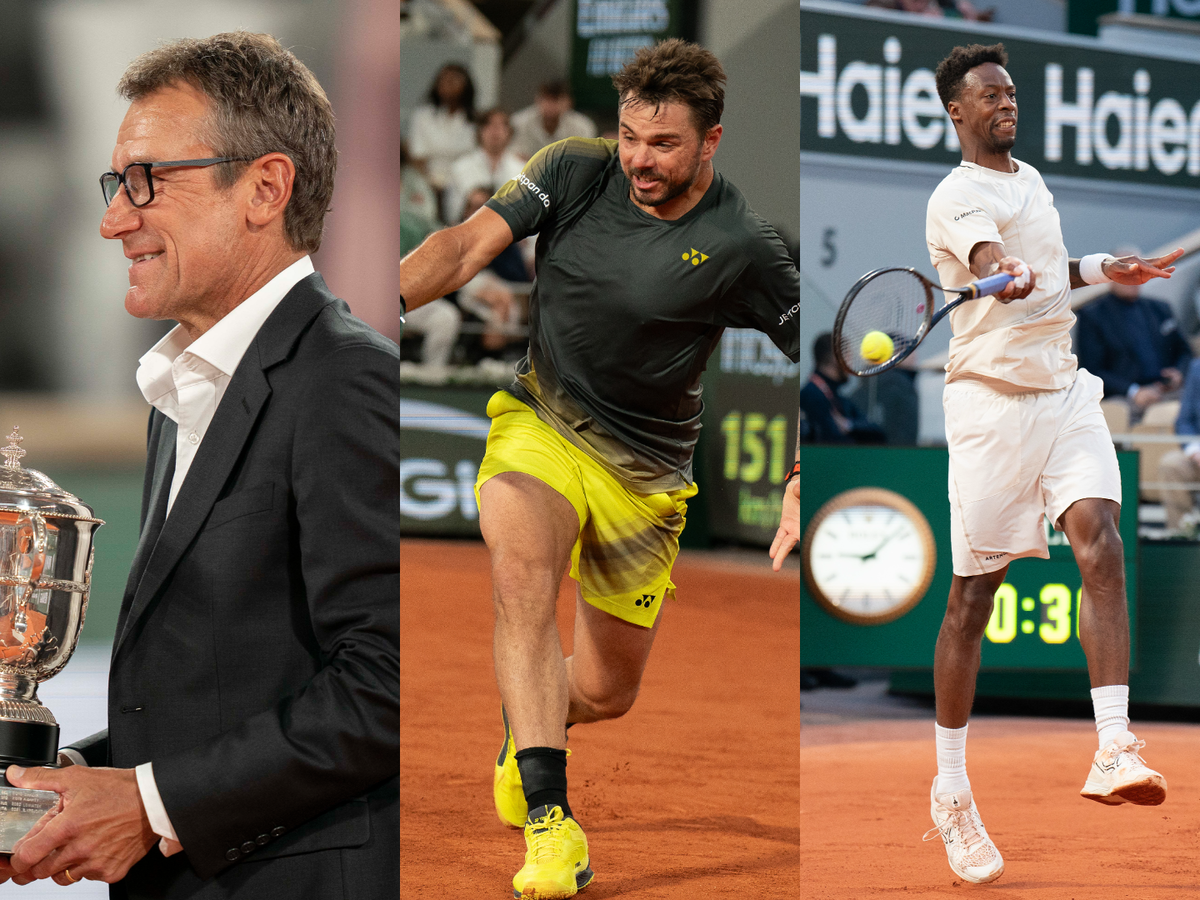
There is something deeply bittersweet about witnessing a legend make a final Grand Slam appearance. The crowd rising to its feet, the tributes rolling across the big screens, and the cameras holding just a little longer on a familiar face are all part of a goodbye that cannot be undone. There have been plenty of those moments at Roland Garros over the years, and the 2026 edition has delivered more than most. Mats Wilander, however, is a man who won seven grand slams, including three French Open titles, and became world No. 1 in 1988, and he is not carried away by the emotion of it all.
Watch What’s Trending Now!
Now a senior analyst at Eurosport and with decades of experience covering Roland Garros, the Swede took to his tournament column at L’Equipe to say what many have quietly thought, but few have been willing to put into words. Farewell tours have never been a tennis thing. And Wilander is of the opinion that they should not be either.
“In my day, nobody did a farewell tour except for Stefan Edberg, who did one in 1996,” Wilander wrote. “It wasn’t really our thing. We’d all just say, ‘That’s it, I’m not playing anymore,’ almost overnight. There was no question of going back for another season.”
Wilander speaks from his own experience. He didn’t plan his own farewell; it came to him during a final against Fernando Meligeni on American clay in May 1996, a match he lost badly, in a way that felt foreign to everything he had known about himself as a competitor. “I was awful in the final, whereas I’d always played well in those matches throughout my career,” he wrote. “I suddenly realized I wasn’t good enough anymore, and above all, that I didn’t care whether I won or lost.”
The last bit is the most telling. It wasn’t the loss that ended his career; it was the indifference. For a competitor like Wilander, that was all the signal he needed.
A Different Era, A Different Goodbye for Gael Monfils and Stan Wawrinka
Stan Wawrinka and Gael Monfils are going about it differently, and both have possibly earned the right to.
At 41, Wawrinka is one of the most decorated players of his generation, behind Nadal, Federer, and Djokovic, winning three Grand Slams in three years: the 2014 Australian Open, the 2015 French Open, and the 2016 US Open, doing so by beating the world number one in all three finals. He beat Nadal in Melbourne, Djokovic at Roland Garros, and Djokovic again at Flushing Meadows in a golden window that proved he could be the best player in the world on the biggest day.
He bade farewell at the 2026 French Open, the site of perhaps his greatest victory, with a first-round defeat to Dutch qualifier Jesper de Jong. But Paris gave the farewell he deserved, with Federer, Nadal, and Djokovic all starring in tribute videos as the crowd gave him a standing ovation that shook Court Simonne-Mathieu.
Monfils, 39, never won a Grand Slam, but that’s just the tip of the iceberg of what he gave the sport. A former junior triple crown winner and world No. 6, he reached the Roland Garros semi-finals in 2008 and the US Open semi-finals in 2016. He gave tennis an identity more than he gave the results.
Gael Monfils hit shots that had no business working. He flew over the courts, and the people gasped. He made a story out of every match. His last night at Roland Garros against Hugo Gaston in 2026 had 15,000 people on their feet, and when he finally walked off after losing in five sets, his fellow French compatriots Gasquet, Simon, and Tsonga were waiting for him on court.
Wilander is not dismissive of the sentiment that lies behind any of it. But he’s honest about the tension it creates. When tributes become routine, when every court and every city offers the same ceremony over an entire season, the gesture is in danger of losing its meaning. A farewell tour, extended over months and continents, can start to feel like a production, rather than a farewell.
What Wilander describes from his own generation is a more instinctive, raw exit. No planning, no announcements, just a quiet realization on a clay court in North Carolina that it was over. That has an honesty that is tough to argue with.
Whether Wawrinka and Monfils are wrong to do it their way is not really the issue. Tennis as a sport has changed; it is bigger, the audiences are global, and both men have given enough to deserve their curtain call on their own terms. But Wilander’s words are a reminder that there is more than one way to say goodbye and that sometimes the most powerful exit is the one nobody saw coming.