
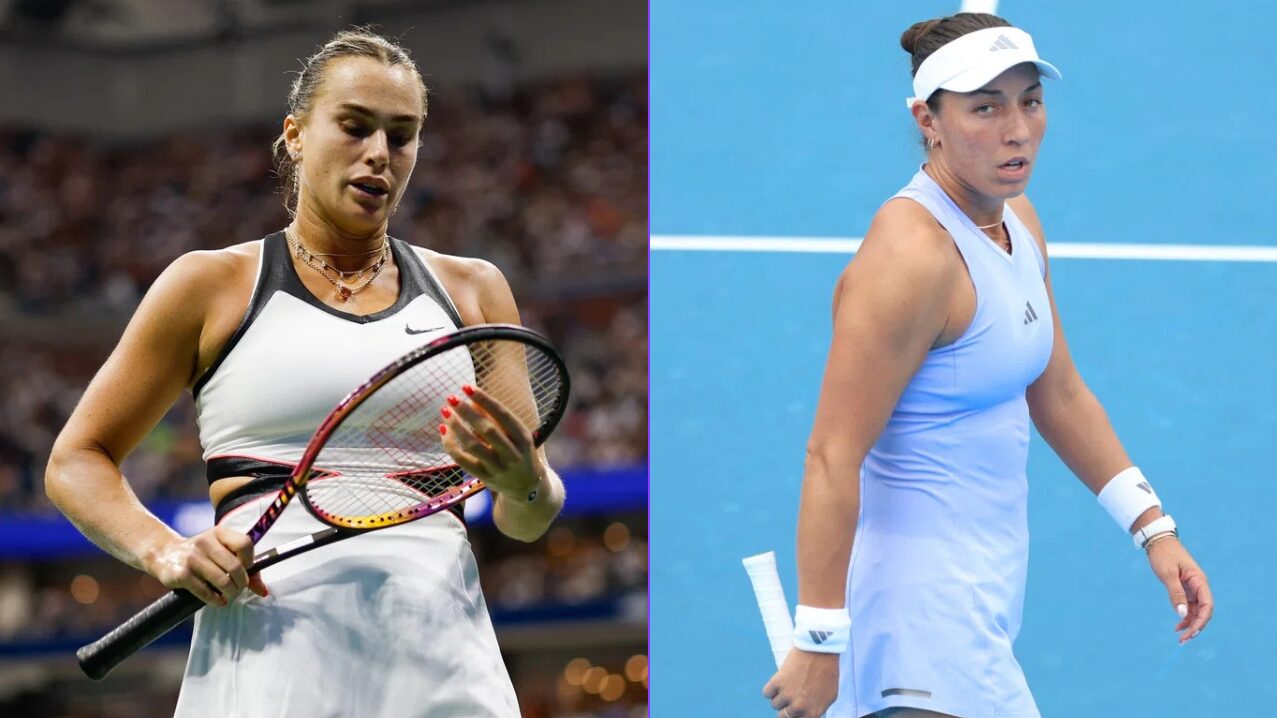
With Sabalenka still sitting on the throne, Pegula knows what she must do on her end to reach No. 1: win the US Open. She has wanted that spot since she was seven, even admitting it once mattered more to her than winning a Slam. Now, with the top ranking finally within reach, the US Open is no longer just another major for Pegula. It is her shot at taking the throne she has chased for more than two decades.
Watch What’s Trending Now!
“My goal when I was younger actually wasn’t really to win a slam. It was to be number one… To be number one in the world at something is incredible… It is definitely extra motivation,” said the current World No.3. “I think to put myself in that position is great… I think I’d have to win this tournament in order to be number one.”
Pegula must win the US Open, but even that may not be enough. Elena Rybakina also needs to lose before the semifinals, because reaching the final four would guarantee her the World No. 1 ranking. That makes the World No. 2 a major obstacle for Pegula. Rybakina is 42-13 this season with two titles and already proved she can deliver on the biggest stage by beating Sabalenka to win the 2026 Australian Open. With Rybakina standing between Pegula and the top spot, this No. 1 race is far from a two-player battle.
Sabalenka sits at No. 1 with 8,575 points, followed by Elena Rybakina at No. 2 with 8,141 and Pegula at No. 3 with 7,265. With the gap narrowing, Pegula has even more incentive to make a deep run at the US Open, and that’s now it.
You see, if everything falls into place, Pegula would become the oldest first-time World No. 1 in WTA history, and by a huge margin.
- Angelique Kerber currently holds that record after reaching the top at 28 years and 238 days in September 2016. Pegula would do it at 32, nearly four years older than Kerber.
- The next names on the list are even younger: Simona Halep reached No. 1 at 26 years and 12 days, Jennifer Capriati at 25 years and 200 days, Karolina Pliskova at 25 years and 118 days, and Amélie Mauresmo at 25 years and 70 days.
That history makes the Sabalenka angle even sharper. Pegula reached the 2024 US Open final, but Sabalenka beat her 7-5, 7-5 in 1 hour and 53 minutes. Pegula even fought back from 3-0 down in the second set to lead 5-3 and serve for the set at 5-4, only for Sabalenka to shut the door.
A year later, Pegula got even closer. She took the opening set in their 2025 semifinal before Sabalenka came back to win 4-6, 6-3, 6-4. Pegula had four break-point chances in the deciding set but failed to convert any of them, while Sabalenka blasted 43 winners to Pegula’s 21.
But the American has begun this chase perfectly, beating Elena-Gabriela Ruse 6-3, 6-2 in just 83 minutes.
Pegula overcame early nerves, then found her rhythm and controlled the match from the baseline. She hit 26 winners, made only 14 unforced errors, and won 92% of first-serve points. From here, the projected route becomes tougher, with Sofia Kenin, Leylah Fernandez, and Cirstea as her possible opponents. Karolina Muchova could follow in the quarters.
The projected semifinal could bring Sabalenka, whom Pegula trails 4-9 in their career meetings. Rybakina could then await her in the final, holding a 6-3 advantage over Pegula.
Every round carries more weight, because seven wins could bring her childhood dream to life.
Jessica Pegula Backs US Open Prize Money Boost as Players Gain More Power
The 2026 US Open has set a $108 million purse, the biggest in tennis history. Women’s singles champion Aryna Sabalenka will receive $5.5 million if she successfully defends her title. Every main-draw singles player receives at least $140,000, another Grand Slam record this year.
That money lands while players continue pushing for a bigger share of tournament revenue.
Sabalenka and Jannik Sinner previously limited their media appearances at the French Open to 15 minutes as part of a coordinated player protest, with Iga Swiatek and several other top names joining them. The 15-minute cap was meant to mirror the roughly 15% of revenue Roland Garros was paying out in prize money.
Players were pushing for a bigger revenue share, better pension, healthcare and maternity support, and more say over scheduling, late-night finishes and tournament expansion. They have asked the Grand Slams to raise prize money to 22% of revenue by 2030, making the protest about far more than just a bigger paycheck.
Now, all 4 Grand Slams are creating a Player Advisory Council to give the players a voice in the decisions that are being made.
Sabalenka welcomed that change, hoping future disagreements can happen without boycotts or strained relations. “We’re super happy … we’re finally getting to the point where we wanted to be.”
Jessica Pegula also praised players for standing together and making huge progress this year. She highlighted that the prize money, player welfare, and the new council are important steps forward for tennis.
Still, Pegula knows the council’s real impact depends on its structure and authority. Players will help shape its membership and framework after this year’s US Open. Although it is a slow process, we can see that Tennis is starting to move in the right direction as a sport.