
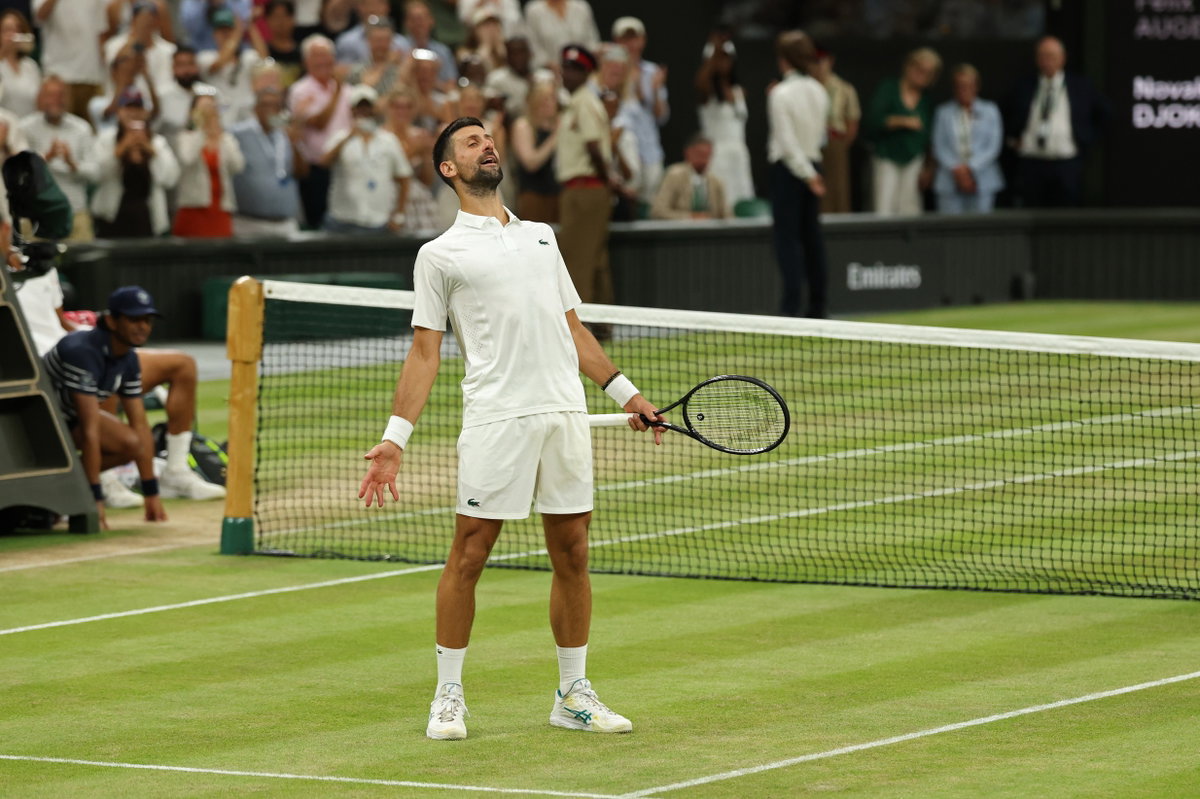
With Racket and a lot of heart, Novak Djokovic won a five-hour, fifteen-minute marathon against Felix Auger-Aliassime on Center Court at this year’s Wimbledon. The 39-year-old Serb had one of his most legacy-defining moments in one of the most prestigious courts in the world, showing he was still capable of producing magic against opponents 14 years younger than him. However, the path to victory was not easy for the seven-time Wimbledon champion, as he had injury scares, a tiff with the supervisor, and an exceptionally determined opponent.
Watch What’s Trending Now!
While the scoreline tells the story of a five-set epic, several defining moments shaped Djokovic’s record-breaking victory. Here are the five biggest moments that stood out from his historic quarterfinal:
1. Overcoming an Early Injury Scare
Fans held their breath in the very first set, when Djokovic had to call for a medical timeout, with the Serb seemingly facing an issue with his leg. Djokovic has struggled with his body in recent times, which has hampered his progress at Slams, which is why the injury scare raised legitimate concern. However, the Serb did not budge, showing his mental strength, and played a first set that lasted one hour and nineteen minutes.
Auger-Aliassime did not make it easy for Nole, as the Canadian saved two set points in the tenth game and even earned a break point on the Serb’s serve in the eleventh. Djokovic held firm to force a tiebreak, which became a contest within the contest.
For 20 tense minutes, both players traded blows with remarkable precision, each taking turns edging ahead. Djokovic showcased his legendary clutch mentality by saving three set points before eventually sealing the breaker 12-10, giving himself a crucial advantage after one of the highest-quality sets of the tournament.
Losing such a set heartbreakingly often leads to a collapse, but there was no such let-up from Auger-Aliassime. The Canadian sensed his opportunity in the second set, breaking Djokovic in the eighth game. Although the Serb created chances to break back immediately, the fourth seed held his nerve to level the match.
With the match tied at one set apiece, Djokovic soon found another source of motivation.
Imago
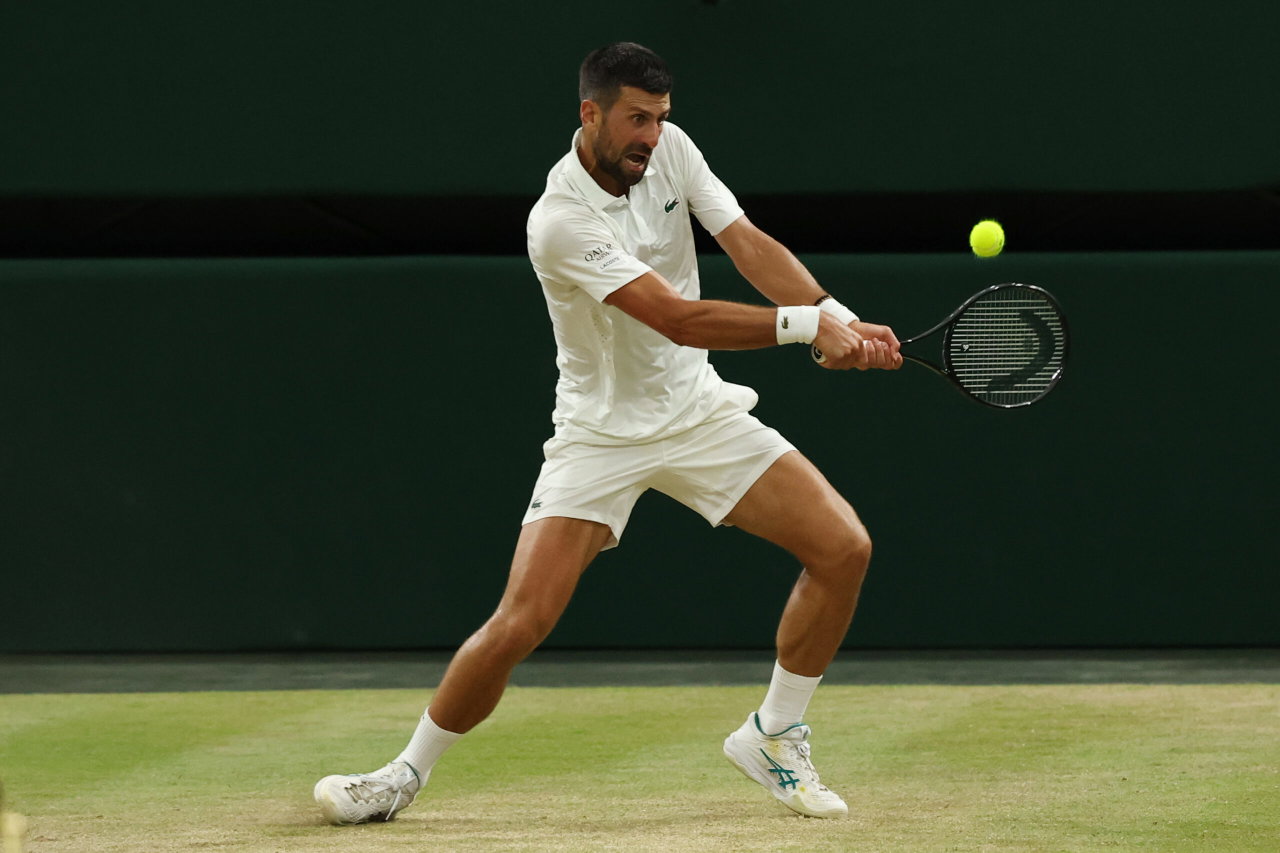
Jul 7, 2026; London, United Kingdom; Novak Djokovic (SRB) hits a backhand against Felix Auger-Aliassime (CAN) (not pictured) on day nine of The Championships Wimbledon 2026 at All England Lawn Tennis and Croquet Club. Mandatory Credit: Geoff Burke-Imagn Images
2. The Roof Controversy
After the second set ended, match supervisor Denise Purnell decided to close the Centre Court roof as daylight began to fade, a decision that did not sit well with Djokovic. Nole had a verbal confrontation with Purnell, citing examples from his previous matches at the tournament in which the roof was closed later than on that particular occasion.
Having already played under the roof during his opening two rounds, Djokovic had previously voiced his displeasure with changing conditions. Added to that was the increased injury risk that comes with stopping play midway through a match before resuming under different conditions, something that was highlighted at SW19 following Grigor Dimitrov’s incident last year. As has often been the case throughout his career, Djokovic appeared to channel that frustration into his tennis.
The Serb played a near-flawless third set, serving superbly, facing only one break point, and repeatedly attacking Auger-Aliassime’s second serve. Although the Canadian escaped three break points earlier in the set, the sustained pressure eventually paid off as Djokovic secured the decisive break before confidently closing out the set 6-3.
An early break in the fourth set suggested the match might finally be slipping away from Auger-Aliassime. Instead, the Canadian responded immediately, breaking back before forcing another tiebreak. This time, there was no extended drama, as Auger-Aliassime claimed it 7-4 to send the match into a deciding fifth set.
3. The Fifth Set Tie-Breaker
From there, it became a battle of nerves as the clock ticked toward Wimbledon’s 11 p.m. curfew. Both players continued serving brilliantly, with Djokovic not facing a single break point in the deciding set, eventually taking the contest to a 10-point match tiebreak.
With everything on the line, few players are more dangerous than Djokovic. Leading only 4-3, the Serb created decisive separation by winning four of the next five points to move ahead 8-4. The thirteenth point featured one of the longest rallies of the evening before Auger-Aliassime sent a forehand wide.
Imago
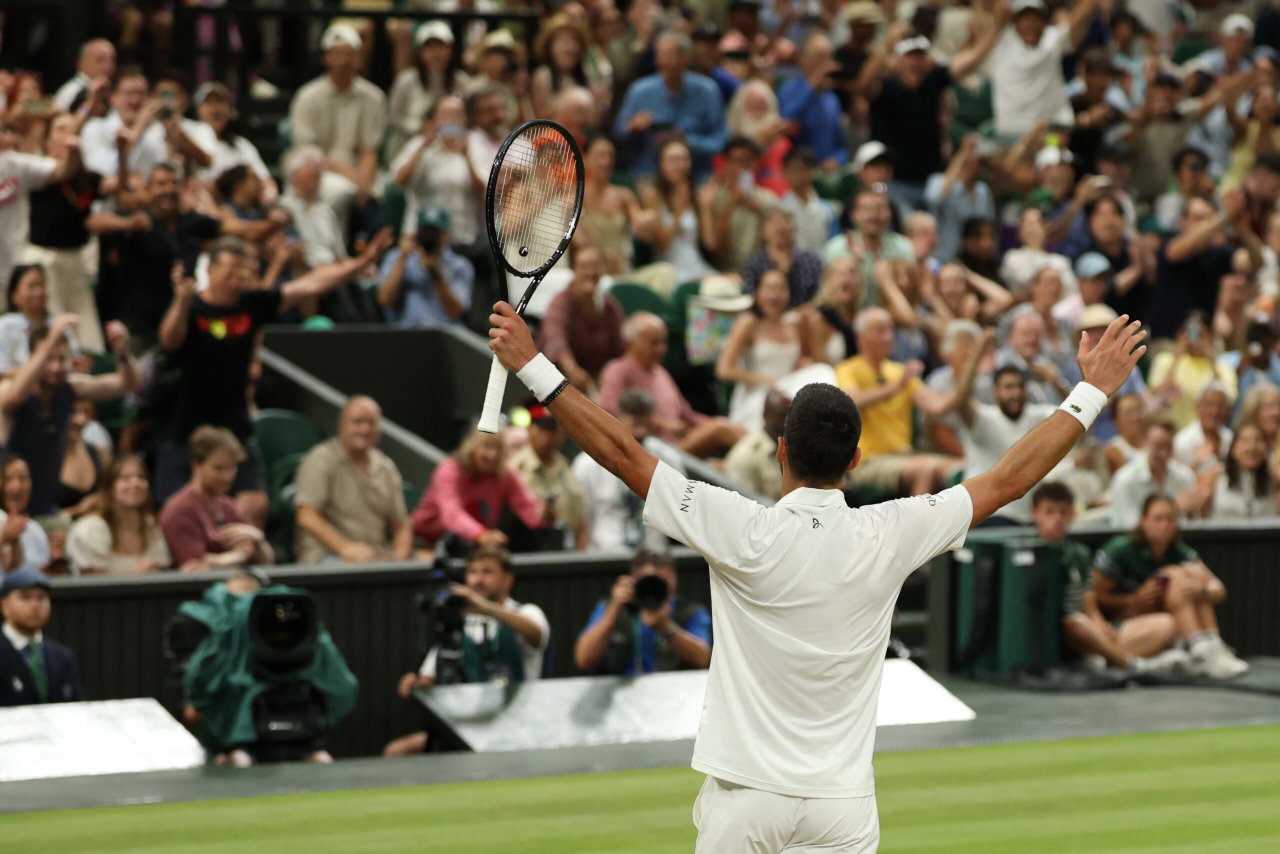
Jul 7, 2026; London, United Kingdom; Novak Djokovic (SRB) celebrates after match point against Felix Auger-Aliassime (CAN) (not pictured) on day nine of The Championships Wimbledon 2026 at All England Lawn Tennis and Croquet Club. Mandatory Credit: Geoff Burke-Imagn Images
While the Centre Court crowd rose to its feet, Djokovic could barely remain on his. Leaning on his racket for support, he still managed a smile before stepping up to serve for one final point. Moments later, another Auger-Aliassime forehand drifted wide, sealing the longest men’s quarterfinal in Wimbledon history.
4. Djokovic’s Dad- Mode on After Historic Win
The Serb was visibly exhausted during his on-court interview but still made time to speak about his children, who had ignored his suggestion to head to bed after the fourth set.
“You know, I was telling the kids to go to sleep after the fourth, but they didn’t want to listen, and I’m glad they stayed because it was honestly one of the best matches I was part of on this court in my career,” Djokovic said.
With the record-breaking victory complete, Djokovic now turns his attention to an even bigger challenge.
5. En route to the 15th Wimbledon Semifinal
The upcoming semifinal at Wimbledon on Friday will be Djokovic’s 15th last-four appearance at SW19, with no other player having more semifinal matches at a single Grand Slam. In doing so, the Serbian has matched his two legendary peers, Roger Federer and Rafael Nadal, who have each had 15 semifinal appearances at the Australian Open and the French Open, respectively. However, when that was pointed out to the Serb during his on-court interview, he was quick to brush it off.
“That’s great, but it’s just another semi-final for me”, said Djokovic in his on-court interview. “I’m going to look at all the numbers and everything when I finish my career. Right now, it’s all business”. The Serb was in a similar mood in his press conference, as he looked determined to keep his run at Wimbledon going against Jannik Sinner.
Novak Djokovic Preparing to Take on Jannik Sinner
“I’ve proven I can beat players 15 years younger than me. I am proving to myself and others that I’m capable of competing with the best players in the world and beating them on the biggest stages. That’s what I did in Australia”, said Djokovic in his post-match press conference. “That’s what I’ve done here. I will try to do this again against Sinner.”
The Serb is obviously referring to the epic semifinal clash he won against Sinner at the Australian Open this year, which will no doubt motivate him to replicate the heroics on Wimbledon grass. However, there is one key element that differs here: accumulated fatigue. Back in Melbourne, Djokovic got a fourth-round walkover from Jakub Mensik and a fortunate retirement from Lorenzo Musetti in the quarterfinals, who had won the first two sets, which meant the Serb was relatively fresher for the Sinner clash. Even though he is ready for the semifinal at Wimbledon, the match against Auger-Aliassime (which was Nole’s longest at SW19) has taken a lot out of the tank from the Serb.
“I wish it were finals, you know, so I don’t need to worry about how the body will feel tomorrow”, said Djokovic on court. “Let’s keep it short because I have no energy left, my friend”.
Imago
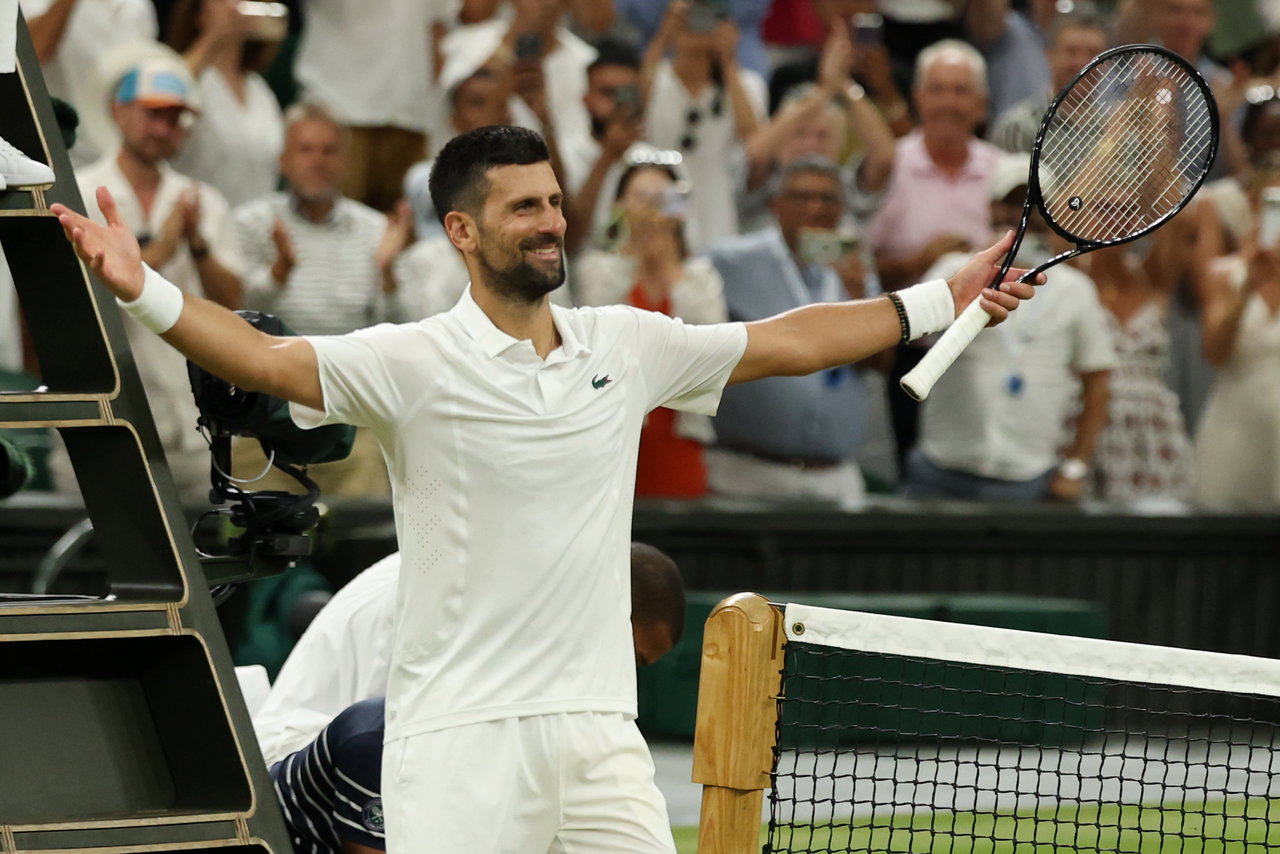
Jul 7, 2026; London, United Kingdom; Novak Djokovic (SRB) celebrates after his match against Felix Auger-Aliassime (CAN) (not pictured) on day nine of The Championships Wimbledon 2026 at All England Lawn Tennis and Croquet Club. Mandatory Credit: Geoff Burke-Imagn Images
There is no denying the longevity that Djokovic has shown in the sport, which is not known for players going on beyond 35, let alone nearing 40. With his win over Auger-Aliassime, Djokovic is now second only to Ken Rosewall in terms of age for reaching a Major semifinal, while completing the 50th five-set match at Grand Slams, which is the most for any player.
Nole has played three hours more tennis than Sinner has at this tournament, and at this stage of his career, it might very well take its toll on the Serb. Also, fatigue aside, Sinner is the only player with a 6-5 head-to-head record against Djokovic, having won five of their last meetings, and will be determined to settle the score after the Melbourne loss. The two met in the semifinals at Wimbledon last year as well, but on that occasion, the Italian handed the Serb a straight-set beating, as the Serb was not at his physical best.
Djokovic will get two days’ worth of rest, and the Serb will need every second of it if he has to replicate what he did against Sinner in Australia. The Italian had a shaky start to the tournament, but has gradually built up his form over the last few rounds. He has yet to face top-quality opposition like Djokovic. Considering all factors, one had better get ready with their popcorn on Friday, as the Center Court might see one of its greatest matches yet.
But in case you missed a glimpse of his greatness last night, here’s a recap of all the records Djokovic broke in the five hours and fifteen minutes of the match at SW19:
At a Glance
- Longest Quarterfinal: Lasting 5 hours and 15 minutes, it officially stands as the longest men’s singles quarterfinal match in Wimbledon history.
- Longest Personal Match: This was the longest match Djokovic has ever played on the grass courts of the All England Club.
- Beating the Clock: The final super tiebreak concluded at 10:52 PM local time, beating Wimbledon’s strict 11:00 PM curfew by a mere eight minutes.
- Career Match Wins: The win extended his newly minted men’s tournament record to 107 Wimbledon match victories, which he secured just two days after breaking Roger Federer’s previous record of 105.
- Defying Age: At 39, Djokovic became the oldest men’s singles semifinalist at Wimbledon since Ken Rosewall reached the milestone in 1974.
- Consecutive Semi-Finals: By advancing, he broke the Open Era record for the most consecutive Wimbledon men’s singles semi-final appearances (8), moving one clear of Roger Federer.