
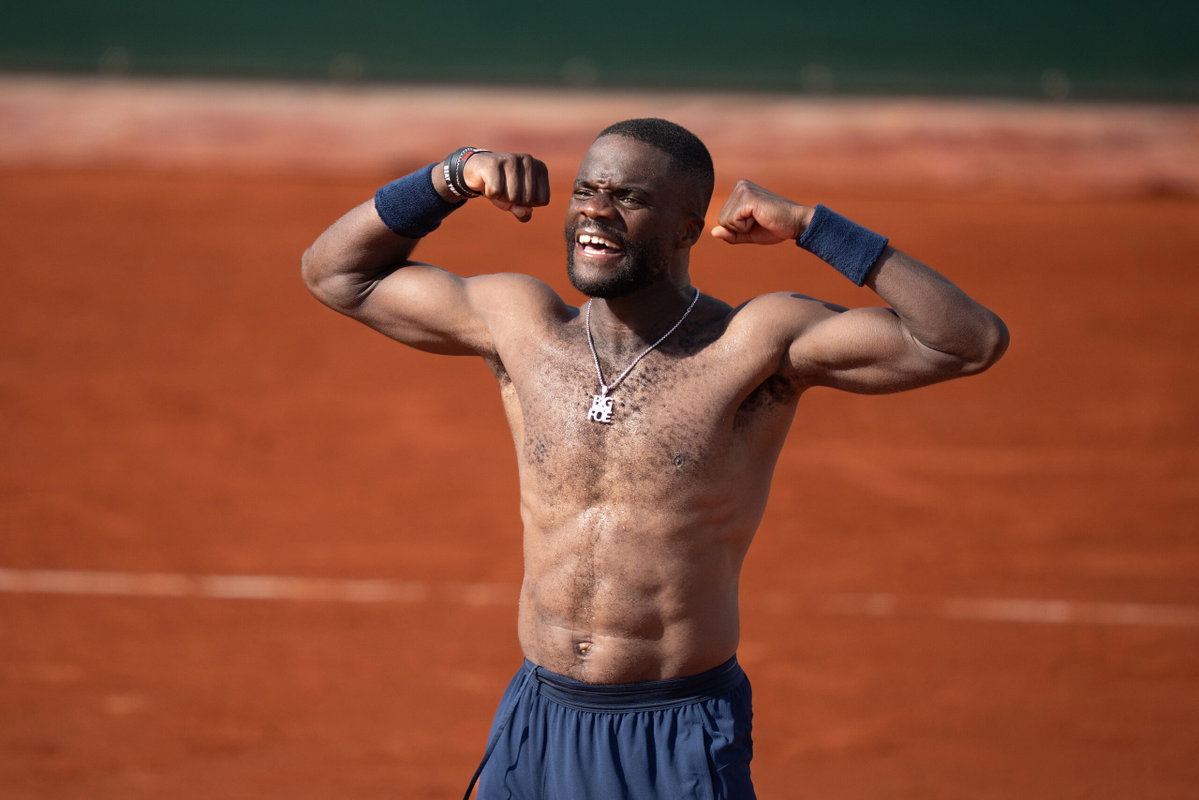
Line-call disputes have plagued Roland Garros this year. After the line-call controversy in the Kokkinakis-Atmane match of the French Open, another has erupted. This time, Frances Tiafoe traded strong words with Jaime Faria in another flashpoint that has the tournament buzzing.
Watch What’s Trending Now!
The heated situation unfolded in the fifth set when Faria’s serve was called in, but Big Foe argued it was out. The chair umpire checked the mark and confirmed it was in. Even the Hawkeye on TV showed it was just 1 mm in. As the game dragged past midnight local time in Paris, the Portuguese took a long break to exchange words with Tiafoe and, later, the chair umpire at the net.
Tiafoe mocked Faria: “Relax and play.” The umpire, mainly speaking to Faria, who had approached the net, insisted, “Okay, all of this has to stop, all of this.”
Tiafoe continued at the net, almost laughing as he told Faria, “Why don’t you quit trying to act like you’re tough? You’re not hard, bro; just play. You’re trying to act like you’re tough. You’re not hard, bro. Just play. Just play. Enjoy the match. You’re sitting here saying this ball’s out. Just play.”

Frances Tiafoe on telling Jaime Faria to quit acting tough at Roland Garros “He thought he was Ryan Garcia or something.” 😭😭😭😭😭😭
Faria shot back, “You’re disrespectful,” and returned to his baseline. He later went to the umpire and said, “You see what he’s saying?” The umpire replied, “You were as well, so please… You act like you haven’t been saying anything about him or about me.”
Faria insisted, “I never said anything about him.” The umpire responded firmly, “Please let me do my job.” On TNT, John McEnroe weighed in, saying, “I don’t know what Faria is complaining about. He’s entitled to look at the mark, for God’s sake. Let’s see who it affects more. Just play! Hey, it’s late, midnight in Paris!”
Despite the heated exchange, play resumed calmly. The Portuguese qualifier had taken a two-set lead, clearly outplaying Tiafoe early in the match. But Tiafoe fought back, forcing the third set into a tiebreaker and eventually winning the fourth set to keep his tournament hopes alive. Tiafoe seized momentum in set four after Faria committed two double faults and won, advancing to the next round.
After the match, Tiafoe spoke in an on-court interview with fellow American Sloane Stephens. “I felt like I needed that too,” he said.
“Because I’m up at the time, but I’m still a little nervous. And he was chirping. He definitely gave me a lot of lip. He thought he was Ryan Garcia or something. So, I just had to definitely let him know, like, ‘Just chill out, bro. Just play. Just enjoy being in Paris and just play.’ It was a little back-and-forth. Nothing serious, but it definitely went in my favor.”
But this wasn’t the only line-calling dispute highlighted this year, showing once again the importance of Electronic Line Calling (ELC) in modern tennis.
French Open line-call dispute ends with no handshake after the match
The WTA draw at this year’s Roland Garros also witnessed a major line-calling controversy when Tamara Korpatsch and Wang Xinyu became involved in a heated dispute during their match.
The first flashpoint arrived when Wang crossed to Korpatsch’s side to inspect a ball mark. The move came after the chair umpire ruled that Wang’s shot had landed beyond the baseline.
The crowd booed the 32nd seed for her actions. Even the chair umpire handed her a code violation for unsportsmanlike conduct. The point carried significant importance in the match at the end. The ruling gave Korpatsch a set point on Wang’s serve in the closing stages of the opening set, making the disagreement even more tense.
Although play resumed after the chair umpire’s intervention, the frustration did not disappear. The issue resurfaced when both players met at the net after the match.
Instead of shaking hands after the match, as is the custom, the two walked away from each other. Afterwards, Korpatsch responded to Wang’s claims that she was “not a fair player”.
The German ace maintained that there had been two visible ball marks on the clay, one old and one new, but insisted both were out.
“The chair umpire came down and showed the mark, and it was out. Also on the TV, they showed the Hawk-Eye, and it was like 8mm out. She came on my side because she didn’t believe it,” Korpatsch said.
“At the end, we didn’t have a handshake because she told me she’s not OK with the ball marks. I didn’t offer her my hand because that’s not fair for me. She was unfair to come on my side, and I’m not an unfair player.”