
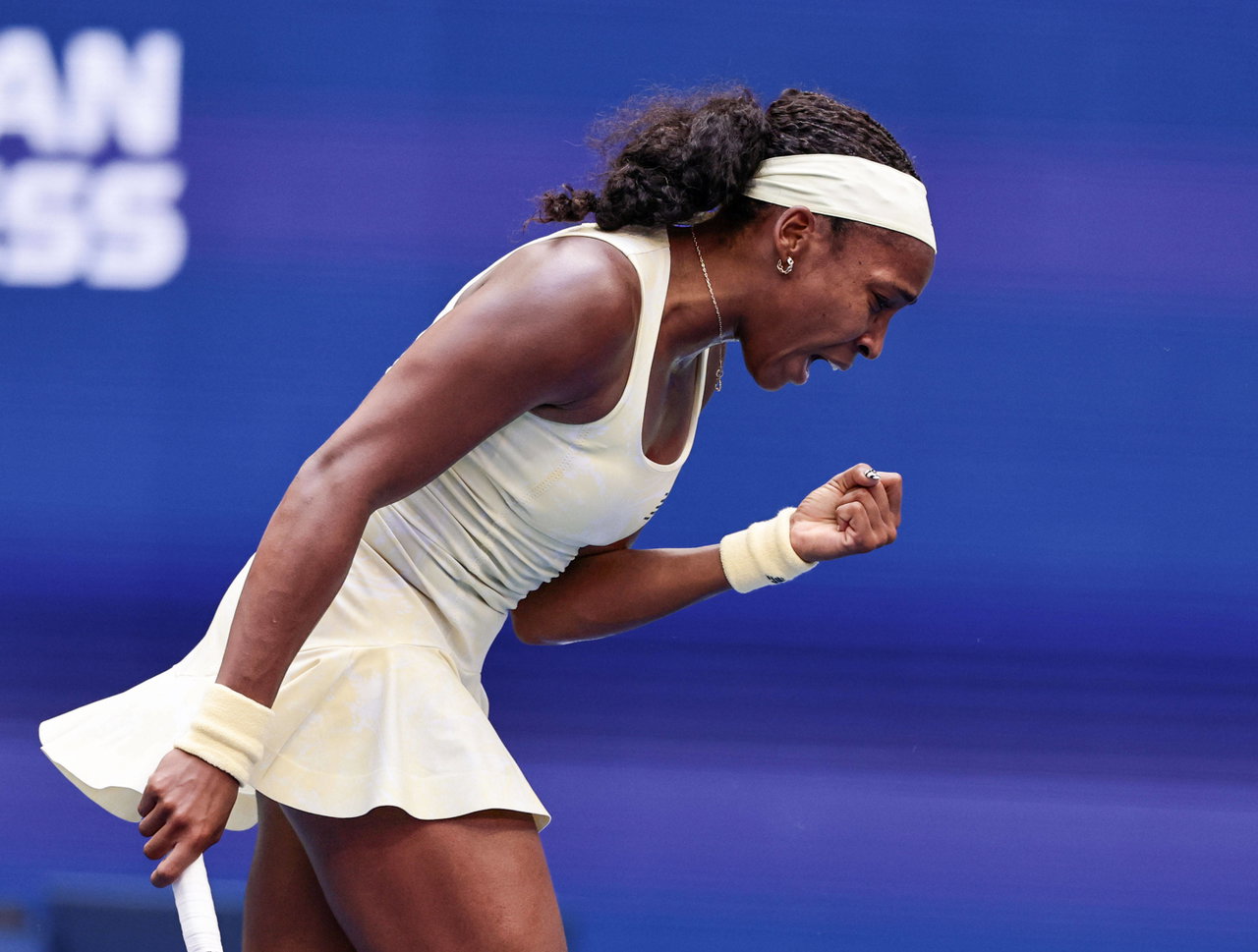
If winning ugly is the mark of a champion, Coco Gauff has made a habit of it. She has won 12 matches in 2026 after dropping the first set, repeatedly digging herself out of trouble when her game is nowhere near its best. It may not always be pretty, but it keeps wearing opponents down. Mirra Andreeva became the latest victim in the US Open quarterfinal, and Andy Roddick believes that stubborn refusal to go away is exactly what makes Gauff so dangerous.
Watch What’s Trending Now!
“Coco has the biggest insurance policy in tennis. She doesn’t have to hit it well. She can run. She can scrap. She can shrink the court. She is so fast that instead of playing a foot or a foot and a half inside the line, she shrinks it to six inches. All of that matters. She does not need to hit the ball well to win, and she’ll get criticized for it,” said Roddick on his podcast, Served with Andy Roddick.
“She gets criticized sometimes, but she just wins. She doesn’t care what it looks like or how she does it. If she’s hitting the ball well, great, she’s going to win three and three. If she’s not, she’s going to claw and scratch, and you’re going to have to knock her out. There is no winning on cards with Coco Gauff. You have to knock her out.”
Even though her US Open escape against Andreeva stands out, it was hardly the first time Gauff turned a match around from the brink. Earlier this year in Dubai, she beat Elise Mertens 2-6, 7-6(9), 6-3 after saving three match points, despite committing 16 double faults and 63 unforced errors and finishing with fewer total points, 96 to Mertens’ 101. In Rome, Iva Jovic led 7-5, 5-3, served for the match and held a match point before Gauff flipped it to win 5-7, 7-5, 6-2.
The same pattern showed up again in New York. Against Andreeva, Gauff dropped the opening set 6-2, survived two match points in the second-set tiebreak and still came through 2-6, 7-6(7), 6-2.
Andreeva knew exactly what was happening. “I think she’s just more patient than me. I’m the one that’s trying to rush and make more mistakes than her,” she admitted after the match, while also revealing that she noticed Gauff’s early nerves and tried to exploit them. The problem was that recognizing Gauff’s game and actually stopping it proved to be two very different things.
Roddick’s point has played out against plenty of Gauff’s opponents. Even when her serve breaks down, she can lean on her speed and defense to extend rallies until the other side cracks. Aryna Sabalenka learned that in last year’s French Open final, where Gauff absorbed her power, forced extra balls and drew errors on her way to the title.
Gauff entered the Andreeva clash in pristine form, having won her previous nine matches in straight sets. She had not dropped a set since her Cincinnati opener against Liudmila Samsonova, putting together a run of 20 consecutive sets before her old serving and forehand issues resurfaced in New York.
The numbers showed just how messy the escape had been. Gauff piled up 40 unforced errors and 12 double faults across the first two sets, but once she took control in the decider, the mistakes almost disappeared. She committed just two unforced errors and zero double faults in the third set.
That ability to survive trouble is exactly what Roddick was describing. But against Elena Rybakina, Gauff may not have the same margin for error, with the Kazakh’s serve and first-strike power capable of punishing the kind of slow start Andreeva failed to finish.
Coco Gauff Will Need to Be at Her Best Against Elena Rybakina
If there is one player capable of hitting through Gauff’s defense, it is Elena Rybakina. The two have split their two meetings, with Rybakina taking the most recent one at the Canadian Open last month.
Gauff’s scrambling usually puts pressure on opponents to hit one more ball, but Rybakina presents a different problem. She owns one of the biggest serves on tour and can end points before Gauff gets the chance to turn them into a grind. If Gauff’s own serve slips again, breaking Rybakina consistently on a quick Arthur Ashe court could become a major problem.
Rybakina did show some frustration during her quarterfinal against Zheng Qinwen, but she is rarely a player who unravels for long. Gauff, meanwhile, knows Arthur Ashe better, has the crowd behind her and has already survived the kind of pressure that comes with deep runs in New York.
Still, Rybakina enters the semifinal with the confidence of a player set to reach World No. 1. Against that serve and first-strike power, Gauff may not be able to rely on another escape act. This time, she may actually have to play her best tennis to reach a second US Open final.