
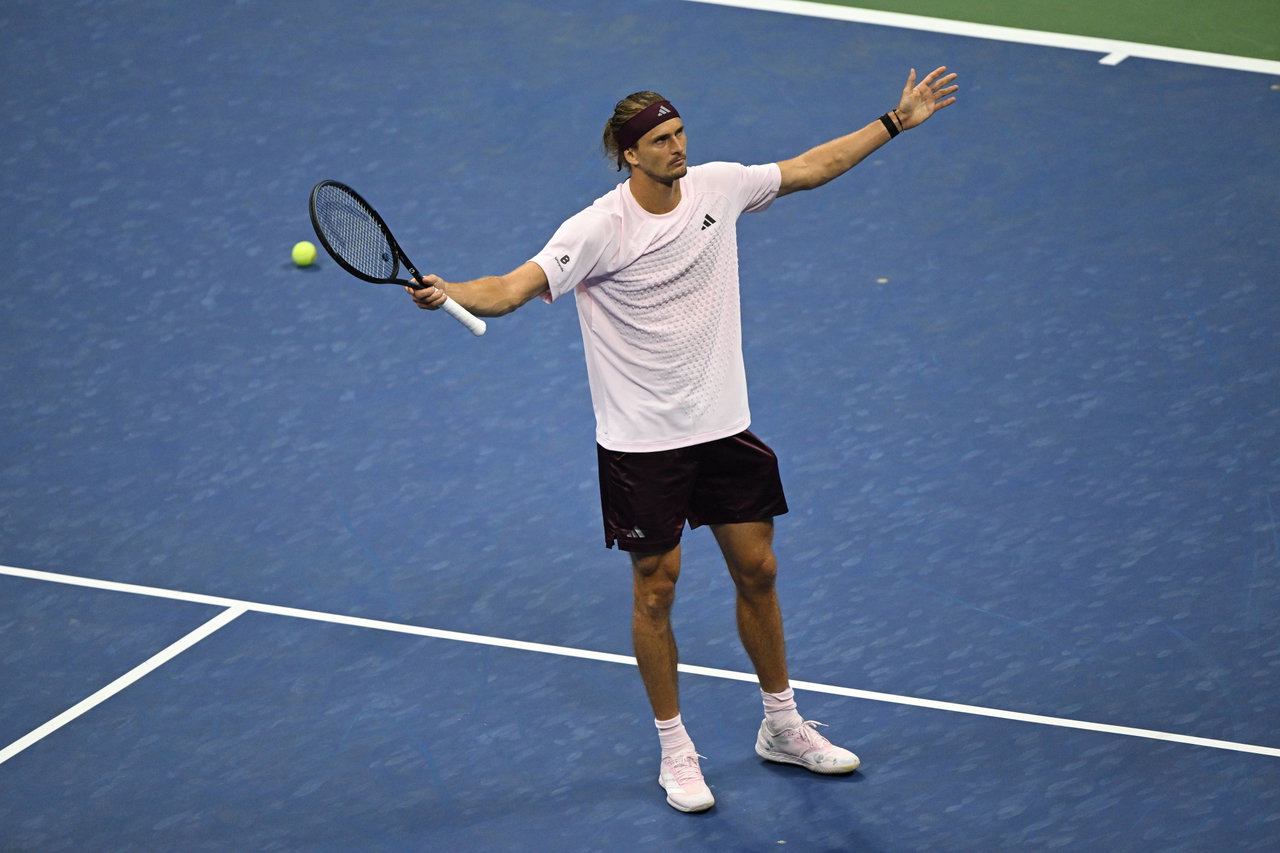
Halys had Zverev in trouble. He led 4-1 in the third set, and even when Zverev started pushing back, Halys was still up 4-2. Then came the strange part. With Zverev holding two break points at 15-40, the German stopped play to change his drenched shoes. He came back, broke serve to make it 4-3, erased the deficit, and eventually stole the set 7-6(3).
Watch What’s Trending Now!
That timing is exactly why the shoe change became such a talking point. But Andy Roddick was less interested in accusing Zverev of gamesmanship. Instead, he questioned whether the real problem was the equipment itself.
“The fact that he asked the umpire before he did it. If you have a problem with the equipment, you are allowed to change shoes anytime you like,” said Roddick.
Boos followed as Zverev stepped away, but Roddick felt the reaction was unfair. “We don’t often see Sascha using gamesmanship,” he said. “I don’t know that I think he does this if there’s not something wrong with the shoe.” For Roddick, Zverev had earned the benefit of the doubt.
Under the 2026 ATP Official Rulebook, shoe changes fall under Section 7.22, “On-Court Procedures and Requirements,” subsection P, “Time and Equipment Cases.” The chair umpire can allow reasonable extra time for a player to change shoes or socks, usually during a changeover, and normally only once if extra time is needed.
If the issue qualifies as “equipment out of adjustment,” however, the umpire can judge the request separately. A broken shoe is treated more seriously, with officials allowed to stop play so the player can get a replacement.
That is why Roddick’s equipment argument did not come out of nowhere.
Zverev appeared to be wearing the Adidas Adizero Ubersonic 5, the same model Rafael Jódar has already had repeated trouble with.
“It would be better if you didn’t do it now,” the umpire told him.
Zverev replied, “Can I? Quickly?” and was allowed to make the switch.
Jódar’s laces broke repeatedly during the North American hard-court swing. Against Denis Shapovalov in Cincinnati, they snapped twice, with the second stoppage lasting around four minutes while Jódar’s father helped prepare another pair. Shapovalov protested as Jódar was able to towel off and drink water, fueling accusations that the delays were helping him recover.
Jódar rejected that idea, insisting the laces had genuinely broken and he simply needed replacements. He even arrived for his next match against Alejandro Tabilo carrying several pairs of shoes in a transparent bag, apparently trying to avoid another long delay.
Similar problems had already surfaced in Washington and Canada. Brad Gilbert also publicly called on Adidas to “fix” the issue and joked that Jódar might need “titanium” laces because of how aggressively he slides.
The controversy followed Jódar all the way to the US Open, where he eventually snapped when another reporter brought up his shoelaces. “What’s the question?” he asked before saying the question “doesn’t make sense.”
Zverev’s problem was different, but that hardly helps Adidas. When the same shoe model keeps showing up in awkward equipment stoppages, scrutiny naturally shifts from the players to the footwear itself.
For Zverev, the shoe debate now takes a back seat. Next up is Alejandro Tabilo.
Zverev Faces Tabilo With Recovery Becoming the Real Test
On paper, Zverev should be favored against Tabilo.
He leads their head-to-head 2-0, including a straight-sets win at the 2025 US Open and a three-set comeback victory in Rome in 2024. Zverev also comes in as the world No. 2 with a 46-13 record this season, a Roland Garros title and a Wimbledon final already on his résumé.
But the bigger issue is workload. Zverev has already needed five sets in both of his opening matches in New York, surviving Lorenzo Sonego in 4 hours and 53 minutes before going another 4 hours and 33 minutes against Quentin Halys. That is a huge amount of tennis this early in a Grand Slam, so the Tabilo match is as much about recovery as it is about form.
For Zverev, this is where the tournament needs to get cleaner. He has already proved he can survive chaos, but another marathon could become a real problem later in the draw. Against Tabilo, the goal will be simple: control the match early, shorten the points where possible, and avoid turning another round into a physical grind.