Imago
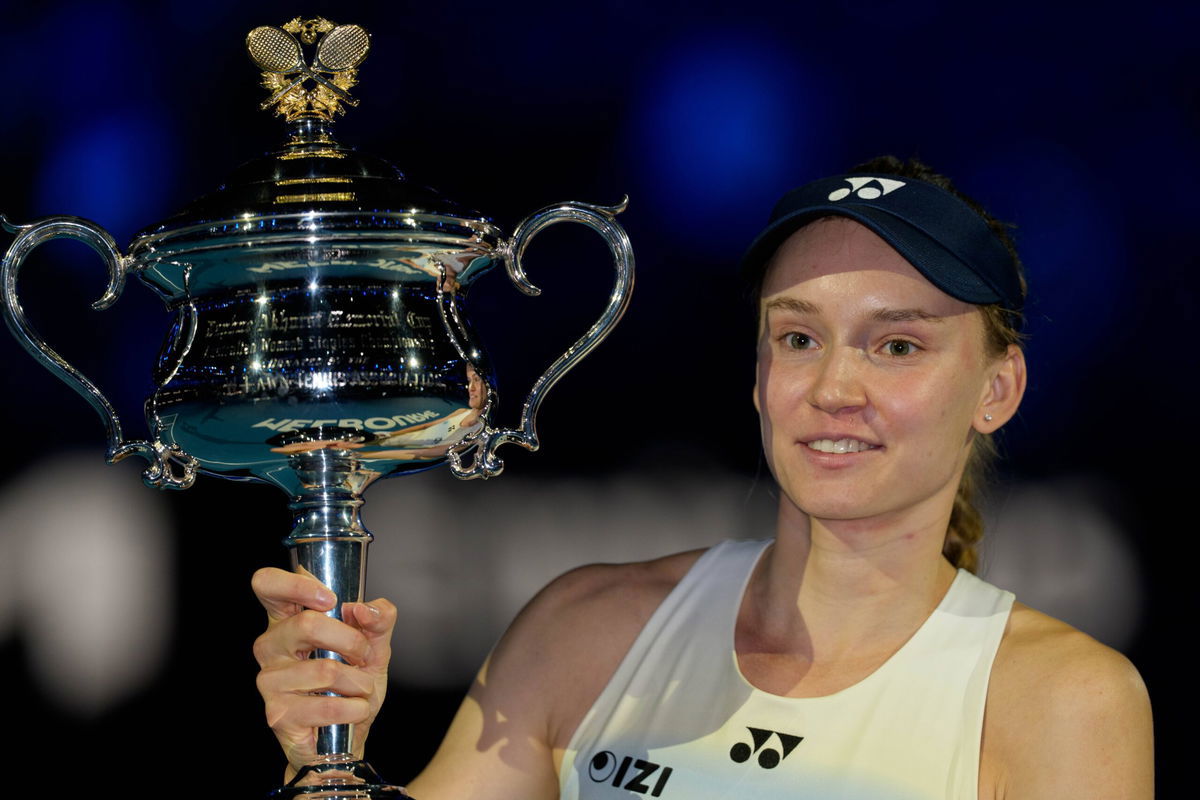
January 31, 2026: 5th seed ELENA RYBAKINA of Kazakhstan holds the Daphne Akhurst trophy after winning the 2026 Australian Open by defeating 1st seed ARYNA SABALENKA of Belarus on Rod Laver Arena in the Women s Singles Final match on day 14 of the 2026 Australian Open in Melbourne, Australia. /Cal Media Melbourne Australia – ZUMAc04_ 20260131_faf_c04_019 Copyright: xSydneyxLowx
Imago
January 31, 2026: 5th seed ELENA RYBAKINA of Kazakhstan holds the Daphne Akhurst trophy after winning the 2026 Australian Open by defeating 1st seed ARYNA SABALENKA of Belarus on Rod Laver Arena in the Women s Singles Final match on day 14 of the 2026 Australian Open in Melbourne, Australia. /Cal Media Melbourne Australia – ZUMAc04_ 20260131_faf_c04_019 Copyright: xSydneyxLowx
Elena Rybakina claimed her first Australian Open crown with a gripping three-set win over Aryna Sabalenka, sealing a 6-4, 4-6, 6-4 triumph in Melbourne. The victory delivered her second Grand Slam title after Wimbledon 2022. As celebrations begin, attention now shifts to a pressing question: how much prize money did Rybakina actually take home after taxes from her 2026 Australian Open win?


What was Elena Rybakina’s Australian Open 2026 prize money?
Watch What’s Trending Now!
As the 2026 women’s singles champion, Elena Rybakina earned A$4.15 million for winning the Australian Open. The prize equals roughly $2.75–2.8 million. It marked a record payout and represented a 19% increase from the 2025 champion’s earnings.
The Australian Open 2026 featured a historic prize structure. The tournament offered a record-breaking total prize pool of AUD 111.5 million.
That figure equals about $74.73 million. It was the largest prize pool in the event’s history and followed a 16% increase from the previous year.
Do tennis players pay tax on Australian Open prize money?
Tennis players must pay tax on Australian Open prize money. Under Australian law, income from professional sport is taxable. It is not treated like lottery winnings. Prize money earned through competition must be declared.
Any income earned in Australia falls under Australian tax rules. This includes money won at the Australian Open. The Australian Taxation Office, or ATO, oversees this process. Players are required to comply with these regulations.
View this post on Instagram
Non-resident athletes are also subject to Australian tax laws. Australia taxes only income that is sourced within the country. This applies even if the player does not live in Australia.
Foreign players must pay tax on prize money earned in Australia. This includes international stars such as Elena Rybakina. Their residency status does not exempt them from paying Australian tax on local earnings.
Tournament organizers usually deduct tax before paying the prize money. This is done under Foreign Resident Withholding Tax rules. The tax is withheld directly at the source.
The withholding tax follows Australian marginal tax rates. For non-residents, rates can rise to 45 percent on higher income levels. The exact amount depends on earnings and thresholds.
Players can later file an Australian tax return. This allows them to adjust for overpayment or underpayment. They may also claim deductions for expenses. As a result, winners often receive less than the advertised prize money.
How much did Elena Rybakina earn after taxes?
Elena Rybakina is a non-resident for Australian tax purposes. Because of this status, the ATO applies tax to income earned in Australia.
Prize money from professional sport is treated as taxable income. This includes winnings from the AO. The tax applies because the income is sourced in Australia.
For foreign athletes, Australia uses the non-resident withholding tax system. These tax rates are progressive. They can rise to as high as 45% above certain income levels.
Based on past ATO practices, a large share of prize money is withheld immediately. In many cases, this is around one-third or more of total earnings.
After withholding, Rybakina’s estimated take-home amount could fall between AUD 2.3 million and AUD 2.7 million. This equals roughly $1.6 million to $1.88 million. These figures assume a 30 to 45% tax range.
The final amount can change. It depends on tax treaties, allowable deductions, and whether she files an Australian tax return.
Rybakina may also owe tax in Kazakhstan. Many countries allow foreign tax credits. This helps avoid paying tax twice. Double taxation treaties can further reduce her total tax burden.
For the match itself, this defeat marked another tough moment for last year’s US Open champion Aryna Sabalenka. It was her third loss in the last four Grand Slam finals. Those defeats also included last year’s Australian Open and French Open finals.
Sabalenka looked in control at key moments. She broke Elena Rybakina’s powerful serve late in the second set. She then struck again early in the deciding set while chasing a third Australian Open title in four years.
However, the momentum soon shifted. As the pressure increased, Sabalenka tightened. Three unforced errors opened the door for Rybakina to break back and regain control.
Rybakina seized the moment. She stayed calm and focused during the closing games. Her confidence never wavered as the match reached its decisive stage.
The 26-year-old sealed the victory in style. She served out the match with an ace. That moment secured her second Grand Slam title after winning Wimbledon in 2022.
It also marked her first Australian Open crown. The Melbourne crowd watched a new chapter unfold in her career.
Attention now turns to the men’s final. Carlos Alcaraz will chase a career Grand Slam at a historic young age. Novak Djokovic will aim for a record-breaking 25th major title. Who do you think will win tomorrow?
