
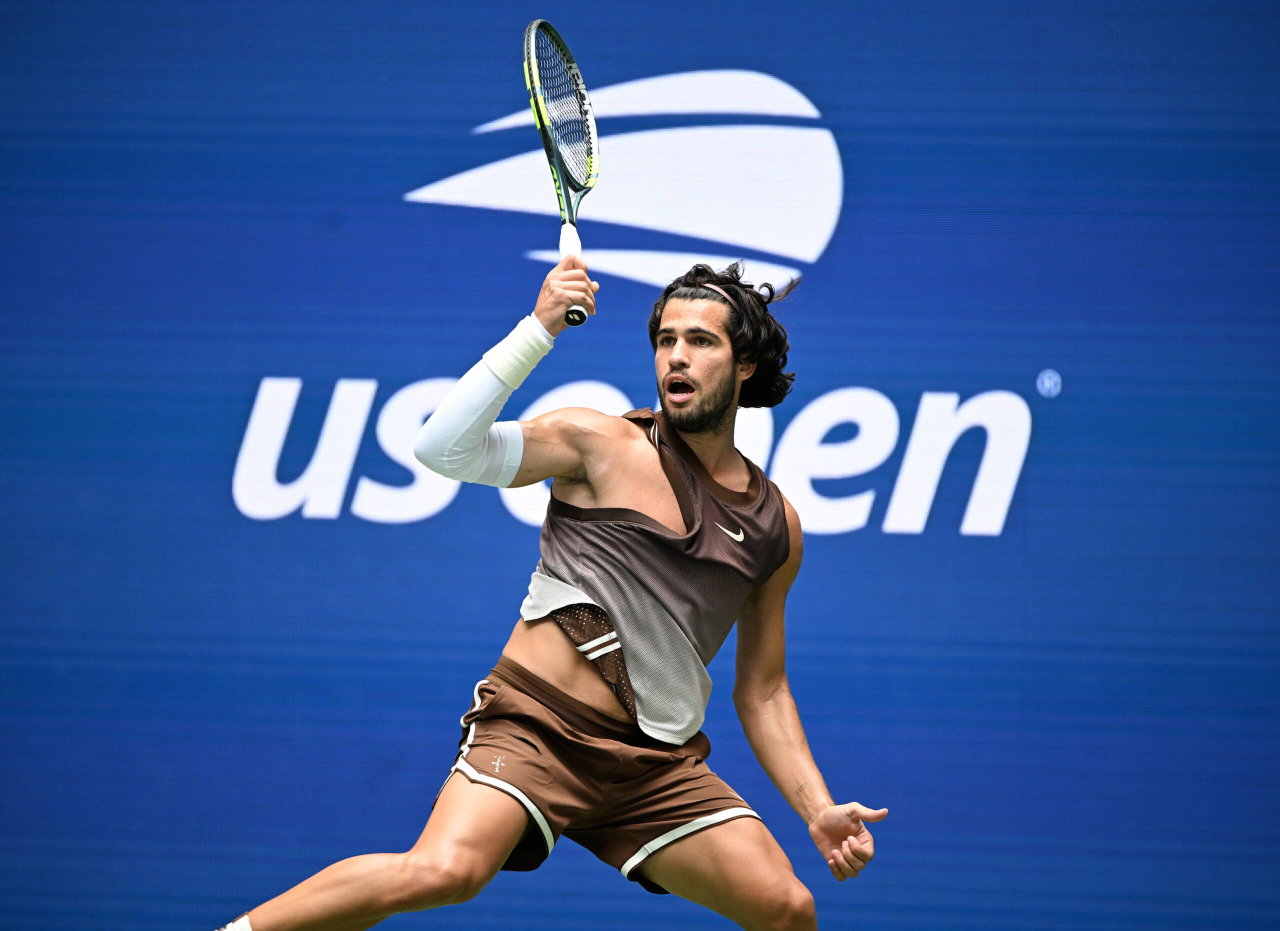
After beating Tommy Paul 6-4, 6-3, 6-4 in the fourth round and storming into the US Open quarterfinals, Carlos Alcaraz sat down for an interview in his native Spanish and gave himself a B for his tournament so far. He made it clear he still had work to do before earning an A, especially if he wanted to keep going deep in New York. But when the conversation turned to whether he believed he could win the whole thing, Alcaraz did not suddenly start beating his chest about the title.
Watch What’s Trending Now!
He stressed that, more than anything, he was grateful to be healthy, back on tour, and competing again after months away. Somehow, that nuance still got twisted.
Tennis TV turned it into a declaration that Alcaraz “felt capable of winning the tournament.” He quickly corrected them in the comments: “I didn’t say that 🤨.” A nuanced Spanish answer had suddenly become a quote he never claimed as his own.
He never said it. That is the problem, and this is where Tennis TV got ahead of itself.
Alcaraz had just said he was nowhere near an A yet and still had plenty to improve after returning from a four-month wrist injury. Then he asked, “After four very good matches, do I now feel capable of winning the tournament?” That was not a victory speech. It was him weighing up where he stood. Turning that into “I feel capable of winning the tournament” made him sound far more cocky than he actually was.
And Alcaraz had every reason to be encouraged.
In his first match back after four months out with a right wrist injury, he beat Roman Safiullin 6-4, 6-4, 6-4 and said his body felt great afterward. Jaime Faria briefly rattled him in Round 2 by taking the opening set, but Alcaraz responded brutally, winning the next three 6-0, 6-3, 6-2. By Round 3, he was cruising again, brushing aside Wu Yibing 6-3, 6-4, 6-1 and admitting he was “feeling better and better after every match.”
By Round 4, Alcaraz was not surviving a comeback. He was already looking dangerous again.
And Alcaraz is not the first top player forced to correct a broadcaster over words he never said. At Wimbledon in 2025, Aryna Sabalenka stopped BBC presenter Lee McKenzie mid-question after McKenzie said she had called Laura Siegemund’s game “annoying.” Sabalenka immediately pushed back: “No, no, no, I didn’t say that. They asked a question saying that she said that she has an annoying game. I didn’t say that, just to make it clear!” She then corrected the characterization altogether, saying, “It’s not like it’s an annoying game, it’s a smart game. She’s really making everyone work against her.”
For Alcaraz, though, the confusion did not stop with what he supposedly said. He was about to get another surprise, this time over who he was actually playing next.
Carlos Alcaraz was surprised to hear about his next opponent
His relaxed approach even produced a hilarious moment with Andy Roddick. Appearing at the ESPN desk after beating Paul, Alcaraz was asked about a potential quarterfinal against Ben Shelton or Stefanos Tsitsipas.
His reaction revealed just how little attention he had paid to the draw.
“I thought.. I thought.. Oh my God! I thought I was playing Medvedev or Tiafoe. Oh my God,” Alcaraz said.
“Surprise,” Roddick replied.
Alcaraz admitted he “didn’t see the draw” before promising to watch the Shelton-Tsitsipas battle. Shelton eventually emerged with a 6-2, 6-3, 6-4 victory.
The American now faces perhaps his biggest test of the tournament. Alcaraz has won all three of their previous tour-level meetings and is 13-0 against American opponents at Grand Slam tournaments.
Shelton knows exactly what awaits him…
“Special tennis. I think the level he’s been playing at is really, really impressive… I think it’s gonna be fireworks on Tuesday night. I hope you guys come back, because I’m ready to go.”
He later added, “To not play for 5 months, then do what he’s done so far this tournament has been superhuman.”
The stakes could hardly be higher. Shelton is chasing America’s first men’s Grand Slam singles title in 23 years, while Alcaraz is attempting to become the first man since Roger Federer in 2008 to successfully defend the US Open crown.
But amid all the talk of history and titles, Alcaraz’s message remains remarkably simple.
“For me it continues to be a gift to be able to compete once again, to be able to step back onto the court for a US Open quarterfinal. We’re going to try to enjoy it.”
And perhaps that is precisely why he was so quick to correct the quote. Winning the tournament may be the dream. But for Alcaraz, at least for now, the journey back to feeling like himself appears to matter just as much.