Imago
Image Credits: Imago
Imago
Image Credits: Imago
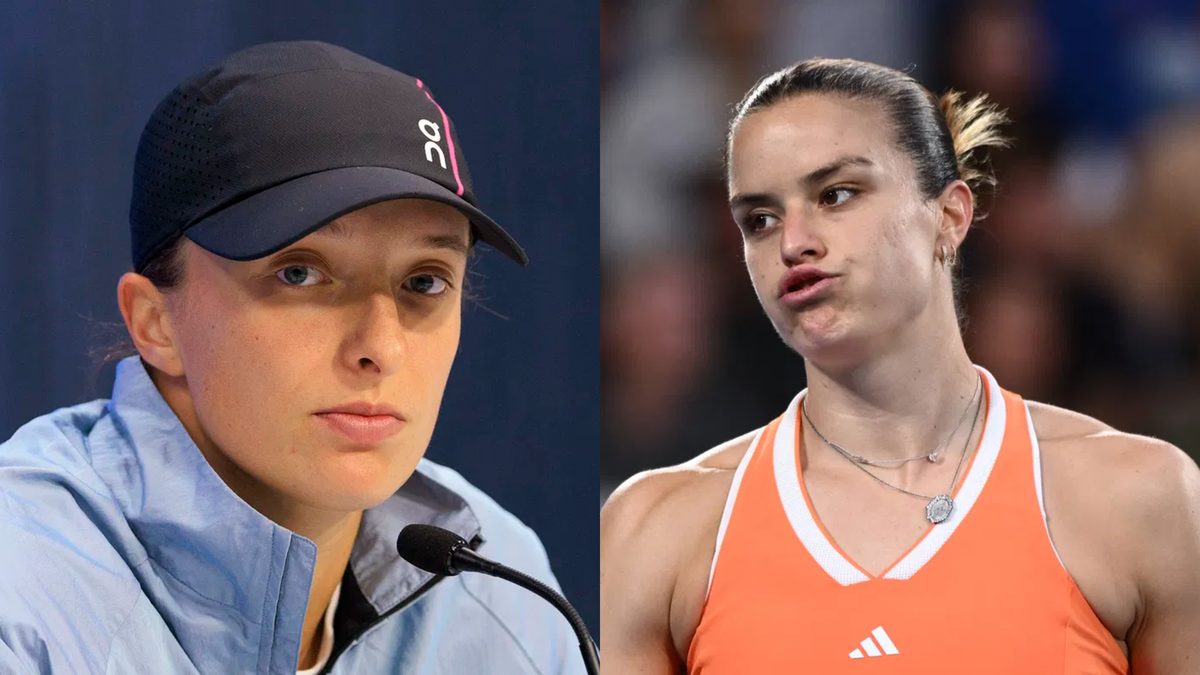
A gripping quarterfinal at the Qatar TotalEnergies Open delivered drama beyond the scoreboard, as Maria Sakkari outlasted Iga Swiatek 2-6, 6-4, 7-5. The deciding set hinged on a tense video review moment that quickly sparked debate across the tennis world.


After the match, Swiatek addressed the tense “double bounce” moment from her quarterfinal clash against Sakkari in Doha. The Pole, who went down in three sets to the Greek in Doha, admitted afterward that she was unsure whether the ball had bounced twice before she made contact. “I didn’t know if I… I mean, from the physics, how the ball went,” Swiatek insisted in her post-match press conference. “It was either from the floor or I framed it. So, I wasn’t sure, honestly.”
Watch What’s Trending Now!
The flashpoint came at 5-3 (30-40) on Sakkari’s serve. Swiatek sprinted forward chasing a dropshot, and the chair umpire initially allowed play to continue. Sakkari immediately halted the point and requested a video review – a challenge confirmed in her favor as the replay showed a double bounce.
As per the Greek star, “It’s great that we have it, because imagine if we didn’t have it today. I feel like it’s, you know, it’s very tough also for the umpire to see because you don’t know how they put the racquet. And they’re not, you know, robots; they’re human beings, and they can lose the balance with their vision. It’s the first time I’ve used it, and I’m happy that it exists.” But what did she say when she was asked whether she could tell when a ball had bounced twice?
“I feel like you do. Sometimes, maybe you’re confused. I’m not saying that she knew or anything, of course, but sometimes I feel like you know. But you can also, you know, be a little bit, ‘I’m not so sure, I’m unsure about how the bounce was.'”
The Doha debate revived memories of a similar situation involving Emma Navarro at the Australian Open earlier in 2025. During that quarterfinal, a drop shot appeared to bounce twice before Swiatek returned it, but chair umpire Eva Asderaki‑Moore did not stop play. Navarro requested a review, yet the appeal was denied because the point had not been halted immediately. Iga Swiatek went on to dominate the remainder of the match, winning 6-1, 6-2 – though the incident drew criticism online.
Afterward, Swiatek firmly denied knowing the ball had bounced twice. “I wasn’t sure if it was a double-bounce, or I hit it with my frame. It was hard to say because I was fully sprinting,” she explained, adding she trusted officials to make the call and deliberately avoided watching the replay to stay focused. Navarro herself defended the Pole, noting the responsibility lies with umpires rather than players.
Heureusement que le replay existe désormais car, à son attitude, tête baissée, les images laissent penser qu'Iga Swiatek sait très bien que la balle a doublé mais elle ne le dit pas.
Elle a quand même débreaké sur ce jeu mais elle a perdu le match.pic.twitter.com/Ta047erjdS
— Tennis Legend (@TennisLegende) February 12, 2026
While opinions varied over whether players “feel” the bounce, the technology ultimately ensured the correct call – even if it didn’t decide the match immediately. Iga Swiatek fought back to erase the immediate damage, but Sakkari’s resilience proved decisive. The Greek closed the set 7-5, sealing one of her most dramatic wins in Doha and leaving behind yet another debate about instinct vs. instant replay in modern tennis. What did Maria Sakkari say about this incredible win against the world number 2, though?
Maria Sakkari shares thoughts about her incredible win against Iga Swiatek
A comeback, a statement, and perhaps a turning point – Maria Sakkari produced one of her biggest victories in recent memory by knocking out Iga Swiatek in the quarterfinals of the Qatar TotalEnergies Open. She has now reached the Doha semifinals for the third time in her career and the first in three years.
After being overwhelmed early by Swiatek’s dominance, Sakkari flipped the match through aggressive baseline play and belief. “You’re always the underdog when playing against the No. 2 in the world, especially where I’m coming from,” said Sakkari, a former world No. 2 currently ranked 52nd. “But I kept telling myself, even after the first set, that I was playing good tennis and that I had to stick to my game plan and the way I was playing. I was aggressive, I was brave, and it worked out really well.”
The result carried historic weight. Iga Swiatek had been 109-0 at the WTA 1000 level after winning the first set, but Sakkari ended that streak while also leveling their head-to-head at 4-4 and snapping a four-match losing run against the Pole.
“I’m speechless because it’s been a while since I had a big win like today,” Sakkari said in her on-court interview. “When you drop in the rankings, and you’re not playing good tennis, you start doubting yourself. And you’re thinking that you’re never going to beat those players again. “So it’s a huge process that you have to go through in your head, that you know you can do it. Last year, in the second round here against (Swiatek), I was not confident. I was not believing in myself. And this year, it’s different. I feel quite a lot better.”
She’s happy to turn things around in the last two sets against a strong competitor like Iga Swiatek. The 30-year-old has been rebuilding after her ranking dropped to No. 90 last spring. Reuniting with longtime coach Tom Hill, she has rediscovered form – defeating Jasmine Paolini earlier in the week and earning her first Top-5 win since beating Coco Gauff in Miami 2024.
Sakkari opened the event with straight-set victories over Zeynep Sonmez, Paolini, and Varvara Gracheva before dethroning Swiatek, handing the Pole just her third loss in 21 matches at the tournament. The run pushed Sakkari into her 11th career WTA 1000 semifinal and first since the 2024 Indian Wells.
She will now face Karolina Muchova in the SF. Do you think she can win that match as well?
Written by

Edited by

Snigdhaa Jaiswal