
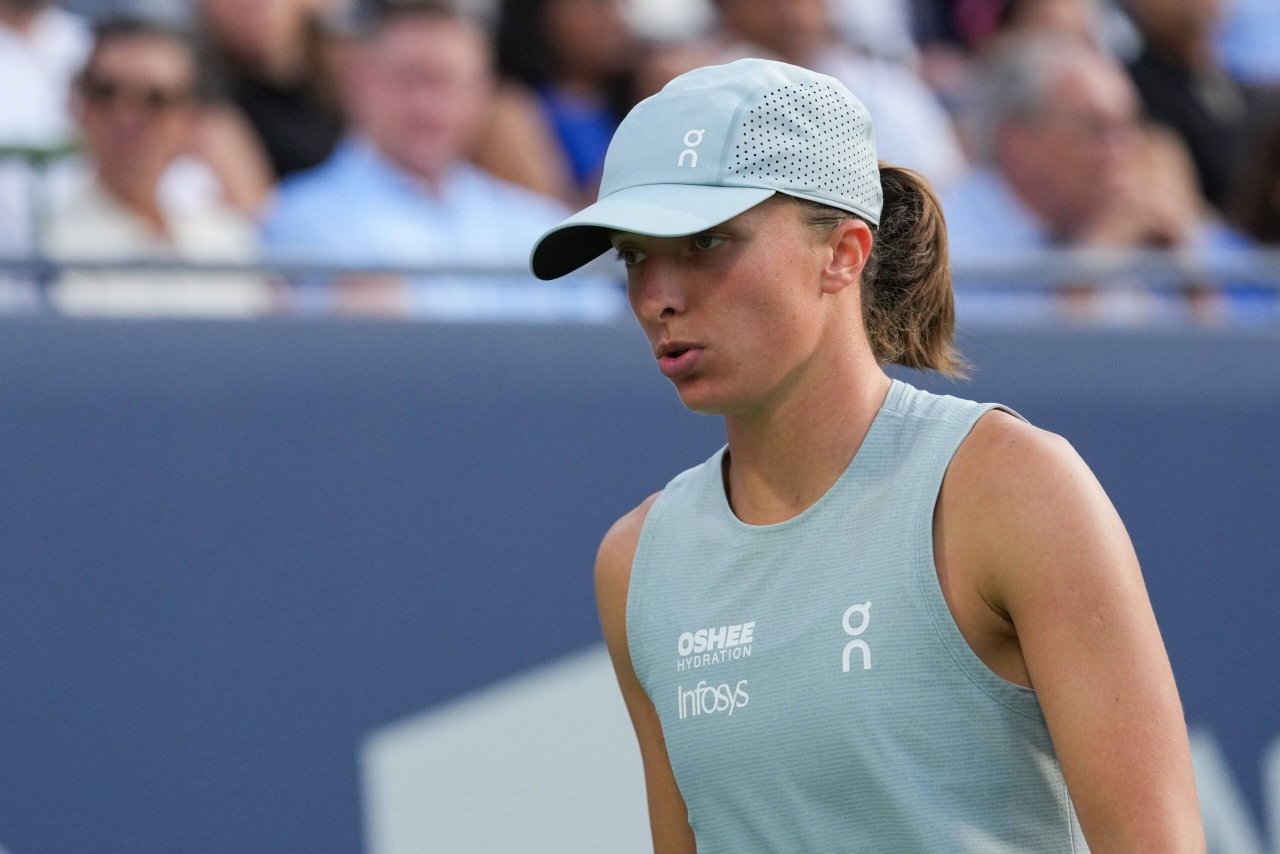
WTA’s updated Women’s eligibility policy, featuring the new one-time gene-testing method, has caused some division within the tennis world, with former World No. 1 Iga Swiatek sharing her views on it. The Pole was cautious in her reply, taking no decisive side in the debate and offering a nuanced take on the sensitive subject, contrary to those of current World No.1 Aryna Sabalenka.
Watch What’s Trending Now!
“I think we should stick to the communication that WTA is releasing re: this topic…it’s not a topic that any individual player should talk about because it’s about all sports and it goes far beyond like one person,” said Swiatek in her press conference before the Cincinnati Open. The Pole’s views on the matter differ from those of Sabalenka, who had clearly stated her support for the initiative, which she felt would be crucial in preserving fairness within the sport.
As per the new policy, all WTA players are subject to a one-time SRY-gene screening test to detect its presence in their DNA. The SRY gene is associated with male sex development and is used by the WTA as its initial biological-sex screening marker. And a positive result initially prevents the player from competing pending further medical assessment to determine whether an exception applies.
This new policy differs from the existing WTA mandate, which gave weight to gender identity and monitored testosterone levels, with players allowed to play on the WTA even if they had testosterone in their systems, provided they kept it below the stipulated threshold.
While Swiatek talked about the issue being broader than that of a singular player, Sabalenka welcomed it, with the Belarusian even pointing out that the WTA was a bit late in bringing the policy. Sabalenka is not the only one who has given strong support to the policy, with the likes of Belinda Bencic, Jessica Pegula, and former WTA legend Martina Navratilova welcoming the change.
On the other hand, Swiatek was not the only one who had a balanced take on the subject, with the likes of Coco Gauff also speaking about both sides of the debate.
“I don’t really know how to answer this question in a way that people aren’t going to spin it. But as far as where I stand, I definitely support the trans community, but I also support the need of creating fairness in sport too,” said Gauff in her press conference at the Canadian Open.
There are no transgender athletes on the WTA circuit at the moment, and the arguments have been made within the tennis community that the new policy by the WTA is a way of copying the mechanisms that are present in organizations like the IOC, which adopted a similar policy earlier this year.
While the debate about gene testing will rage on within the sport, players will be focused on the upcoming events in Cincinnati in the buildup to the US Open. Swiatek had a tremendous start to the North American hard-court swing, winning her first title in Canada, and will now look to defend her championship points from last year in Cincinnati.
Gauff, too, had a decent run in Toronto, reaching the semifinals, where she lost to Elena Rybakina, whereas Sabalenka will hope to get back to her dominant form in Cincinnati, as Rybakina is close on her heels for the No.1 ranking.