

Essentials Inside The Story
- Clay is Carlos Alcaraz's strength, but is his body helping him?
- Jannik Sinner has a big window of opportunity waiting as tennis world enters the clay season.
- Here is what I think gives Sinner a better chance to separate himself from Alcaraz's threat:
“Pressure is a privilege,” Billie Jean King once said. It applies just as sharply to rivalries that define eras. When the dominance of Roger Federer, Rafael Nadal, and Novak Djokovic began to fade, many wondered what tennis would look like next. But with Jannik Sinner and Carlos Alcaraz, that question is starting to answer itself.
Watch What’s Trending Now!
A 10–7 head-to-head between two players, still only 24- and 22-years-old, is no fluke. It’s the early shape of something special, especially now, as the clay season begins to set the tone for the months ahead.
With Sinner taking the No. 1 momentum after Monte Carlo, this rivalry is no longer just about wins; it’s about control at the top. The question is simple: can Alcaraz take it back after Roland Garros ends, or is the shift already underway?
Clay is Alcaraz’s territory, but is he fit enough to own it?
For me, the answer isn’t simple, because it starts with a moment that looked small, but now feels significant. I keep going back to Pista Rafa Nadal. At 5–4 against Otto Virtanen, Alcaraz called for the physio, and at the time, it felt routine, just another minor wrist concern. Even Alcaraz downplayed it.
“I’ve felt before, and I didn’t think it would get any worse.”
Looking back, that confession now feels far more significant, especially given everything that has unfolded since. He has admitted uncertainty around his recovery and timeline when speaking at the Laureus World Sports Awards, hoping to stay positive. And then came the visual that said more than words.
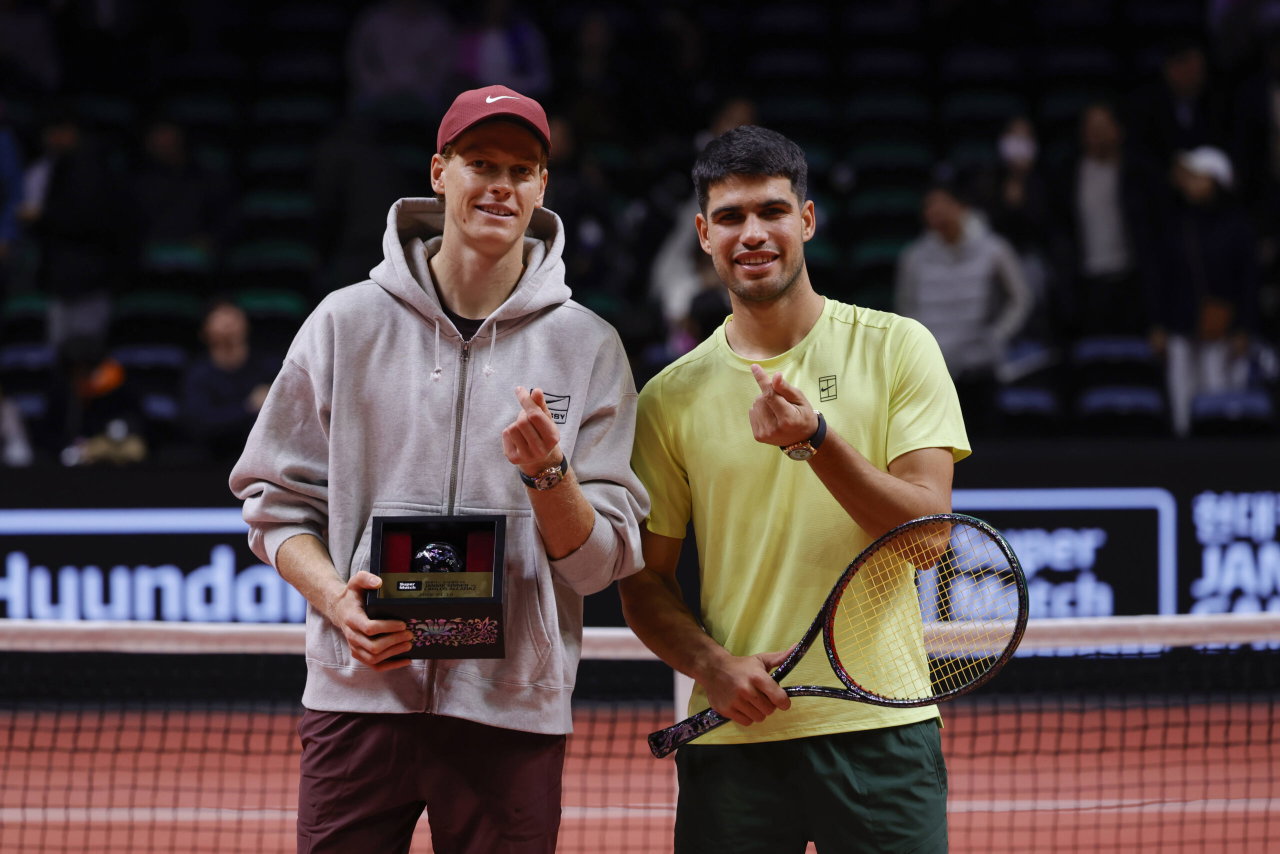
Imago
Sinner vs. Alcaraz: Super Match 14 Highlights in South Korea Jannik Sinner L of Italy and Carlos Alcaraz R of Spain pose for a photo with the trophy after the Hyundai Card Super Match 14 at Inspire Arena in Incheon, South Korea, on January 10, 2026. Incheon South Korea PUBLICATIONxNOTxINxJPN Copyright: xMatrixxImages/JungxUi-Chelx
Standing on stage to receive the World Sportsman of the Year award, his right hand was already bandaged. Who could’ve missed that detail?
Even Feliciano Lopez didn’t hold back when assessing the situation. “I’ve had that injury myself,” revealed the Madrid Open director during an interview with Radioestadio Noche. “From what I’ve heard, it’s a very common injury in the world of tennis. I think his wrist tendon is a bit inflamed, I imagine, and I hope it’s not ruptured.”
Now ask the real question: can you dominate clay while managing uncertainty in your wrist? The answer is no, not at this level.
Meanwhile, Jannik Sinner is doing the opposite of waiting; he is accelerating.
He has confirmed his return to Madrid, shutting down any doubts about his schedule. And the form he brings is ruthless. He has already captured three ATP Masters 1000 titles this season, extended a remarkable winning run that dates back to the Paris Masters in 2025, and underlined his dominance with a commanding 7–6, 6–3 victory over Alcaraz in the final of the Monte-Carlo Masters. That victory wasn’t just another win; it was his fourth straight Masters 1000 title, placing him in elite company.
Here’s the part most people are missing: Sinner has nothing to defend in Madrid due to last year’s absence. That means every point he earns is pure gain, widening the gap. This has moved beyond a rivalry; it’s now a contest between fitness and certainty, and certainty is firmly in control.
Why Madrid could stretch Sinner’s lead further
At this moment, the gap between Jannik Sinner and Carlos Alcaraz looks manageable on paper. Sinner sits at 13,350 points, while Alcaraz trails at 12,960, a difference that feels minor but carries serious implications. But does “minor” stay minor once Madrid begins? The answer is no, because this is where momentum turns into separation.
If Sinner goes on to win Madrid, the math becomes brutal.
Add another 1000 points, and suddenly the gap stretches to 1,390 points, a margin that shifts pressure entirely onto Alcaraz. The gap remains technically within reach, but realistically only if everything falls perfectly into place for Carlos Alcaraz from here.
Rome is not just another stop, as it is a battleground of obligation. Alcaraz is defending 1000 points there after beating Sinner last year, which means anything less than a deep run becomes a direct loss. For Sinner, the scenario is different.

Imago
Sinner v Alcaraz tennis super match in South Korea Jannik Sinner L of Italy and Carlos Alcaraz R of Spain attend a press conference, PK, Pressekonferenz for the Hyundai Card Super Match at the Hyundai Card headquarters in Seoul, South Korea on January 09, 2026. Seoul South Korea PUBLICATIONxNOTxINxJPN Copyright: xMatrixxImages/JungxUi-Chelx
He has 650 points to defend as last year’s finalist, and across the clay season, he is protecting 1,950 points in total, including Roland Garros. The pressure is clearly uneven, with Carlos Alcaraz defending what he has while Jannik Sinner continues to expand his ground. And then comes the uncertainty that changes everything.
Concerns around Alcaraz’s fitness are no longer speculation as they are shaping the race itself. That warning carries real weight as it points to the next unavoidable outcome: Carlos Alcaraz would lose 1000 points without even stepping onto the court if he misses Rome.
Even the Spaniard made the uncertainty clear himself, saying, “I can’t give a timeframe for my return. What I can guarantee is that I’ll do everything possible to come back as soon as I can.”
This is where the race could quietly be decided. Madrid might ignite the battle, but Rome will define whether Alcaraz can realistically chase Sinner.
Even with 2000 points on offer at Roland Garros, the reality remains harsh, as a widening gap before Paris turns any comeback into something far more theoretical than real.
Alcaraz’s 2025 clay comeback: the blueprint he must repeat
When Carlos Alcaraz struggled physically at the Barcelona Open last year, it didn’t just disrupt a tournament; it stalled momentum at the worst possible time. The final against Holger Rune told the story. The Spaniard needed treatment on his upper right leg as the match slipped away, and with it, a chance to dominate a stretch where expectations were sky-high.
That moment hurt more because of what surrounded it. This was a two-time Madrid champion, a player who had already lifted Monte Carlo, and looked ready to own the clay swing. He had hoped to recover in time for Madrid. But the timing betrayed him, and he later admitted the tournament came too soon for him to compete at full strength.

Imago
Sinner wins Monte Carlo Open 12/04/2026 – Jannik SInner ITA wins Monte Carlo Open 2026 beating Carlos Alcaraz ESP International Sports Fotos Ltd Monte Carlo Monaco Copyright: xx
But then, at the Italian Open, alongside Jannik Sinner returning on home soil, Alcaraz not only came back but made an immediate impact. He won the title in Rome, and if I’m being honest, that’s when I started believing again. Not as a fan, but as someone watching the sport, because it felt like something bigger was building.
That feeling reached its peak at the French Open, where it all culminated in a breathtaking 5-hour, 29-minute final. Saving three championship points, he produced a comeback so improbable it scarcely seemed believable, even as it was happening.
The stakes are higher now.
With Novak Djokovic and Alcaraz absent in Madrid, the door opens for Sinner to take control and possibly chase a fifth straight Masters title. That leads to the real uncertainty. Will Alcaraz return in Rome to defend his 1000 points, or will the gap widen before Paris even begins? If that gap stretches too far, Roland Garros will no longer be the battleground, and the chase will inevitably spill into the grass season.
Right now, there are no clear answers, only one certainty: this time, there’s absolutely no margin for error.