
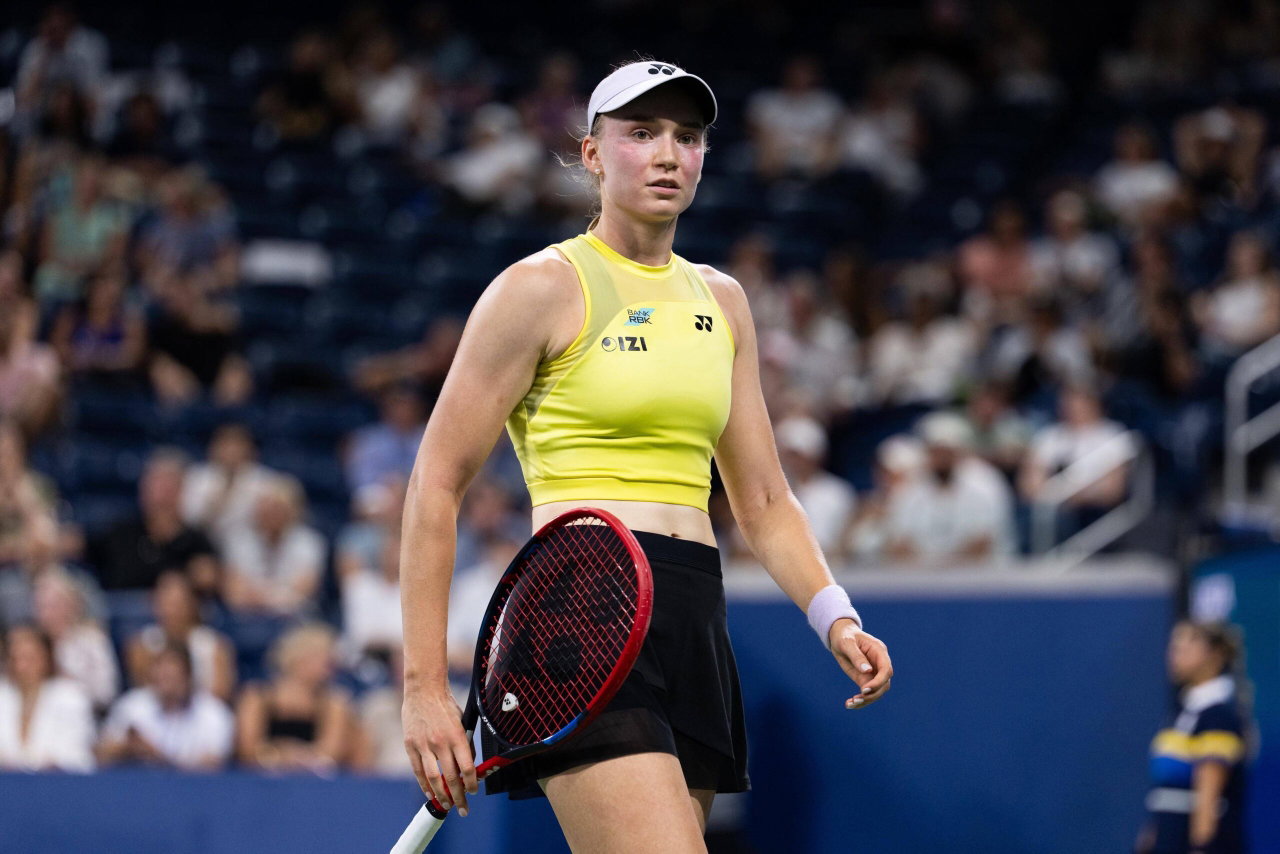
Elena Rybakina has had an amazing 2026 season. She has won two Grand Slam titles, reached World No. 1, and secured her place at the WTA Finals. However, she has decided to keep playing tournaments before the season-ending championship. This raises an important question: Is the Kazakh star taking an unnecessary risk before the WTA Finals?
Watch What’s Trending Now!
Elena Rybakina is currently playing at the Ningbo Open. She wants to defend the title she won in 2025 after defeating Ekaterina Alexandrova 3-6, 6-0, 6-2 in the finals. She has also confirmed that she will play at the Toray Pan Pacific Open in Tokyo from October 26 to November 1. The WTA Finals will take place from November 8 to 15 at the Indian Wells Tennis Garden in California.
This schedule leaves Rybakina with little time to rest between Tokyo and the WTA Finals. More importantly, she has made this decision after facing repeated problems with her lower leg and foot. These problems forced her to retire from a major tournament earlier in the season and withdraw from Wuhan in October.
There are reasons why she may want to keep playing. More matches could help her find her rhythm, defend her Ningbo title and prepare for the strong competition at the WTA Finals. However, she has already qualified for the championship. So, the possible cost of playing more matches deserves attention.
The question is not whether Elena Rybakina can win more matches. It is whether the benefits of playing more tournaments are worth the physical effort before one of the biggest events of her season.
Rybakina’s recent schedule raises concerns because her injury problems did not begin in October.
The first major warning came at the Cincinnati Open in August. Elena Rybakina faced Iga Swiatek in the quarter-finals but struggled with a left ankle injury. She retired while trailing 4-1 in the first set.
The timing was difficult for Rybakina. The US Open was approaching, so she had limited time to recover and prepare for the final Grand Slam of the season.
After the Cincinnati injury, Rybakina admitted that she was struggling. According to an Associated Press report published by The Washington Post, she said, “Of course I feel not the greatest.”
Explaining the problem, she also said, “It’s painful to walk.”
Despite this setback, Rybakina made a strong comeback. She won the US Open by defeating Aryna Sabalenka 6-4, 5-7, 6-2 in the final on September 12. The victory gave her a third Grand Slam singles title and helped her reach World No. 1.
However, winning the US Open did not mean that her injury problems had disappeared for good.
Rybakina suffered a surprise three-set loss to Alina Charaeva, ranked 118, in the second round of the China Open. The next day, the Wuhan Open announced that Rybakina had withdrawn because of an injury.
Elena Rybakina also said that she needed time away from tennis.
“I’ll take some time to rest and recover. Thank you for your understanding and continued support,” she said, reported by WTA.
That message makes her current decision worth discussing. Rybakina has returned to the Ningbo court and confirmed she will play in Tokyo. Her return is encouraging, but there is a risk of injury recurrence and fatigue as well before the all-important WTA finals.
This does not mean that she will suffer another injury. However, a player who recently needed time to recover has now added two tournaments to her schedule before the WTA Finals.
Why play when qualification is already secured?
One major reason to question Rybakina’s schedule is that she has already achieved her main goal: qualifying for the WTA Finals.
The tournament brings together the eight best singles players of the season. It is one of the biggest events on the women’s tennis calendar. The WTA confirmed that Elena Rybakina became the first singles player to qualify for the 2026 edition after winning the US Open.
This achievement gives her more freedom to manage her remaining schedule. She no longer needs to keep winning matches just to secure a place at the Finals.
However, she still has reasons to compete. Rybakina lost early in Beijing and missed the Wuhan Open. Playing in Ningbo and Tokyo could help her regain the consistency she lacked in China.
Practice sessions can help players improve their skills and fitness. However, tournament matches offer a different challenge. Players must deal with pressure, adjust to their opponents and stay focused over several days.
Her World No. 1 ranking is another factor. Strong results could help her strengthen her position, while skipping tournaments would mean losing chances to earn more ranking points.
However, ranking points are not the only thing that matters. Protecting her fitness for the WTA Finals could be more valuable than winning a few more matches before the event.
Rybakina’s decision is a question of priorities rather than necessity.
Although Rybakina has a strong reason to play in Ningbo as she is the defending champion.
In 2025, she won the Ningbo title during a successful end to her season. She also won the WTA Finals in Riyadh that year.
Returning to a tournament she has already won could give her confidence. She also knows what it takes to succeed at the event. Another strong run could help her find the form that made her so successful during her Grand Slam-winning season.
Her first match in Ningbo offered an encouraging start, but it did not fully test her fitness.
Rybakina faced World No. 105 Polina Kudermetova in the second round on October 22. Rybakina quickly took a 5-0 lead in the first set after breaking Kudermetova’s serve three times.
However, Kudermetova retired because of a physical problem. This sent Rybakina into the quarter-finals without completing the match.
Rybakina showed concern for her opponent after the match.
“Definitely not the way I wanted to finish the match,” Elena said, reported by WTA.
She added, “I think Polina, before, she played some tough matches and conditions here are not easy. The balls are quite heavy. I just wish her a speedy recovery and hope it’s nothing too serious.”
Her comments showed that she understood the physical demands of playing during a busy part of the season. However, her comments do not show that she was facing a fitness problem herself.
Rybakina was scheduled to face Katarzyna Kawa in the quarter-finals on October 23. Kawa was ranked No. 128 at the time. Winning the Ningbo title again would give Rybakina another trophy. It could also help her build confidence before the WTA Finals.
However, Kudermetova’s early retirement means that Rybakina’s first match cannot tell us how ready she is for several full matches in a row.
The biggest concern is the timing of Rybakina’s planned appearance in Tokyo. This leaves Rybakina with only a short break between the two tournaments. If she reaches the later rounds in both events, she could face several matches, travel and limited recovery time.
Because Elena Rybakina has recently dealt with ankle and foot problems, playing more matches could create an additional risk. She cannot ignore that possibility.
This creates a difficult choice for Rybakina. She needs to decide how much match practice she requires without tiring herself before the WTA Finals.
Unlike players fighting for the final qualifying places, she does not need to accept every chance to earn more ranking points.
Rybakina’s results in 2026 help explain why she may want more match practice before the WTA Finals, even though she has already qualified.
Her recent form shows she won three singles titles this season: the Australian Open, Stuttgart Open and US Open. She also reached the finals at Indian Wells and the Canadian Open in Toronto.
Elena defeated Aryna Sabalenka 6-4, 4-6, 6-4 in the Australian Open final and beat her again 6-4, 5-7, 6-2 in the US Open final. She also won the Stuttgart Open by defeating Karolina Muchova 7-5, 6-1.
However, she lost two other big finals. Sabalenka beat her 6-3, 3-6, 7-6 at Indian Wells, while Iga Swiatek defeated her 6-2, 6-3 in the Toronto final. These results show that Rybakina has been able to win major titles against top players, but her season has also included tough losses.
These results show that Rybakina can compete at the highest level. Her season has not been defined by poor form. She has won some of the biggest titles in tennis despite facing physical problems.
However, her loss to Charaeva at the China Open showed that she can also suffer unexpected defeats.
Her performance against Kawa in Ningbo and her movement in later matches could offer more information about her readiness. Even then, match results and observations cannot replace a medical assessment.
Now the big question is, when should a player stop competing?
The WTA calendar gives players many chances to earn ranking points, win titles and build confidence. Skipping a tournament can mean giving up prize money and opportunities to improve their results.
However, playing too often can leave players with less time to rest. This becomes especially important when they have recently dealt with an injury.
Her decision to play in Tokyo may still turn out to be the right one. If she feels physically ready and manages her workload carefully, the tournament could help her prepare for the WTA Finals.
However, if she has not fully recovered, resting instead could be the better choice.
The WTA Finals will begin on November 8. Rybakina will be defending the title she won in 2025. In the 2025 WTA Finals in Riyadh, Elena Rybakina defeated Aryna Sabalenka 6–3, 7–6 (7–0) in the final to win the women’s singles title.
Her main goal should be to arrive ready to compete against the other qualifiers, not simply to play as many matches as possible beforehand.
The real question is whether Rybakina can gain enough from extra match practice to justify the limited recovery time before the WTA Finals. With qualification already secured and a major title to defend, protecting her fitness may be just as important as maintaining her match rhythm.