
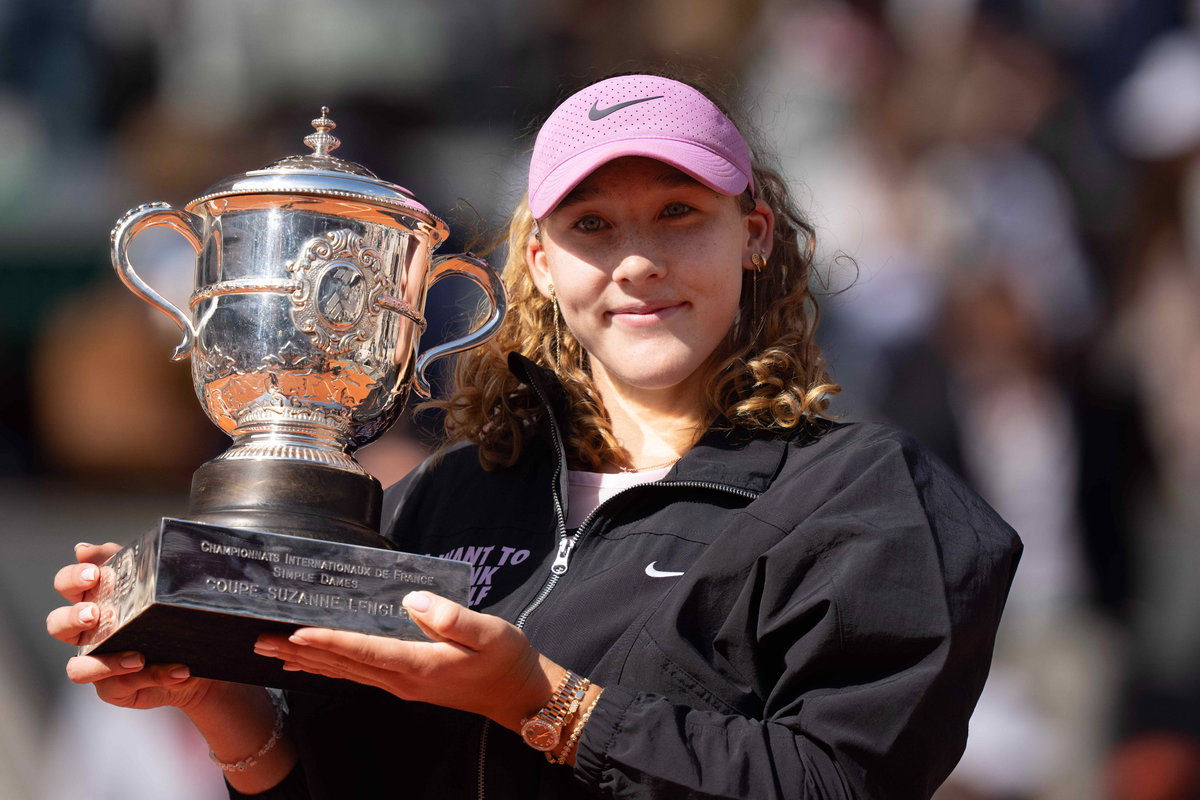
Mirra Andreeva had been circling this moment for two years. The semifinals at Roland Garros at 17, the quarterfinals at 18, and now, on a warm Saturday afternoon on Court Philippe-Chatrier, the final. Maja Chwalinska, a qualifier who had shocked the draw to get there, stood across the net. It did not matter. Andreeva wrapped up the match in one hour and 22 minutes, in straight sets. The next issue that was tackled was whether she became the youngest-ever winner of the tournament. The answer is no, but a true picture of Andreeva’s performance on the clay at the French Open this fortnight is far more interesting than just an age comparison.
Watch What’s Trending Now!
Is Mirra Andreeva the Youngest French Open Winner Ever?
Monica Seles holds the all-time record, and it has been 36 years. Seles was 16 years and 6 months old when she defeated Steffi Graf 7-6, 6-4 in the 1990 final to become not only the youngest French Open champion in history but, at the time, the youngest major champion of the Open Era. It has never been achieved at Roland Garros in the women’s draw, and Andreeva, who is 19 years and 38 days old on the final day, is no different.
What Andreeva does is she becomes the youngest French Open women’s champion since Iga Swiatek took the title at 19 in October 2020, too. Crucially, though, Andreeva is actually younger than Swiatek was when the Pole lifted the trophy. Swiatek was 19 years and 132 days old on that occasion. Andreeva, born on 29 April 2007, was 19 years and 38 days old on Saturday. That means Andreeva is the youngest Roland Garros champion in 28 years, and the youngest teenager to win the title since Iva Majoli in 1997.
Andreeva is among the most successful teens in the sport’s history. Martina Hingis first claimed a Grand Slam title at the age of 16 at the 1997 Australian Open. Maria Sharapova won Wimbledon when she was 17. Andreeva is part of that group, and the way she has done it is just as compelling as the rest.
How Did Mirra Andreeva Make French Open History in 2026?
Chwalinska, a qualifier who had been the hit of the tournament on the run to a first-ever Grand Slam final, was no match for Andreeva’s game. The 6-3, 6-2 result in an hour and 22 minutes was a performance that reflected the full two weeks rather than just the afternoon. Andreeva played six matches on her path to victory, conceding just one set in all of her matches in Paris. Nor was she tested like most champions, and this is a telling sign of how high above the field she was operating at this tournament.
Andreeva’s win as the first teenager to clinch Roland Garros since Swiatek in 2020 is worth putting in some perspective as to how rare that has become. For the first six years, from Swiatek’s title to Andreeva’s win, the women’s draw was dominated by those who had matured their games over 10 years or more of professional experience. Aryna Sabalenka, Swiatek herself, Elena Rybakina, and Gauff took the major titles during that stretch, and while Gauff was still relatively young when she broke through, teenage Grand Slam winners have become genuinely exceptional in the modern game. It’s not only that Andreeva has won Roland Garros; it’s that she’s accomplished what very few players do at this level anymore.
The overall tournament context enhances the achievement. Swiatek, Sabalenka, Rybakina, and Gauff, the four players who have won the bulk of Grand Slams in the last few years, were all in the WTA draw at Roland Garros in 2026. Andreeva navigated that field without losing a set until it was virtually irrelevant, and she did so as the eighth seed, an unseeded player’s equivalent of what Swiatek did in 2020 as a 54th-ranked outsider.
Where Does Mirra Andreeva’s French Open Triumph Rank Among the Greatest Teenage Achievements in Tennis?
There are not many teenage Grand Slammers in the women’s game, and each is an important name to be added to the list. Monica Seles won eight Grand Slams before she turned 20, one of the most incredible performances to ever take place in the sport. Martina Hingis has won three majors before the age of 20, two Australian Opens and a US Open, plus her 1997 final appearance at the French Open. When Sharapova won Wimbledon 17 in the most challenging major ever, she was announced as the next face of the women’s game.
Andreeva’s victory is significant and, in some ways, better than those accomplishments. The glamor days of Seles and Hingis are not the same days as the present-day WTA Tour operates. The physical conditioning, tactical sophistication, and sheer range of quality in the top 20 today make a teenage Grand Slam title harder to win than it was in any previous era. More players can beat you on any given day, more players are more experienced, physically intimidating, and have more years of experience at the highest level, and fewer weak draws to deal with.
In addition to being the player who is being compared with, Andreeva has made her way to this position more slowly and steadily than many of those she’s being compared to.
She reached the French Open semifinals in 2024 and the quarterfinals in 2025. She claimed the 2025 Indian Wells Masters title over Sabalenka in the final at the age of 17. By the time she walked onto Court Philippe-Chatrier on Saturday, Andreeva had won 35 matches in 2026 alone. This was not a shock. It was an arrival that had been signaled for two years.
She is still 19. Monica Seles won eight Grand Slams before her 20th birthday. Hingis won five. Andreeva has one, and she has just turned 19. The record books, and Roland Garros in particular, may come to know her name rather well in the years ahead.