
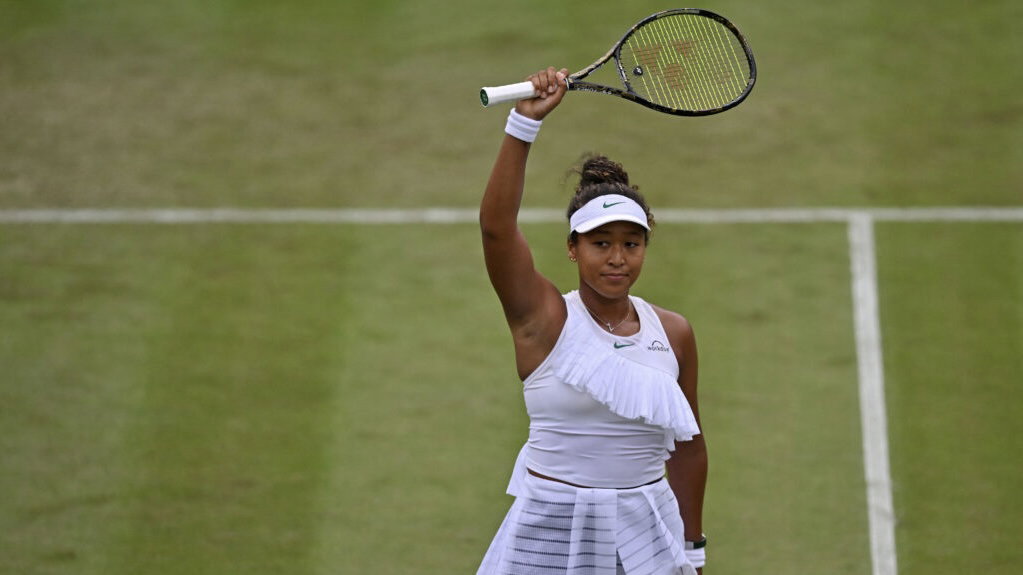
Naomi Osaka’s best-ever run at Wimbledon ended in straight sets against the Czech star Karolina Muchova. Though the four-time Grand Slam champion battled hard, a recurring foot injury flared up badly enough to require a medical timeout during the match. Yet, after bowing out, the Japanese ace offered an update on the troubling issue.
Watch What’s Trending Now!
“It’s not my ankle. I’m just getting old,” Osaka said in her post-match press conference. “I have plantar fasciitis in my feet. That’s what we assume it is. It’s never my ankles. I actually have really flexible ankles,” she added.
The medical timeout came when the Japanese ace was preparing to serve at 2-3 down in the first set. At that point, the tournament physio was called out to treat her, and Osaka had her left foot re-taped on court.
And it was not the only time this issue had interrupted an important grass-court run for the 28-year-old. Osaka had also dealt with a similar problem during her run in Bad Homburg.

Naomi Osaka was asked if her ankle was okay during her match with Muchova at Wimbledon “It’s not my ankle. I’m just getting old 😂. I have plantar fasciitis in my feet. That’s what we assume it is. It’s never my ankles. I actually have really flexible ankles. Thanks for asking”
That WTA 500 tournament had marked an important step for her, as she reached the first grass-court final of her career in Germany. But the title match did not go the way the former world No. 1 wanted.
She was forced to retire against the same opponent, Karolina Muchova, in the wake of a foot injury. The Japanese ace had taken a medical timeout during the opening set before eventually signaling that she could not continue.
After that timeout, she walked to the net and shook hands with Muchova and the umpire, bringing the match to an early end.
The plantar fasciitis initially emerged during last year’s off-season and resurfaced during the tournament in Germany. “I think it reactivated on a grass court because I’m pushing off a lot more to go forward. I don’t think it will bother me on hard court,” she added today.
And while Osaka’s SW19 campaign is now over, she did not frame the defeat entirely around the injury. Instead, the former world No. 1 pointed to herself for the loss.
Lack of energy ultimately cost Naomi Osaka her match against Karolina Muchova
It was a bitter ending for the Japanese, especially because of the level she had shown just two days earlier. Osaka had stunned world No. 1 and arrived for her latest match without dropping a single set at this year’s Championships.
Still, there was something important to take from the campaign, as this year marked Osaka’s best performance at SW19 so far.
The 28-year-old also reached another notable milestone during the tournament. At SW19, Osaka recorded her 15th career win over a top-10 player, and notably, it was her first such victory on a surface other than her favorite hard court.
But the immediate emotion after the difficult loss was disappointment. “It’s hard for me to immediately think of something positive. I feel like it’s hard ’cause I played so well in my last match, then today I just feel like I didn’t play well at all and I didn’t have any energy. The score was pretty good for what it was,” Osaka said in her post-match press conference.
Reflecting on that schedule, the former top seed admitted she may rethink how she approaches the grass swing going forward. “I just wanted to try that to see the rhythm. Obviously, it worked out well. But I think I probably won’t do that again. I would say it was like an accumulation of playing two weeks straight without a day off,” Osaka explained.
Now she turns her attention toward the American hard court swing and the US Open, carrying plenty of positives despite the loss. And if her on-court form holds, fans will be hoping the four-time Grand Slam champion can rediscover that level again as she eyes a deeper run and possible redemption at Arthur Ashe Stadium.