
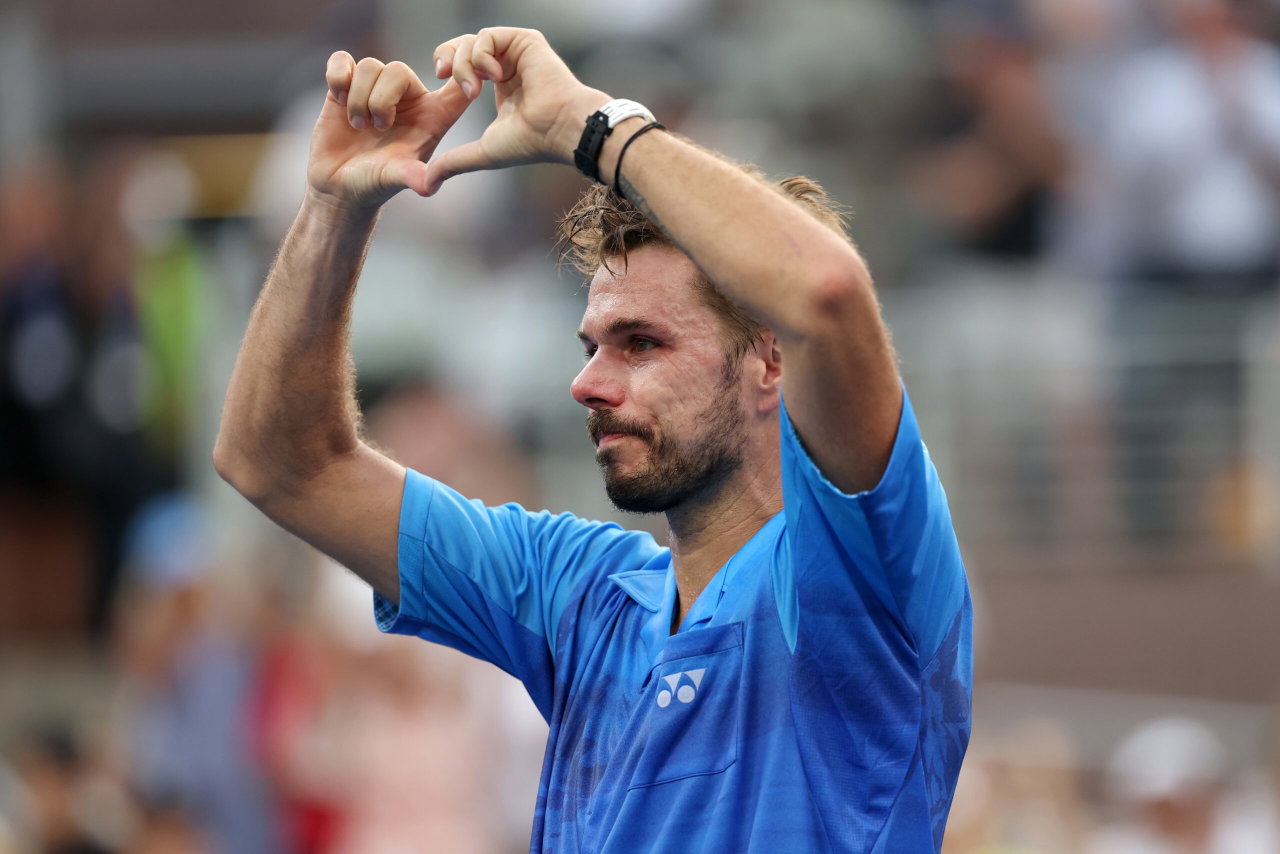
And just like that, Stan Wawrinka’s Grand Slam career is over. After more than 20 years, the Swiss legend walked off a major court for the final time in New York, knowing there would be no next Slam and no final comeback, only goodbye.
Watch What’s Trending Now!
“For me, it’s been more than 20 years since the first time I came here to New York… I’d like to thank the tournament for the wildcard. For me, this opportunity to finish here was really meaningful from my side,” said the 2016 US Open winner.
“It was important for me to have the opportunity to finish the 4th Grand Slam, here in New York, ten years after winning… I really want to thank you all for all those years of support,” said Wawrinka, thanking the fans for backing him through the years.
Stan Wawrinka’s final Grand Slam match ended in defeat, but the score quickly became secondary. The 41-year-old fell to Matteo Berrettini 7-6(4), 7-6(3), 6-0 at Grandstand before the emotion took over as he faced the New York crowd for the final time.
Even getting to New York one last time had been uncertain. Wawrinka was initially overlooked for a wildcard and had already returned home to Switzerland before Patrick Kypson’s withdrawal opened a last-minute spot. He quickly made the trip back across the Atlantic for one final Grand Slam appearance.
“I am super grateful for the wild card because it was important for me to have the opportunity to finish playing all four Grand Slams here in New York,” Wawrinka said. “I’m gonna miss it for sure. I’m gonna miss it big time.”
And there was a reason leaving New York hit him this hard.
- First, the US Open was part of his life for more than 20 years. Wawrinka made his main-draw debut in New York in 2005 and kept returning until 2026, finishing with a 46-17 record across 63 singles matches.
- Second, New York gave him one of the defining moments of his career. Wawrinka beat Novak Djokovic in the 2016 final to win his third major, adding the US Open to his 2014 Australian Open and 2015 Roland-Garros titles.
- Third, that title did not come out of nowhere. Wawrinka had already reached the US Open semifinals in 2013 and 2015, making New York one of the places where his best tennis repeatedly surfaced.
- Fourth, he felt a real connection with the New York crowd. Wawrinka said he was struck by the tournament’s energy from his first visit, and that support only grew over time. He later admitted that the love from the fans helped him produce some of his best tennis there.
But Wawrinka’s story was always bigger than New York. His final US Open goodbye closed one chapter, but the career he leaves behind was built across an era dominated by some of the greatest players tennis has ever seen.
The Legacy of Stan Wawrinka after his final goodbye
Three Grand Slam titles will headline Wawrinka’s résumé, but they do not fully explain his place in tennis history. He never reached World No. 1, yet at his peak he became one of the few players capable of taking down the sport’s biggest names on its biggest stages.
Wawrinka reached four Grand Slam finals and won three. In each victory, the reigning World No. 1 stood across the net: Rafael Nadal at the 2014 Australian Open, then Novak Djokovic at the 2015 Roland-Garros and 2016 US Open.
And he did it during an era ruled by Roger Federer, Nadal, Djokovic and Andy Murray. Wawrinka became one of only three players to beat all four at Grand Slams and recorded five major victories over World No. 1 opponents.
His peak came between 2014 and 2016. He won the Australian Open, Roland-Garros and US Open in three consecutive seasons, climbed to a career-high No. 3 and built a reputation for becoming almost impossible to stop once he caught fire.
His only Masters 1000 title came at Monte-Carlo in 2014, where he beat Federer in the final. It was another reminder that Wawrinka did not need an easy path to win the biggest trophies.
The résumé stretched well beyond the majors. He won 16 ATP singles titles, collected nearly 600 tour-level victories and played 50 consecutive Grand Slam main draws before injuries finally broke that run.
There was success for Switzerland too. Wawrinka won Olympic doubles gold alongside Federer in 2008 and later helped Switzerland capture its first Davis Cup title in 2014.
Fans will remember the one-handed backhand, the finger pointed to his temple and the long matches where Wawrinka kept swinging against opponents who were supposed to be unbeatable.
He never matched Federer, Nadal or Djokovic for week-to-week dominance, but on the biggest stages, he proved he could beat the men who ruled his era. That is what will keep his name tied to theirs long after the trophies stop being counted.