
Imago
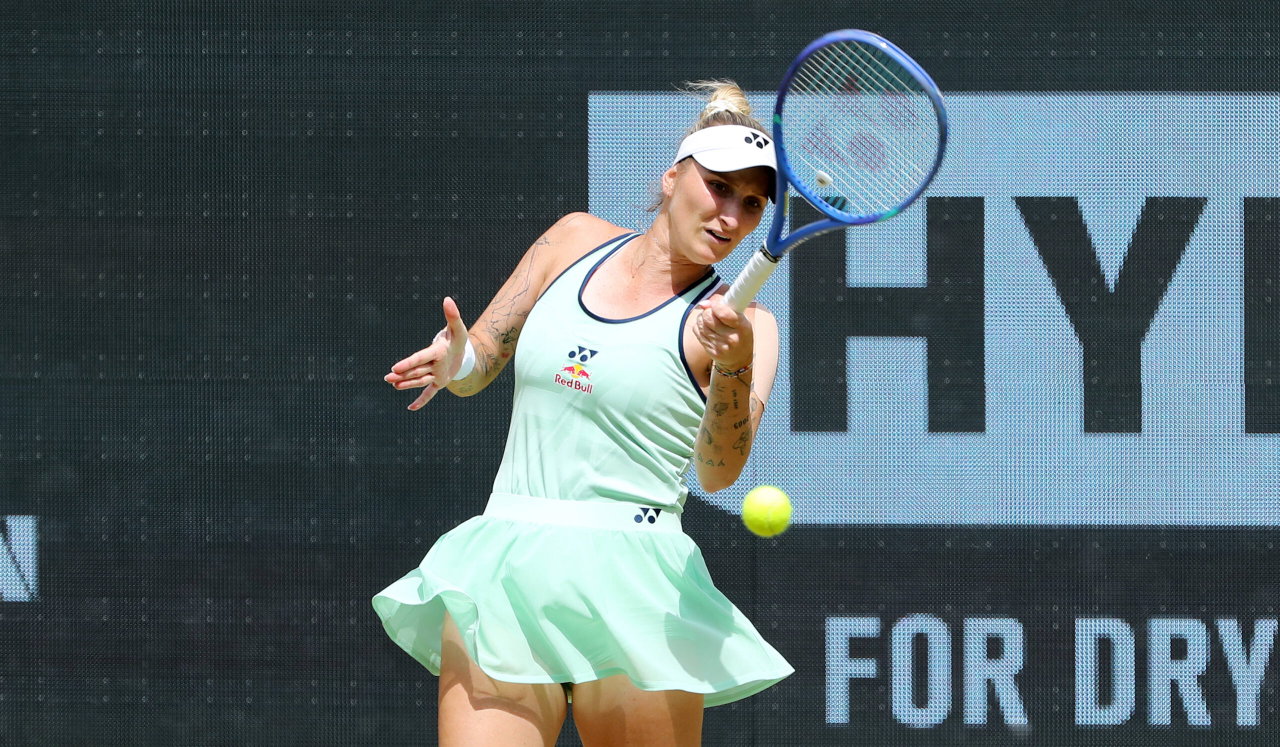
Sport Bilder des Tages Marketa Vondrousova CZE im Steffi Graf Stadion / / HYLO Berlin Tennis Open Damen auf Rasen / 19.06.2025 / *** Marketa Vondrousova CZE at the Steffi Graf Stadium Sport HYLO Berlin Tennis Open Women on grass 19 06 2025
Imago
Sport Bilder des Tages Marketa Vondrousova CZE im Steffi Graf Stadion / / HYLO Berlin Tennis Open Damen auf Rasen / 19.06.2025 / *** Marketa Vondrousova CZE at the Steffi Graf Stadium Sport HYLO Berlin Tennis Open Women on grass 19 06 2025
Marketa Vondrousova’s decision not to open the door to a doping control officer at her Prague apartment has closed the door on her professional tennis career for the next four years. While much of what unfolded that night has been under wraps, the International Tennis Integrity Agency has finally released a 58-page report revealing the full sequence of events. Let’s find out the timeline, the reasoning behind ITIA’s rejection of her defense, and what comes next for Vondrousova.
Watch What’s Trending Now!
The night it all unfolded
The entire sequence of events began shortly after 8 p.m on December 3, 2025, when a doping control officer arrived at Vondrousova’s apartment in Prague. She wanted to carry out the out-of-competition drug test. Five minutes later, both parties had their first interaction through the apartment intercom. Right after this, things started taking a wrong turn.
According to the tribunal’s report, Vondrousova declined to open the door, telling the officer she needed to speak with her agent first. She reasoned that she had never previously been tested at home outside her designated one-hour whereabouts slot. Then, at exactly 8:05, she sent a message to her boyfriend.
“At 8:05 pm, the player sent a text message on WhatsApp to her boyfriend, Andrew Paulson, who is also a Czech professional tennis player,” read the ITIA statement. “The message, translated into English, read: ‘So, like, here is ringing some c** from the doping.’
In the meantime, her agent tried to contact the WTA to ask whether the doping officer was really permitted to carry out the test at that time of the day. From here, the accounts of both parties start to differ.
The doping control officer said that there was another conversation over the intercom about five minutes later. There, she claimed that Vondrousova had yet again refused to take the test and asked the officer to leave the premises. Meanwhile, Vondrousova has claimed that they had just one intercom exchange. While they might disagree on that, they do agree on what exactly happened next. Here, there is another witness too: Vondrousova’s dog.
About ten minutes later, Vondrousova came downstairs to walk her Italian Greyhound. It was there that she had a face-to-face talk with the officer, and there yet again she declined to go through the testing, and even signed an acknowledgement form for the same. The tribunal ultimately concluded there was no dispute that Vondrousova had refused the test.
“This is a very unfortunate manner in which the player made a decision in the heat of the moment to refuse doping control, in a state of stress and anxiety, with significant consequences.”
Why the tribunal rejected Vondrousova’s defence
Throughout the entire proceedings, Vondrousova argued that her refusal to go ahead with the test was simply because she feared for her personal safety. She said the officer came late at night, rang her doorbell around five to eight times, and even failed to identify herself properly. Vondrousova, in fact, even cited the 2016 knife attack on Petra Knitova. She had been seriously injured after she allowed an intruder into her home. That was Vondrousova’s reasoning behind her unwillingness to open the door. But the tribunal was not convinced for multiple reasons.
In the written document, it was cited by the tribunal that the area of Prague where Vondrousova lives was considered relatively crime-free. As far as the comparison with Kvitova’s case goes, they claimed it was a little bit of an “exaggeration.”
However, the biggest point against Vondrousova was really what happened 10 minutes after refusing entry to the officer. The tribunal said that her decision to leave the apartment to walk her dog was “entirely inconsistent with identifying a potential threat.”
Not just that, it also mentioned that neither her messages to her boyfriend nor the conversations with her agent mentioned the concerns for her personal safety.
Vondrousova also mentioned that at the time she was going through an acute stress reaction and anxiety disorder. While the tribunal accepted that, it also mentioned that the circumstances did not amount to the type of justice required to reduce the mandatory sanction.
Did Vondrousova misunderstand the anti-doping rules?
One of the biggest questions raised from this entire incident is whether players fully understand the anti-doping regulations. After the incident occurred, Vondrousova had in fact publicly argued that the officer had arrived outside her designated one-hour testing window. She took to Instagram to cite her grievances.
“Every day we are required to be home for one specific hour for doping control. I respect that rule – every single day. Tonight, however, a tester arrived at 8.15 pm and told me that my declared time doesn’t matter and that I must be tested right now. When I pointed out that it’s outside my testing window and a serious intrusion into my privacy, I was told: ‘This is the life of a professional athlete.’
“Is it normal for doping officers to sit in our living rooms at night waiting for us to pee? This is not about avoiding testing – it’s about respect. Respect for the rules that we follow, and for the personal life we’re entitled to after a long day of training and competition. Rules should apply to everyone. Even to those enforcing them.
The tribunal, in fact, came to reiterate that the one-hour whereabouts slot is not the only period during which the athletes can be tested. While players must nominate one hour each day when they for sure know they will be available, the anti-doping officers have the flexibility to conduct tests at any reasonable time outside the window as well. The report mentioned that Vondrousova and her agent were aware of the rules. But even this, the ITIA rejected.
The main point they cited was that Vondrousova is not an inexperienced player; she had already gone through 83 anti-doping tests. They claimed that any claims of misunderstanding the regulations are not “credible” for them.
“Unpredictable testing is an essential tool to protect clean sport,” ITIA chief executive Karen Moorhouse had mentioned back in June. “The tribunal ultimately supported that principle. This case is an important reminder that players can be tested at any time, in any place, and that refusal comes with significant risk.”
The question, though, right now for everyone from Vondrousova and the fans is, what’s next?
What’s next?
Well, for starters, Vondrousova is expected to appeal the decision to the Court of Arbitration for Sport (CAS) before the August 11 deadline. If the appeal is unsuccessful, the former Wimbledon champion will remain suspended until June 2030, and at that time she will be around 31 years of age.
The tribunal’s report gives a clear account of the events of what is one of tennis most significant anti-doping sanctions in recent years. It also made it clear that players may be tested at any given time.
Even though the situation is tough for the Czech player, she has received support from other WTA players during this time.
Players and experts in Marketa Vondrousova’s defense
WTA players have come out in defense of Vondrousova, claiming the four-year ban was an excessive measure for someone refusing the doping test. Several players have also taken up the matter of security.
Jessica Pegula was one of the strongest voices in this regard, as the American was critical of the time period of the ban. The American also brought up the cases of Jannik Sinner and Iga Swiatek, where the duo had to face bans for three and one month, respectively, even after failing the drug test, although due to accidental contamination.
“But I just think for something like that, for four years, you’re ruining someone’s career over something that could have really just been a complete misunderstanding,” said Pegula. “I just don’t think that’s fair. I think the sentencing is so harsh”.
Experts like Patrick McEnroe also weighed in, sharing the view that four years was far too harsh a punishment for Vondrousova under the circumstances. The Czech also received words of support from the likes of Coco Gauff, Sorana Cirstea, and her compatriot Karolina Muchova, among many others.
Written by

Edited by

Aatreyi Sarkar