
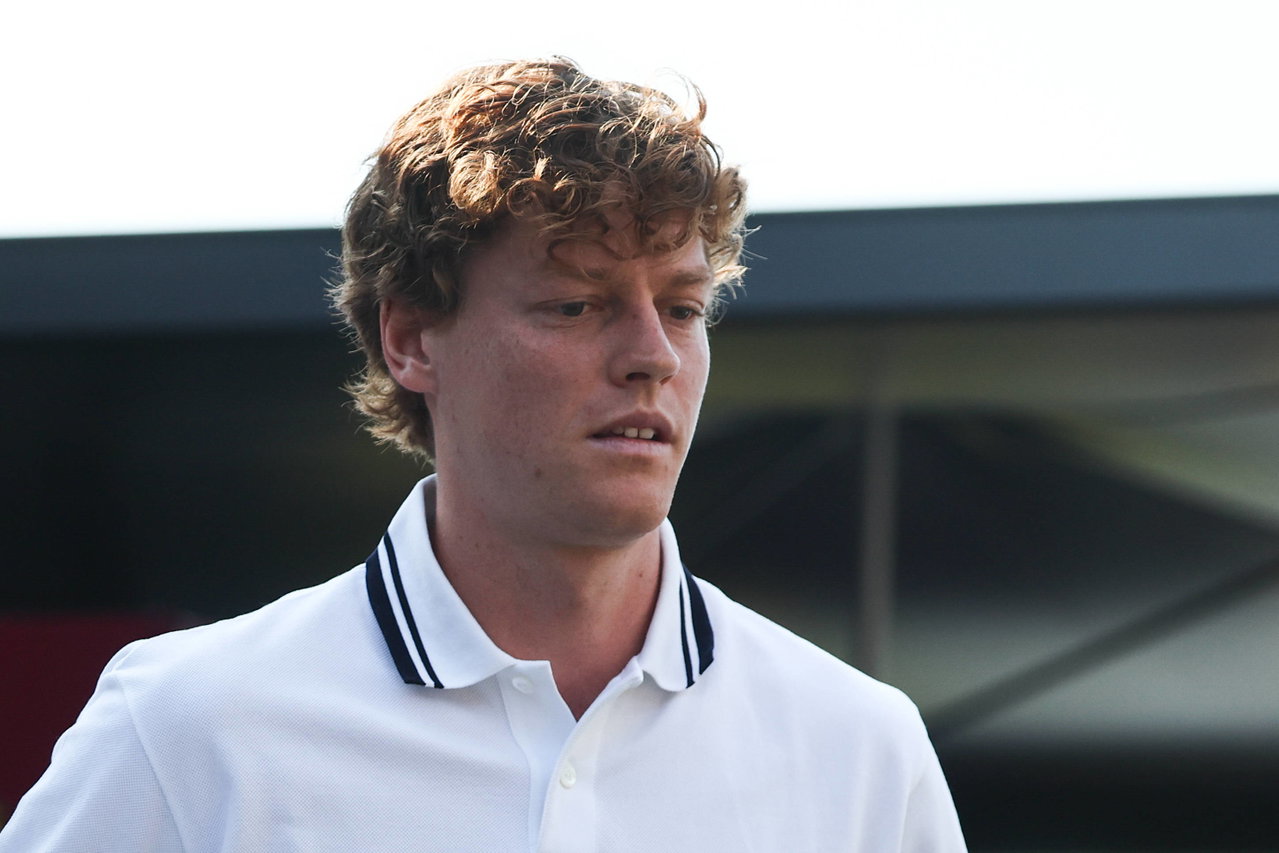
How much of Italy’s tennis boom can survive without Jannik Sinner? The question is becoming harder to ignore as the country’s biggest tennis attraction remains sidelined. Italy still has a deep pool of talent, major tournaments, and record membership figures, but the 2026 ATP Finals exposed a worrying gap between having successful players and having a superstar who can pull an entire nation towards the sport.
Watch What’s Trending Now!
Sinner’s absence is now testing whether Italian tennis can sustain the momentum he helped create. The warning came from Italian Tennis and Padel Federation president Angelo Binaghi. After attending the ATP Finals in Turin, he admitted that he had underestimated Sinner’s influence.
“When I saw Sinner on Sunday at the Inalpi Arena, I confessed that he really surprised me, because I had no idea how dependent we were on him.”
Binaghi also revealed that television audiences without Sinner were less than half the usual level. According to Il Fatto Quotidiano, the eight ATP Finals matches broadcast free-to-air on Mediaset attracted a combined 8.24 million viewers in 2026, compared with 18.72 million in 2025. That represented a 56% decline. The 2025 final between Sinner and Carlos Alcaraz alone attracted more than five million viewers on Rai 2.
The difference was not simply about the absence of an Italian in the draw. Italy still had Flavio Cobolli, Lorenzo Musetti, Matteo Berrettini, Matteo Arnaldi, and Luciano Darderi producing strong results. Yet none could generate Sinner’s nationwide appeal. Binaghi explained that Cobolli attracts fans through his fighting spirit, Musetti appeals to admirers of his style, and Berrettini remains an idol for many. Sinner, however, reaches even people who knew little about tennis three or four years ago.
Cobolli also experienced the pressure of filling that space. After qualifying for his first ATP Finals, he admitted that Sinner’s absence made his task harder.
“Jannik’s absence from the ATP Finals doesn’t help me, because having him here would have taken some of the pressure off.”
He explained that Sinner normally carries much of the attention and expectation from Italian supporters, leaving other players more room to handle their own defeats.
The situation also raises questions about the federation’s financial model. Under Binaghi’s 25-year leadership, FITP secured the ATP Finals in Italy through 2030, the Davis Cup Finals from 2025 to 2027, and the return of the Next Gen ATP Finals in 2026. It also helped turn the Rome Italian Open into a major international event.
However, journalist Claudio Plazzotta highlighted a potential vulnerability in FITP’s 2026 budget forecast. Of its projected €260.2 million production value, €195.9 million, or 75.2%, was expected to come from organizing international events. His concern is that the federation could face a significant financial challenge when those tournaments eventually move elsewhere.
There is also the question of whether the popularity generated by Sinner has translated into lasting participation. CONI’s 2024 figures listed 1,162,477 FITP members, ahead of the Italian Football Federation’s 1,123,054. But Plazzotta questioned how much of that total reflects regular players, since schoolchildren participating in the federation’s Racchette in Classe initiative must also register. The 2026 program involved approximately 110,000 students across 800 schools in Piedmont alone.
Sinner’s influence is not without international parallels. Novak Djokovic helped turn Serbia into a major tennis-following nation, Li Na inspired a generation of Chinese players after her Grand Slam victories, and Kei Nishikori became the face of Japanese men’s tennis after reaching the 2014 US Open final.
Argentina also saw Juan Martin del Potro become central to its Davis Cup ambitions despite repeated injuries. These examples show how one exceptional player can bring national attention to tennis. Italy now faces the challenge of turning Sinner’s popularity into a movement that can sustain itself without him.
There is, however, another side to the ATP Finals story. Despite Sinner’s absence, the 2026 tournament recorded 194,808 Centre Court ticket sales, 5.1% more than the previous year. Total attendance across matches, practice sessions, and the Fan Village reached 233,285. Binaghi therefore described the event as a successful stress test. The tournament could attract spectators, even if television audiences told a different story.
Jannik Sinner Breaks Silence on False Injury Reports as Comeback Plans Change
Sinner’s absence began after his Wimbledon triumph on July 12, 2026, when he defeated Alexander Zverev in the final. A persistent right-knee problem subsequently forced him to miss the Canadian Open, the Cincinnati Open, and the US Open before he announced on October 6 that his season was over.
He also missed the Shanghai Masters, Vienna Open, Paris Masters, ATP Finals and Davis Cup Finals. During rehabilitation, former coach Darren Cahill revealed that he was spending three to four hours daily in the gym.
At a November 10 event in Milan, Sinner addressed the speculation surrounding his condition.
“A lot of false information has come out. But I know the truth, and so do the people around me.”
He also admitted that the situation was difficult because he had never experienced such a lack of control over his professional life.
“It’s the first time I haven’t had control of the situation, and I don’t like that.”
At the time, Sinner hoped to return for the 2027 Australian Open and possibly play a couple of tournaments beforehand. However, he stressed that rushing his recovery could create more serious problems. After conservative treatment failed to produce the expected progress, he underwent minor surgery on his right iliotibial band on November 24. His comeback date remains uncertain.
For Italian tennis, the immediate challenge is clear. The country has talented players, major tournaments, and growing participation. But Sinner’s absence has shown how difficult it will be to maintain the same public attention without its biggest star.