Joao Fonseca Takes a Subtle Jab at Novak Djokovic Over His Rule Change Proposal: “He’s Getting Older”

Add us on Google
Joao Fonseca Takes a Subtle Jab at Novak Djokovic Over His Rule Change Proposal: “He’s Getting Older”
Add us on Google
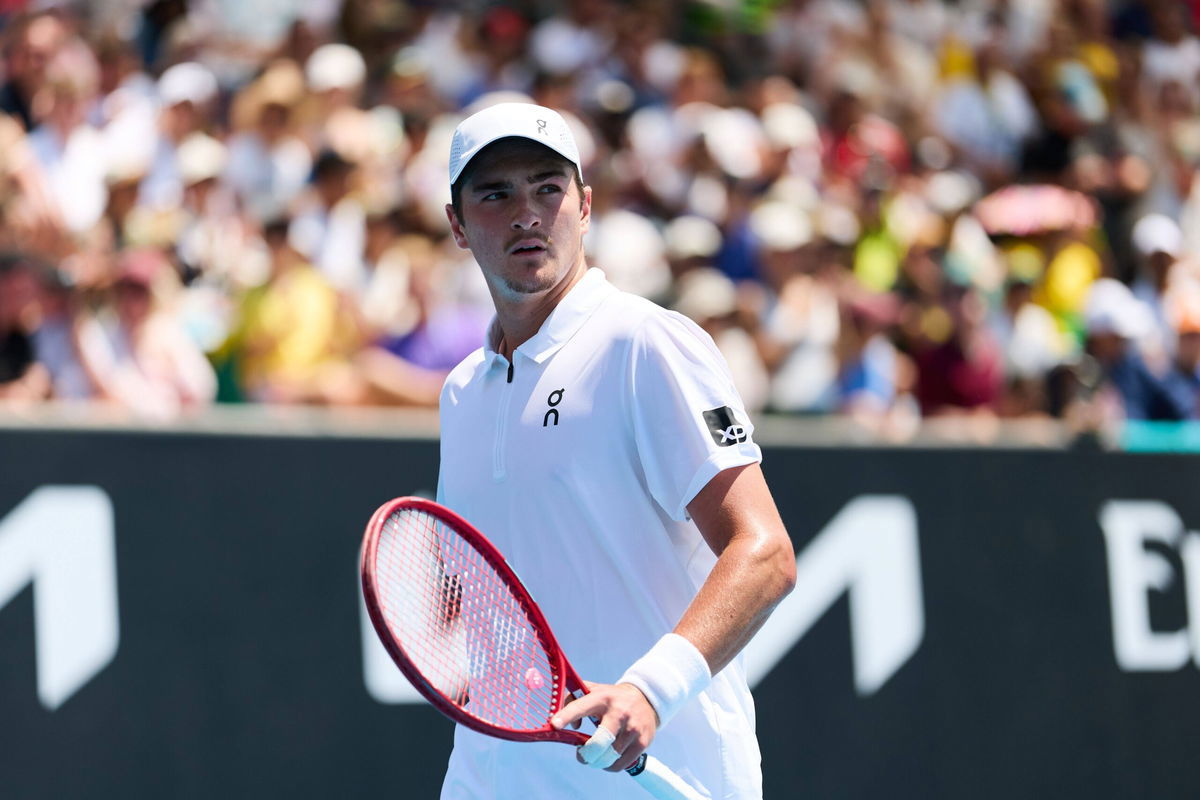
Imago
Joao Fonseca of Brazil Australian Open tennis tournament, Day Three, Melbourne Park, Australia – 20 Jan 2026Melbourne Melbourne Park Victoria VIC Australia PUBLICATIONxINxGERxSUIxAUTxHUNxGRExMLTxCYPxROUxBULxUAExKSAxCHNxDENxINDxITAxPORxESPxSWExTURxMEXxCOLxVENxPERxECUxBRAxARGxCHIxURUxPARxPANxONLY Copyright: xRachelxBach/Shutterstockx 16303004ag
Imago
Joao Fonseca of Brazil Australian Open tennis tournament, Day Three, Melbourne Park, Australia – 20 Jan 2026Melbourne Melbourne Park Victoria VIC Australia PUBLICATIONxINxGERxSUIxAUTxHUNxGRExMLTxCYPxROUxBULxUAExKSAxCHNxDENxINDxITAxPORxESPxSWExTURxMEXxCOLxVENxPERxECUxBRAxARGxCHIxURUxPARxPANxONLY Copyright: xRachelxBach/Shutterstockx 16303004ag
As alluring as tennis may seem, its grueling best-of-five battles can take a serious toll on players when a day at the office turns into a marathon. So, when Novak Djokovic proposed a few tweaks to the rulebook to make things easier for players, he found support from the likes of Ben Shelton, but not everyone was on board. Joao Fonseca, in particular, took a subtle dig to make his disagreement with the Serbian’s proposal known.
Watch What’s Trending Now!
“Well, I had a good time playing 4 games, 4-game sets in the Next Gen. So I can’t complain about it”, said Fonseca during his presser at the Canadian Open. “But I think he’s saying that because of his physique, you know. He’s getting older. Well, that’s what I can say.” Fonseca’s jibe may have been taken the wrong way by Nole fans, but the Brazilian is not far off the mark.
Playing five-set matches lasting four to five hours is physically taxing for Djokovic at 39. When he faced Fonseca at the French Open, the five-set struggle for the Serb became evident, as he had less energy compared to the younger Brazilian, which helped the latter in the fifth set. While critics of the shortened format might argue that Djokovic’s push for a new scoring system is partly driven by his declining physical powers, the Serb has actually been advocating for a shorter format for quite some time.
He called for a best-of-three-set format at the Slams back in 2020, at a time when he was still winning Majors, and was superior to most in a five-set contest.
But Djokovic’s push for a shorter scoring format seems to be about more than just the physical demands of playing long matches. He believes tennis needs to adjust to modern audiences by making matches shorter and more predictable. The idea would allow the sport to keep the drama of a best-of-five format while cutting down on the four- and five-hour matches that can be demanding for players and difficult for casual fans to follow from start to finish.
“I think tennis needs a new scoring system,” Djokovic said, as per AOL. The Serbian proposes experimenting with a scoring system similar to the Fast Four format used at the Next Gen ATP Finals. Instead of traditional sets, where a player needs six games to win, Fast Four uses. “Sets should not be played up to six games. I believe that a set should be played up to four games, with the possible abolition of the ‘advantage’ rule at 40:40.”
The 24x Grand Slam champion further added, “Matches would be played until someone wins three such shortened sets. That way, matches would not last longer than two hours, which, in my opinion, is best for everyone.”
Notably, men’s Grand Slam matches were 23% longer in 2023 than in 1999, according to ATP data analyzed by The Athletic, while WTA match durations have risen 5% since 2008. Despite the longer and more physically demanding matches, players aren’t competing in fewer tournaments.
The ATP top 100 averaged 25.12 events in 2024, almost unchanged from 25.10 in 1999.The injury trend is particularly worrying because physical problems typically increase as the season progresses.
Since 2009, the men’s US Open has seen 50% more retirements or walkovers than the Australian Open. In fact, the research published in the European Journal of Sport Science also points to a broader issue, finding that match retirements have been increasing across both ATP and WTA events, particularly in recent years.
For example, a normal Grand Slam set might finish 6-4, requiring 10 games. Under this system, a comparable set could finish 4-2, requiring only six games. And instead of a 3-3 score potentially becoming 7-5, it immediately goes to a tiebreak.
Tennis has changed its scoring rules before without abandoning its traditional structure. The tiebreak was introduced experimentally in 1970 and sanctioned by 1974, while the Next Gen ATP Finals, launched in 2017, has experimented with four-game sets, tiebreaks at 3-3 and no-ad scoring. Djokovic’s proposal would bring some of those shorter-format ideas to a much bigger stage.
One can argue that players like Fonseca could benefit from the Fast Four format as well, as the Brazilian won the Next Gen ATP Finals in 2024, while Jannik Sinner and Carlos Alcaraz are also former champions of the event. With the Tour schedule being so demanding and the style of tennis so baseline-dominated, adopting this new format at Slams could have its benefits, but it would also take away from the classic five-set contests, which have played an important role in building hype around players and the sport in general.
While Fonseca wasn’t entirely sold on Djokovic’s proposals, several other players, including Ben Shelton, have been more receptive to the idea, suggesting that a revamped scoring system could have a place in modern tennis.
Ben Shelton and Others Back Novak Djokovic’s Scoring Proposal
Compared to Fonseca, Ben Shelton was more open to the new scoring system suggested by Djokovic. The American was up and about to try the new method, but was surprised by the fact that it was the Serb who suggested it, someone who was known for his physical prowess in long matches at his peak.
“I think it could be a good idea. It was interesting that Novak said that, because he’s always been the fittest player on the tour, able to last five or six hours on court”, said Shelton at the Canadian Open. “It would be an interesting change, that’s for sure.”
Shelton’s surprise is not unfounded, as Djokovic is known for his ability to win classic five-set matches at Slams. The Serb won the longest Major final in history when he took down Rafael Nadal at the 2012 Australian Open, where the match went on for nearly six hours. Even at Wimbledon, he produced a performance for the ages, winning over Felix Auger-Aliassime in an epic.
Victoria Azarenka has previously called for shorter matches and scoring changes, arguing that the sport’s increased physicality and unpredictable scheduling make reform worth considering. Martin Landaluce also praised the first-to-four-games format used at the Next Gen ATP Finals, saying it makes matches more dynamic and forces players to start with greater energy.
Even Roger Federer spoke positively about Fast Four scoring after trying it in 2015, saying he liked the best-of-five format played to four games because every point carried more importance and matches stayed close. Federer also noted that having a more controlled match length could be beneficial in difficult conditions such as extreme heat or humidity.
However, one cannot deny the entertainment value of five-set contests between two top players, which helps create anticipation for the fans. When Alcaraz and Sinner played one of the greatest Major finals at the French Open last year, the rivalry between the two shot to prominence, and ticket sales and the hype for their clashes were off the charts when they faced each other at Wimbledon and the US Open finals.
Written by

Edited by

Rati Agrawal