
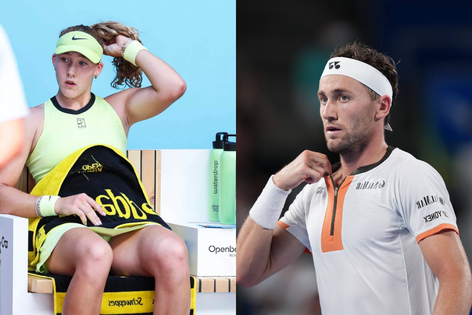
The Mutua Madrid Open is now heading into its final stages, and the last 11 days have delivered some of the standout performances of the clay-court season. There have been plenty of upsets too, including the early exits of Aryna Sabalenka and Coco Gauff.
Watch What’s Trending Now!
But as always, Madrid hasn’t just been about the tennis. It’s also brought its fair share of drama. And on Day 11, there was plenty more where that came from: a controversial line-call incident that has reignited one of tennis’ biggest debates, and yet another net malfunction that turned into an almost comical subplot during Casper Ruud’s campaign.
Mirra Andreeva, Madrid Open and the ELC problem that won’t go away
Mirra Andreeva booked her place in the final of the Mutua Madrid Open with a straight-sets win over Hailey Baptiste on Manolo Santana Stadium. But before she could finish the job, her momentum was briefly interrupted by a controversial moment that brought the match to a halt.
In the middle of the match, play was halted by yet another Electronic Line Calling (ELC) glitch. The system made a call that left Andreeva making gestures of incredulity to the umpire, who – as the umpires here have been compelled to explain, again and again over the last two weeks – could do nothing.
The incident occurred in the first set at 2-2, with Baptiste serving in the fifth game. The ball was clearly out, but the system still showed it was in, and the chair umpire could not overrule the system. However, the Russian went on to win the match in straight sets, with the second set stretching to a tight tiebreaker.
This was the latest incident at the 2026 Madrid Open. The event has been a hotbed of ELC controversy all this fortnight, as the very nature of clay – the ball mark – means the disparity between what’s seen with the naked eye and the ELC’s ruling is even more acute. On hard or grass, there’s no mark to see. On clay, the mark can be seen, but it is overridden.

here we go again, ELC malfunctioning again and no one even the umpire can overrule it 🤨
The most high-profile incident involved world No. 2 Elena Rybakina, playing against Zheng Qinwen in the third round. In game eight of the second set, Zheng was called an ace by ELC – a decision that put her 40-0 up on an important serve. Rybakina immediately protested, holding up her fingers to demonstrate the distance from the service line that the visible clay mark was from. She requested umpire Julie Kjendlie to come down and inspect it.
Kjendlie declined. “I can’t go down,” the umpire said. “How it looks there and how it is, usually looks different. What I can see from here is that it’s very close.” Rybakina’s response was unambiguous. “This is not a joke. The system is wrong. Well with this thing, I won’t trust it at all, because there was no mark even close to what the TV showed.”
After the match, which she won 4-6, 6-4, 6-3, Rybakina was still seething. “It’s kind of a stolen point,” she said. She drew a direct comparison to an incident involving Alexander Zverev at the same tournament in 2025 — when the German took a photograph of a contested ball mark during another ELC controversy and was warned for it. “It was, I think, similar to what Zverev had last year because it was in front of her nose. You can’t not see it.”
The multiple incidents at one event (Rybakina, Andreeva, and some others in the fortnight) have seen Madrid 2026 become a lessons-learned case study for the use of ELC technology on clay. The tool was developed for accuracy. On a court that writes its own history of the balls that are played, it is ironic to be told not to look at it.
The 19-year-old Russian, meanwhile, did not allow herself to get distracted. She shook it off, moved on, and won – and will take the stage in Saturday’s final against Marta Kostyuk. The controversy over the line calls will be there, not because she caused it, but because Madrid has forced her to take it.
The Net That Has It Out for Casper Ruud
If the ELC controversy has been the tennis story of the Madrid Open from a technological perspective, the story of Casper Ruud has been the one from a human perspective – and not for any good reason.
The defending Madrid Open champion was knocked out in the quarterfinals in a 6-4, 6-4 loss to Belgian teenager Alexander Blockx, which in another year would be the big news for Ruud’s tournament. But this year, it will be remembered for something a little more exotic: the net at the Caja Mágica seems to hate the Norwegian.
In his round of 32 match against Alejandro Davidovich Fokina, the match was halted when the net snapped. It was a minor hitch, quickly repaired and likely best forgotten as “one of those things”. It became interesting when it happened again. In his quarterfinal game against the Belgian, the net broke again.
The second instance is statistically unlikely, and certainly amusing, and so the sports world has played it up accordingly. For Ruud, who came to Madrid as the defending champion and leaves it without a defence to defend, the net saga at least offers a tale that doesn’t revolve around his backhand. In each case, play was able to continue after repairs – but a picture of the No. 12 seed waiting for the repair men to fix the same chunk of equipment twice in a week is one that will live long in the memory.

Net broken once again in Madrid while Ruud is playing 😅 Play stopped temporarily until they fix it. Casper Ruud vs Alexander Blockx

The broken net is, on one hand, a trivial piece of tournament theatre. In another, it is emblematic of a Madrid Open that has been anything but predictable – from ELC shenanigans to coaching debates to a draw that lost three of its highest-profile players before play began. 2026 at the Caja Mágica has been full of drama.
Ruud is en route to Rome without a defence. The net, hopefully, will be repaired in time for next year.