
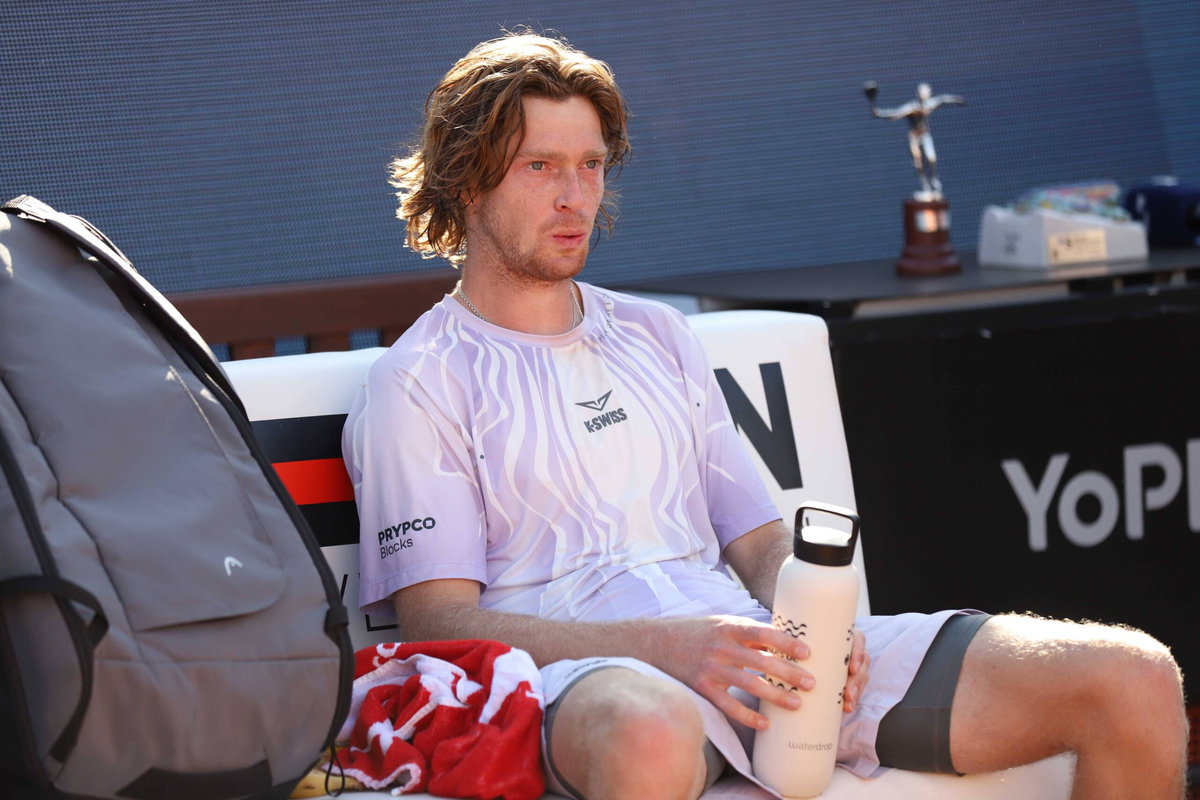
Coaching relationships on the ATP Tour usually follow a familiar script. The coach travels with the player, watches from the box, and helps him work through the good days and the ugly ones. Andrey Rublev and Marat Safin, however, have never quite followed that blueprint. Their arrangement has raised eyebrows before, and Safin’s appearance in Shanghai after Rublev’s campaign had already ended has put their unusual partnership back under the spotlight.
Watch What’s Trending Now!
Rublev’s Shanghai Masters campaign ended on Oct. 9, when Japanese qualifier Rei Sakamoto stunned the 23rd seed 6-4, 6-4 in the second round. Six days later, attention turned to Safin’s presence at the tournament, where he was scheduled to play alongside his sister Dinara Safina in an exhibition against Roger Federer and Li Na. The timing prompted questions about a coaching arrangement that has always allowed Safin considerable freedom over when he travels.
The exhibition was part of Shanghai’s official program, with Federer returning to Centre Court on Oct. 16 for the special doubles event. Safin’s presence therefore had a clear explanation beyond his work with Rublev. Still, the sight of him in Shanghai after Rublev’s early departure was bound to revive a discussion that had already followed the pair through the US Open. There is no confirmed indication of a new disagreement between the two, but their unconventional setup continues to invite scrutiny.
The questions first grew louder during the US Open. Safin was absent from Rublev’s campaign in New York, where the Russian recovered from two sets down to beat Otto Virtanen before losing to Spain’s Daniel Mérida Aguilar in the second round. Some fans questioned the arrangement after Safin attended Roger Federer’s International Tennis Hall of Fame induction ceremony in Rhode Island in August. However, the criticism reflected fan expectations about a coach’s availability, not proof that Safin had broken a commitment to Rublev.
Rublev himself has offered a straightforward explanation for why their partnership does not resemble a conventional coaching arrangement. Speaking to Russian tennis outlet Bolshe, he described the relationship as unusually flexible.
“It’s hard to say anything specific because we have a fairly loose relationship. He travels when he feels like it… It all depends on Marat. In any case, I know the tasks I need to accomplish.”
Those remarks help explain why Safin can be absent from one tournament yet remain an important part of Rublev’s team. The former world No. 1 does not serve as a traditional full-time coach who attends every match. Instead, he works alongside longtime coach Fernando Vicente and contributes when his schedule allows. Rublev has also said the pair were training together in Barcelona after the US Open, a sign that Safin’s absence from individual tournaments did not mean their collaboration had ended.
The arrangement nevertheless presents an obvious question. If a player relies on a coach for tactical adjustments and emotional support, can a partnership remain effective when the coach is not consistently present at tournaments? Fans have repeatedly questioned whether Rublev needs a more stable setup. Yet the Russian has continued to defend the freedom that defines his relationship with Safin.
Why Rublev Credits Safin With Helping Him Find Himself Again
There is a deeper reason Rublev has been willing to make the arrangement work. Safin’s contribution has never been limited to forehands, serve patterns, or decisions at the net. In an interview with L’Équipe published in May, Rublev spoke openly about the personal struggles he experienced in 2025 and credited Safin with helping him recover from a period when he felt he had lost his way.
“I wasn’t finding meaning in life in general. I no longer took any pleasure in anything.”
Rublev explained that his difficulties went beyond tennis. He had stopped enjoying everyday activities. He described the period as reaching rock bottom and said he was feeling much better by the time of the interview. His account offered a revealing explanation for why Safin occupies such a significant place in his life and career.
Rublev described Safin’s impact through an unusually vivid metaphor. Comparing the mind to a car engine, he explained how the former world No. 1 helped him examine problems he had struggled to understand on his own.
“What really helped me was Marat. You know when you open the hood of a car to look at what’s inside? Well, he did the same with my brain. He opened my skull and a lot of answers to my questions appeared.”
Rublev also connected his long-standing on-court outbursts to habits that began in childhood. He said every defeat once felt like a personal disaster, and that pattern gradually became destructive. He admitted that he had not eliminated those tendencies entirely, even after making progress. Safin’s role, therefore, has involved helping him understand the person behind the player, not simply correcting his behavior during matches.
Their work has also extended to Rublev’s tennis. The Russian has tried to build a Plan B that gives him more options when his powerful baseline game is not enough. That includes coming forward to the net in situations where he previously might have waited for a safer opportunity. The adjustment has produced mixed results, but it reflects an effort to change the patterns that have limited him at times.
This is what makes the Shanghai episode more complicated than a simple question of whether Safin should have been in Rublev’s box. His presence at the exhibition after Rublev’s elimination looks unusual, particularly given the scrutiny surrounding their partnership. Yet Rublev’s own words suggest that he values Safin for reasons that go beyond constant tournament attendance.