
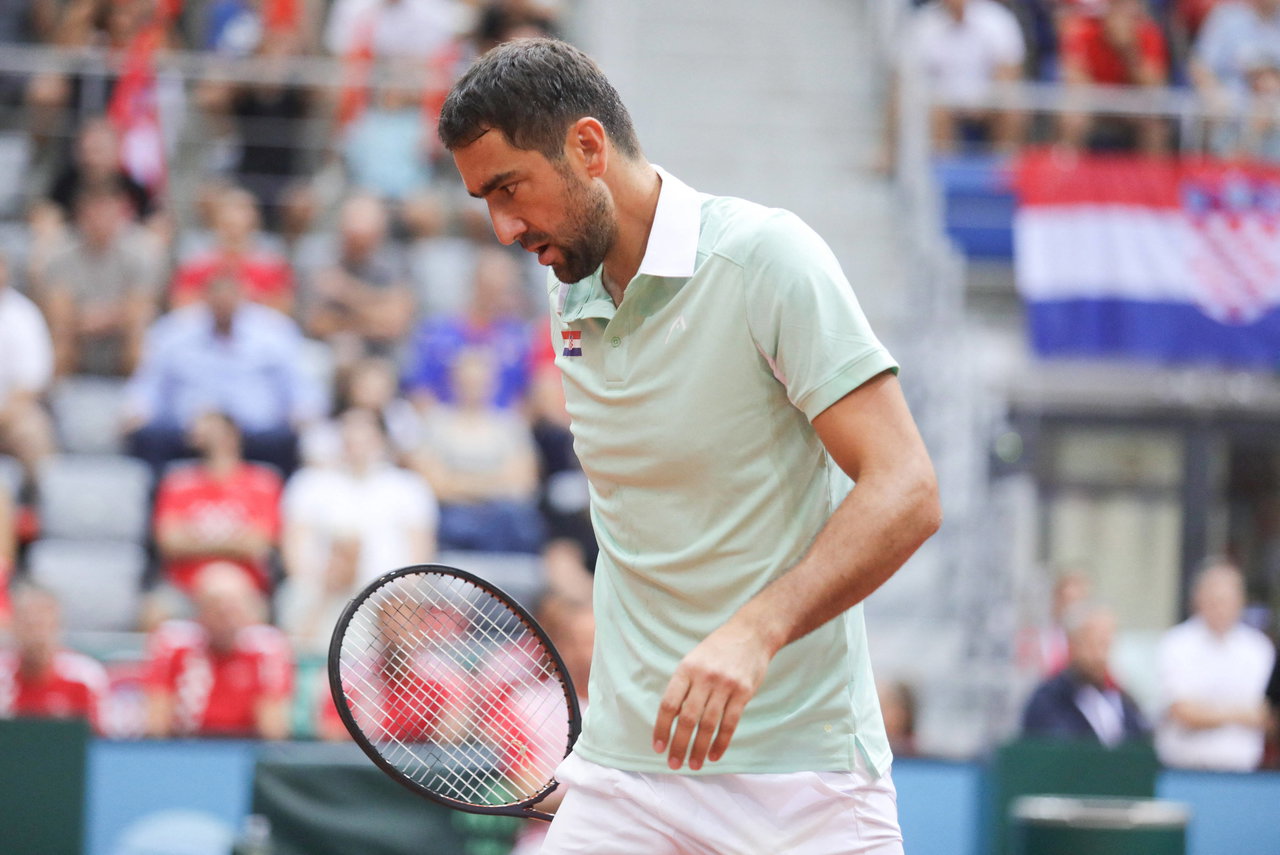
Marin Cilic will not get his 16th US Open appearance after all. The 2014 champion withdrew from this year’s tournament with an injury just hours before he was due to face No. 23 seed Andrey Rublev in the first round, another disappointment in a campaign that has already seen him miss the event for the third time in four years.
Watch What’s Trending Now!
The 37-year-old Croatian’s North American hard court swing gave little indication he was building toward a big result anyway. He won his first round match in Montreal and then lost to Frances Tiafoe in three sets. Heading to Cincinnati after that, he could not get past the first round itself, losing to Daniel Merida 6-3, 1-6, 1-6. Organizers or his team have not confirmed a specific injury that has forced him out, but he has been dealing with his right knee after two surgeries.
Cilic’s place in the draw passes to Otto Virtanen, who now faces Rublev instead. That’s when things really get bizarre. The Finnish tennis player won his first two rounds against Ugo Blanchet and Jack Pinnington Jones, respectively. Then in the third round, the 25-year-old withdrew against Grigor Dimitrov due to a back injury, handing Dimitrov a straight walkover into the main draw.
On the face of it, that should have ended Virtanen’s tournament before it started. Instead, when Cilic withdrew days later, the Finnish No. 1 was still handed the lucky loser spot ahead of the bracket.
The situation resembles a loophole, but it’s a general interpretation of the eligibility rule, not an exclusive one for this case. A lucky loser only needs to have been eliminated in the final round of qualifying. Nothing in the rule requires that the match actually be played to any particular point, or played at all. A walkover is counted as a defeat in that round just like a three-set battle, and the ranking becomes a measure to determine who was in the pool of eligible replacements when Cilic was eliminated.
His withdrawal came on the same day as another notable exit, with 2022 runner-up Casper Ruud also pulling out because of a back injury that had not healed in time, his spot going to lucky loser Arthur Gea.
How the lucky loser system actually works
The lucky losers, who are the top-ranked players eliminated in the final qualifying match, usually fill any vacancies in tour-level events. Grand Slams do it differently. Since 2006, all four majors have adopted a random draw of the highest-ranked eligible qualifiers instead of the best-ranked one.
The origin of that came from a Wimbledon qualifying match in 2005, when Justin Gimelstob aggravated a back injury and planned to give a walkover to his final qualifying opponent. The officials at the time recommended that if he could simply take the court, then he would almost certainly be the first lucky loser due to the amount of expected withdrawals from the main draw, thus proving how easy it was to predict the draw through the old ranking system. The random draw was added in order to eliminate that incentive.
It didn’t do what was most important, which is adding a condition that a player have to play their last qualifying round to be eligible. The case of Virtanen would squarely fit into the rule as stated, and it’s not the first time a player has made the lucky loser list without completing the qualifying campaign.
Earlier this year, Bernard Tomic pulled out of an ATP tournament match in Los Cabos with a bout of illness and was still a lucky loser days later, which got him some criticism from some quarters for “resting up” while still maintaining his status in that tournament’s main draw. For years, tennis forums have been discussing almost identical situations, and usually reaching similar verdicts: a loss in the final round of qualifying is a loss, regardless of the manner.
Whether the ATP or Grand Slam Board revisits the wording again, as it did after Gimelstob’s case two decades ago, may depend on how much attention this particular instance draws in the days ahead.