
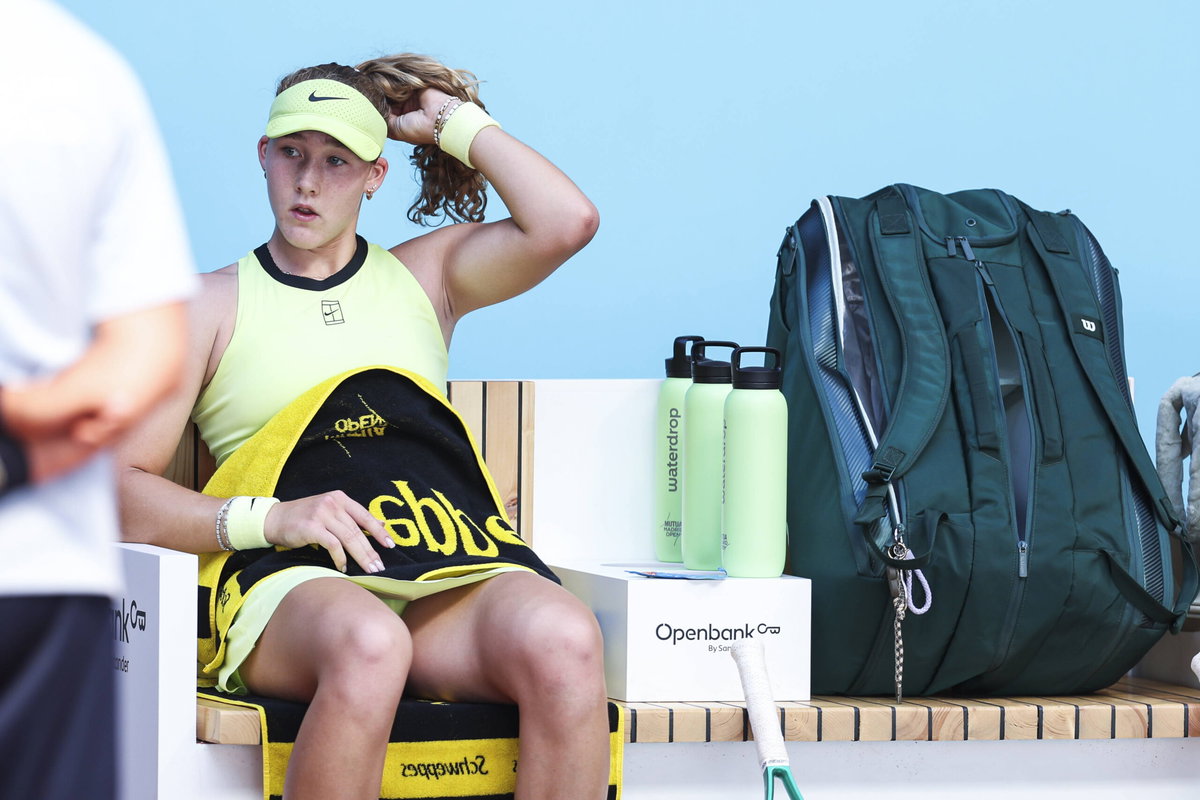
Mirra Andreeva enters Roland Garros on the back of her best clay court season yet, and before the draw was made, she was already taking notes about the playing surface. The 19-year-old was spotted in action during a practice session, and the camera caught her initial reactions to the surface with her coaching staff, including Conchita Martinez.
Watch What’s Trending Now!
“I feel like this has less clay, and it’s a little bit more moisture, like more moist, more wet,” she said, adding that the lines were not as problematic as they were in Rome.
This kind of detailing is what sets a player apart from one who simply shows up at a Slam and treats each variable as something to solve. For Andreeva, that mindset has been on full display throughout the clay swing.

"i feel like this has less clay and it's a little bit more moisture, like more moist, more wet" Talking about the court conditions and the lines (says the lines are not as bad as in Rome).. damn i love these kind of details! 📽️Roland Garros
She began her European clay campaign in Stuttgart, where she advanced to the semifinals and fell to Elena Rybakina in straight sets. Next, she traveled to Madrid, where she reached her biggest clay Masters result, reaching the final before being defeated by Marta Kostyuk in a 6-3, 7-5 victory. Rome offered a continuation of competitive tennis. She took the first set off Coco Gauff in the quarterfinals before losing in three, and then came back to win the doubles title alongside Diana Shnaider.
That run, three deep runs in a row at the surface, two of them at Master events, has converted Andreeva into a contender rather than a prospect at the Roland Garros. She is also one of the most consistent players on the WTA Tour so far this season, with two titles already won at the Linz Open (her second clay court title) and the Adelaide International.
It’s what comes next that makes her observation about the courts particularly interesting. As the tournament drags on, Paris should be quite hot, and the courts at Roland Garros are notorious for drying out and playing faster when it is hot. This surface may feel damp, light, and sticky, but it will likely feel very different by the second week. Early observation of surface shifts helps players adapt when conditions change.
There’s no doubt that Andreeva is one of those proactive players. Her decision to team up with a four-time Rome champion, Martinez, is already paying dividends as she is adjusting her footwork on the court. During the Indian Wells Open, unexpected breezes and surface bounce caused her to overhit, which triggered a notable on-court frustration, and that is something the teenager wants to fix with her expert tactical analysis.
Andreeva will be seeded at Roland Garros, so she’s no longer just a storyline but a true contender in the draw. At 19, the world No. 8 is playing tennis that’s beyond her age. Her comments about the court are not a complaint, but rather a mature look at Parisian clay and taking mental notes before the real action begins.
Mirra Andreeva arrives in Paris with unfinished business
Roland Garros has a special place in Mirra Andreeva’s story. In 2024, it was here she defeated Aryna Sabalenka in the quarterfinals and went on to face Jasmine Paolini in the semi-finals, becoming the youngest women’s Grand Slam semifinalist since Martina Hingis at the 1997 US Open. She returned the following year and lost in the quarter-finals to French wildcard Lois Boisson, a loss that stung given how far she had come.
“I have a lot of great memories from Roland Garros because it was my first semifinal of a Grand Slam. I can’t wait to go back and try to do even better than last year. It gave me extra motivation, yes, because now I know I am able to do it. I was very close, and now I have to just try my best to go further,” she said last year ahead of the tournament.
Those are not the words of a player who is content with a deep run. They are the words of a woman who knows she has the potential of being the title holder and for good reason in 2026.
Andreeva has been one of the most consistent players on tour all year with a 29-9 record. However, the clay swing has its share of heartbreak. In Madrid, she reached her first clay Masters final only to lose to Kostyuk, and the emotions got the better of her afterwards, leaving the court visibly in tears. Next was Rome, where she reached the quarterfinals and even managed to win the first set against and somehow saved five match points in the third set, but it was not enough against the world No. 4, eventually going down. Despite two crushing defeats in a row, she continued to show up and continue to compete again.
That resilience is definitely one of the top traits Andreeva brings to Roland Garros. Results have been good so far, but how she has coped with the defeats has said it all. At 19, she has already discovered that a good player is not someone who is able to avoid difficult situations, but rather someone who knows what to do when they happen. Paris is where she gets to find out how far that lesson has taken her.