
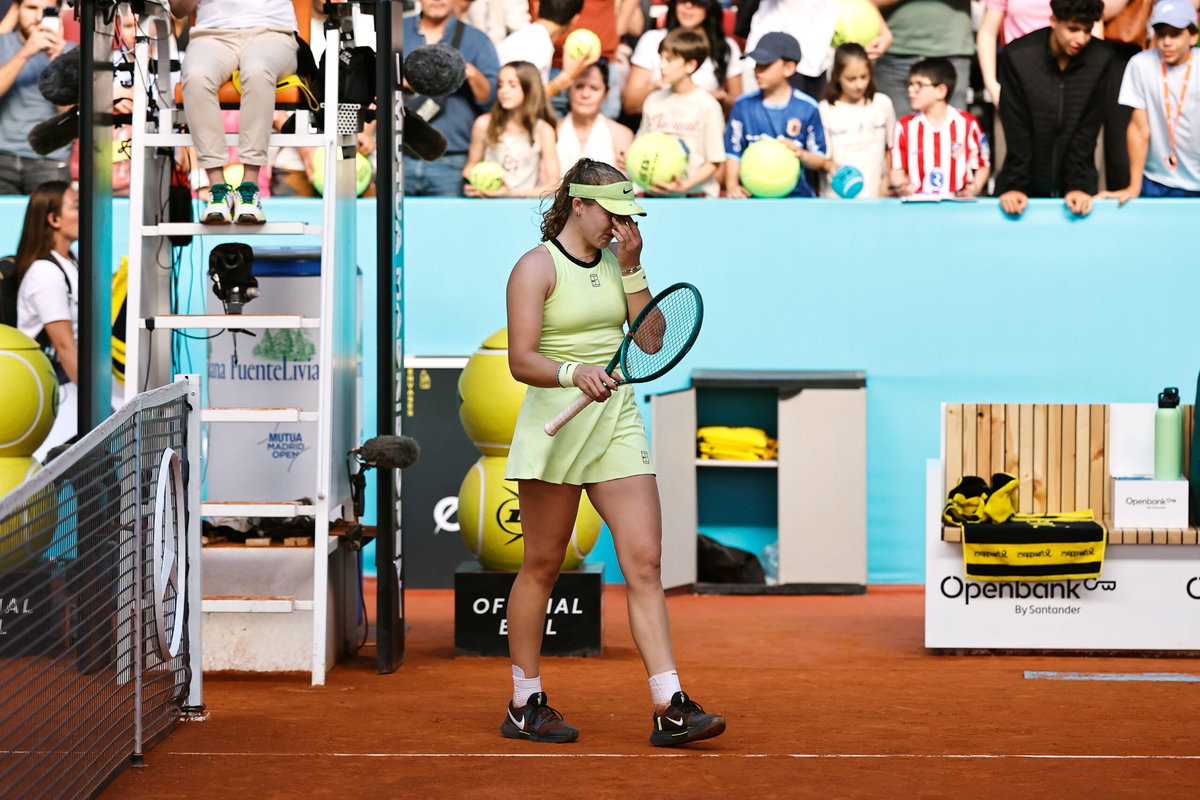
In almost every game, there is a point when the mind starts to go down a spiral. But for Mirra Andreeva, it marks the beginning of her personal quirky routine. At her post-match press conference at Roland Garros, the 19-year-old Russian, now one of the most composed competitors at the 2026 French Open, revealed exactly what goes on inside her head during those moments, and the answer was not what most people were expecting.
Watch What’s Trending Now!
“Sometimes, you know, there are thoughts that at one point come into your head that you cannot really control,” Andreeva said. “Like, oh, you’ve been playing so great; what if this stops, or what if you start to miss, or what if she starts to play better? Then, as I’ve been talking to my psychologist, she said to kind of imagine the big stop sign that is on the road, you know, that red sign with like, “Big Stop.”
The picture is intentionally blunt. Not a breathing exercise, not an affirmation, but a stop sign demanding an immediate, unconditional response. It’s the sort of technique that looks almost too simple until you think about the fact that Andreeva has been using it to navigate pressure situations on the biggest courts in the world.

French wildcard Fiona Ferro fought well but Mirra Andreeva was just too much ↘️ #RolandGarros rolandgarros.com/en-us/article/…
Her routine does not end there. “I start to sing a song in my head; that also helps to kind of switch it up a little bit,” she said, adding that some breathing techniques are woven in as well. When a reporter asked if she had a particular song she goes back to, her answer was both charming and telling. “Sometimes, but it kind of depends. If I hear something that day, then it will just stick in my head, and that’s what I’m going to be singing. Sometimes I won’t even know the words, but the melody will be there.”
The tune was not her own on the day of her third-round win over Marie Bouzkova. The crowd inside the court had been loudly supporting her opponent, Jill Teichmann, and their chanting had lodged itself in her head. “Now the only thing that is playing in my mind is the chanting that they were using,” she laughed. “So for now I don’t know; it’s just what I have in my mind for some reason.” The reporter then joked that she had become a Jill Teichmann supporter. “Yeah, kind of, I guess,” she said, laughing again.
Those techniques have created a calmness that has shown itself in this tournament. Andreeva defeated Marie Bouzkova 6-4, 6-2 in one hour and 35 minutes on Friday, and while the scoreline looked straightforward, she admitted there were tense moments in the first set where her focus wavered.
This week, she has spoken about really embracing the punishing afternoon heat that has punished so many other players, saying it suits her game and her movement. Now she’s into the quarterfinals, where she meets retiring 36-year-old Sorana Cirstea, whom she’s beaten once already this season.
While Older Pros Faltered, Mirra Andreeva Thrived
The mental tools Andreeva described are not interesting by themselves. They take on a different weight altogether when looking at what has been happening around her at Roland Garros this week.
The 2026 French Open has been a brutal one for the veterans of the game. Novak Djokovic, 39, a three-time champion at this event, was visibly overwhelmed by the afternoon heat and vomited on the court in his third-round loss to Joao Fonseca. Jannik Sinner, 23, has thrown away a match he led 6-3, 6-2, 5-1 after the World No. 1 took a controversial bathroom break before losing in five sets and giving up his 30-match winning streak to Juan Manuel Cerundolo under the Paris sun.
Then, on Sunday, in the fourth round, 15th seed Marta Kostyuk beat four-time French Open champion Iga Swiatek, 7-5, 6-1. The second set was an absolute collapse. She gave up her service at 4-3, double-faulted at a critical juncture, and lost six in a row to confirm her earliest exit at Roland Garros since 2019. It was made heavier by the fact that she lost on her 25th birthday.
Andreeva, 19, headed in the opposite direction. This week, she said openly that she likes playing in the afternoon heat, that it suits her movement and her game. She beat Bouzkova without dropping a set in one hour and 35 minutes. She is in the quarterfinals and hasn’t appeared troubled by the conditions that have broken players a decade older than her.
“I was very happy I was able to close the first set despite missing some shots,” she said after her third-round win. “Very happy I was able to play aggressive throughout the match.” She said this week’s hot conditions had actually suited her, preferring to play in the warmth of the afternoon before the courts cooled in the evening.
The stop sign, the songs, the breathing, and the psychologist sessions are all part of the same picture. Andreeva is 19 and already has the mental infrastructure that some pros spend careers trying to attain. That is why she remains standing when so many others are not in the most chaotic, physically punishing French Open in recent memory.