

While the majority of the top players, like Aryna Sabalenka, Coco Gauff, and Jannik Sinner, protested at Roland Garros on Friday by cutting their media duties short, Anastasia Potapova took her time at the pre-tournament press conference to make it clear that she was not a part of this.
Watch What’s Trending Now!
“I think for me it’s a little bit nonsense, so I’m not really into this. So here I am and talking to you as much as I want. As much as you want as well,” she said during the media interaction on Friday.
In an already charged media day, Sabalenka cut off her English interview section on a clock, and Iga Swiatek explained why she would do less for a tournament that does less for the players. However, Potapova was doing the opposite. The 25-year-old sat down, speaking freely and openly, distancing herself from a movement that has brought together some of the most powerful names in the sport.
Her reasoning was clear. When asked about the boycott-like element of the protest, she wondered about the logic of limiting the number of journalists who don’t have a say in the distribution of the prize money.
“Media guys has nothing to do with our prize money. You don’t pay us, right? So, how we can boycott somebody who is also getting paid from the same tournament?” Potapova added.
While other players also made it clear that their anger is not directed towards the media. With Sabalenka, Swiatek, Gauff, and others, the symbolic importance of limiting their commercial media roles outweighed the awkwardness. Although it did not for Potapova.
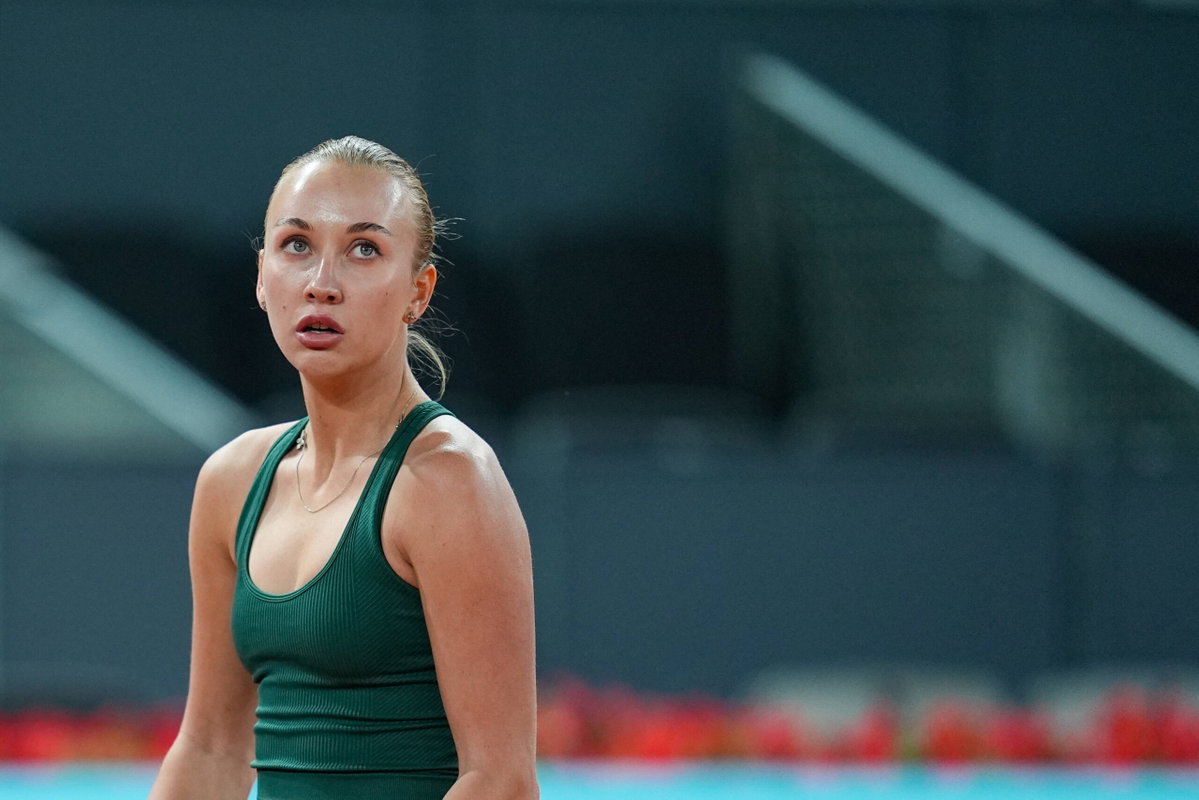
Imago
April 27, 2026, Madrid, Madrid, Spain: Anastasia Potapova of Austria in action against Elena Rybakina of Kazakhstan during the Mutua Madrid Open 2026, ATP, Tennis Herren Masters 1000 and WTA, Tennis Damen 1000, at La Caja Magica on April 27, 2026 in Madrid, Spain. Madrid Spain – ZUMAa181 20260427_zaa_a181_905 Copyright: xDennisxAgyemanx
Potapova’s willingness to speak out puts her in a notable minority. Almost every top name from both sides of the sport, from Sinner and Zverev to Sabalenka, Gauff, Swiatek, Pegula, Andreeva, and Zheng Qinwen, were on the list of those who signed the joint letter to Grand Slam executives demanding a 22% share of revenue by 2030 but Potapova was not one of them.
Born in Russia, Potapova played for the country in her career but changed to Austrian nationality in December 2025. She is currently ranked No.28 in the world and peaked at No.21 in June 2023. She is coming to Roland Garros after reaching the final of the Linz Open earlier this year, where she was defeated by Mirra Andreeva. Her best Grand Slam result at Roland Garros remains a fourth-round appearance in 2024.
Having said that, the demand for an increase in prize money will have a direct and material impact on her career, as the top-ranked players have repeatedly emphasized that the protest is about helping lower-ranked players survive. This makes her opposing stance all the more intriguing.
However, Potapova claims that she is not convinced and said so emphatically. Whether other people privately feel the same as her but didn’t voice it publicly on Friday remains to be seen as the race continues, and as player representatives meet Slam officials this week in Paris. Meanwhile, the Austrian-Russian player will start her campaign on Monday against Australia’s No.1 player, Maya Joint.
The dissenting voice of Anastasia Potapova in a week built on unity
The implications of Anastasia Potapova’s words go beyond simply the words themselves to when she said them. This week at Roland Garros, everything surrounding the players’ move has been about unity between ATP and WTA players, their nationalities, and even ranks, in a public protest. One of the architects of the protest, Jessica Pegula, spoke specifically about the careful consideration the players had taken in picking an action that would ensure that everyone was on board and not split the group. But Potapova’s press conference added a crack in that picture.
It’s important to state clearly what Potapova is saying and what she is not saying. She’s not supporting the prize money distribution of the Grand Slams nor claiming the players’ demands are unwarranted. Her critique is directed at the nature of the protest and the media access as the tool used to effect the change. Her stance is more in line with Novak Djokovic’s, who didn’t use the 15-minute limit but expressed general support for players’ rights. There was only one difference: Djokovic didn’t say anything, but Potapova told the press conference that it was “nonsense”.
That word will follow this story. So, when the top tour players have carefully protested respectfully, having a ranked member of the tour say it is “nonsense” in a roomful of journalists is exactly the kind of dissent that Slam executives and tournament organisers will be able to point to as proof the players aren’t as united as it seems. Whether that changes anything about the outcome of this week’s talks remains to be seen, but Potapova gave them something to work with, whether she intended to or not.