
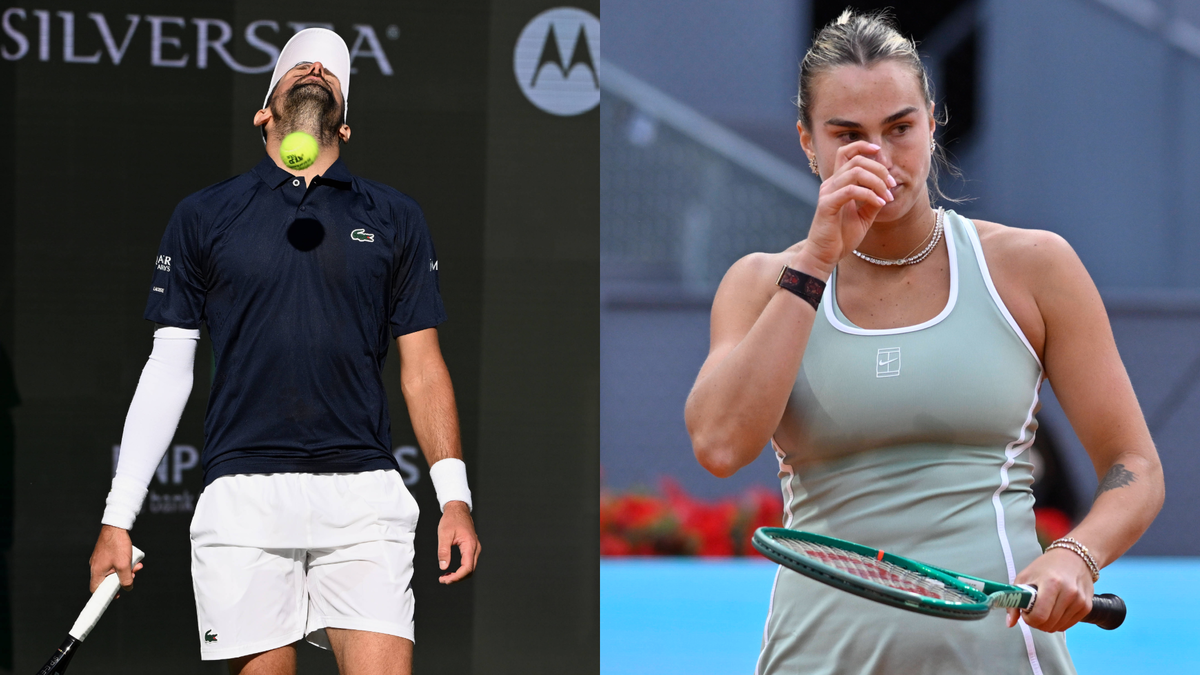
Last year, the sport’s elite united to demand a fairer future, pushing Grand Slam chiefs for higher prize money, stronger welfare funding, and a 22% revenue share to match tour standards. Yet with the French Open looming, unrest still simmers beneath the surface. Stars like Novak Djokovic and Aryna Sabalenka remain unconvinced, signaling that the battle for equity is far from over.
Watch What’s Trending Now!
On Monday, players issued a strong statement responding to recent developments around prize money at the French Open. They made it clear that the announcement on April 16, which confirmed a 9.5% increase in prize money, did not meet their expectations.
According to the players, the increase falls short when measured against the tournament’s growing revenues and the broader financial landscape of the sport. They highlighted that last year the French Open generated $463 million, marking a 14% rise compared to previous figures.
Despite this significant growth, the total prize purse only increased by 5.4%, effectively reducing the players’ share of revenue to 14.3%. Looking ahead, estimates suggest that this year’s revenues will exceed $469 million, yet the players’ share is still expected to remain below 15%.
Imago
ROLAND GARROS 2025 Thierry Larret/MAXPPP – PARIS 75 06/06/2025 Thierry Larret / Maxppp. Tennis. Roland Garros 2025. Internationaux de France de tennis. Stade Roland Garros, Paris 75. Le 6 juin 2025. Illustration dans les allees de Roland Garros PARIS 75 STADE ROLAND GARROS PARIS ILE DE FRANCE FRANCE PUBLICATIONxNOTxINxFRAxBELxSUIxUK Copyright: xMAXPPPxThierryxLarretx TLR202506060655 TLR202506060655
This widening gap between revenue and player compensation has become a central point of frustration among top professionals. The statement also addressed deeper concerns, emphasizing that financial issues are only part of a larger structural problem within the sport.
“The announcement does nothing to address the structural issues that players have consistently and reasonably raised over the past year,” it said. “There has been no engagement on player welfare and no progress towards establishing a formal mechanism for player consultation within Grand Slam decision making.”
The players further expressed dissatisfaction with what they see as resistance from the Grand Slam leadership toward meaningful reform.
“The grand slams remain resistant to change. The absence of player consultation and the continued lack of investment in player welfare reflect a system that does not adequately represent the interests of those who are central to the sport’s success.”
While the tours chose not to officially disclose the names of those who signed last year’s letters, earlier reports provided some clarity. Copies of the first letter, sent in March, revealed that 10 of the top 11 ranked women had signed it.
On the men’s side, leading figures such as Jannik Sinner, Novak Djokovic, Alexander Zverev, and Carlos Alcaraz were among the signatories.
However, Djokovic reportedly did not sign the second letter that circulated during the summer, adding a layer of complexity to the situation. More recently, a spokesperson confirmed that the Serbian star has also not signed the latest letter.
Players have consistently called for more open dialogue with tournament organizers, stressing the importance of communication.
“For sure, it would be great if the Grand Slams wanted to talk to us, because that’s how it’s supposed to be, and I don’t really get why there’s no more open conversation,” Iga Swiatek said at the WTA Finals in November.
Alongside these developments, tensions have also played out on a legal front within the sport.
The Professional Tennis Players Association (PTPA), founded by Djokovic in 2021 before he stepped away from it in January this year, has taken an aggressive stance.
Last March, the PTPA launched a series of lawsuits targeting multiple governing bodies and tournament organisers across tennis. In one case against the US Open organisers, the group pointed to stark financial contrasts.
It claimed that “in 2024, the US Open made $12.8 million from selling a single speciality cocktail, which was more than it paid to both singles champions combined”.
The broader argument centres on how revenue is distributed across the sport and what players consider a fair share. Estimates suggest that the French Open prize pool accounts for roughly 15% of projected revenue, a figure players believe is far too low.
By comparison, joint ATP and WTA Tour events distribute around 22% of their revenues to players.
Other major professional leagues in the United States set even higher benchmarks for athlete compensation. In leagues like the NFL, NBA, and MLB, players typically receive close to 50% of total revenues.
Even the WNBA recently saw players hold out of negotiations for 17 months to secure nearly 20% of league revenue.
Despite the relatively modest increase at Roland Garros, some believe the change has been influenced by earlier shifts led by the Australian Open.
Australian Open unveils record-breaking prize pool for 2026 edition
The French Open prize money increase comes amid a broader trend across the Grand Slams, where financial stakes continue to rise but debates remain unresolved. Earlier this year, the Australian Open announced a 16% jump in prize money, taking its total pool to $75 million.
The US Open went even further, unveiling a 21% rise that pushed its record prize pool to $85 million. Meanwhile, Wimbledon offered $72.6 million in 2025, reflecting a 7% increase from its 2024 total.
Despite these rising numbers, all four majors still allocate less than 22% of their revenues to players, a benchmark the player group is pushing to achieve by 2030. At Roland Garros, the latest prize money adjustments are not evenly distributed, as organizers have focused more on supporting players in the earlier stages of the tournament.
Imago
ROLAND GARROS 2025 Thierry Larret/MAXPPP – PARIS 75 06/06/2025 Thierry Larret / Maxppp. Tennis. Roland Garros 2025. Internationaux de France de tennis. Stade Roland Garros, Paris 75. Le 6 juin 2025. Illustration dans les allees de Roland Garros PARIS 75 STADE ROLAND GARROS PARIS ILE DE FRANCE FRANCE PUBLICATIONxNOTxINxFRAxBELxSUIxUK Copyright: xMAXPPPxThierryxLarretx TLR202506060654 TLR202506060654
Qualifying rounds will see nearly a 13% increase compared to 2025, while the main draw structure favors those exiting in the first three rounds. First-round losers are set to receive just under $102,000, whereas the men’s and women’s singles champions will earn just under $3.3 million each.
The issue of revenue sharing extends beyond elite players and has also become central to the agenda of the PTPA.
Last year, the PTPA escalated tensions by filing an antitrust lawsuit against the ATP and WTA Tours, describing the governing bodies as a “cartel” and labeling the Grand Slams as “co-conspirators.”
In a surprising move, AO organizers chose to settle with the PTPA in December, breaking ranks with the other three majors. On the same day, the organizers of the French Open, Wimbledon, and the US Open collectively responded by filing a joint motion to dismiss the lawsuit.
With tensions still unresolved and dissatisfaction clearly visible among top players, the battle over prize money at Roland Garros appears far from settled.