
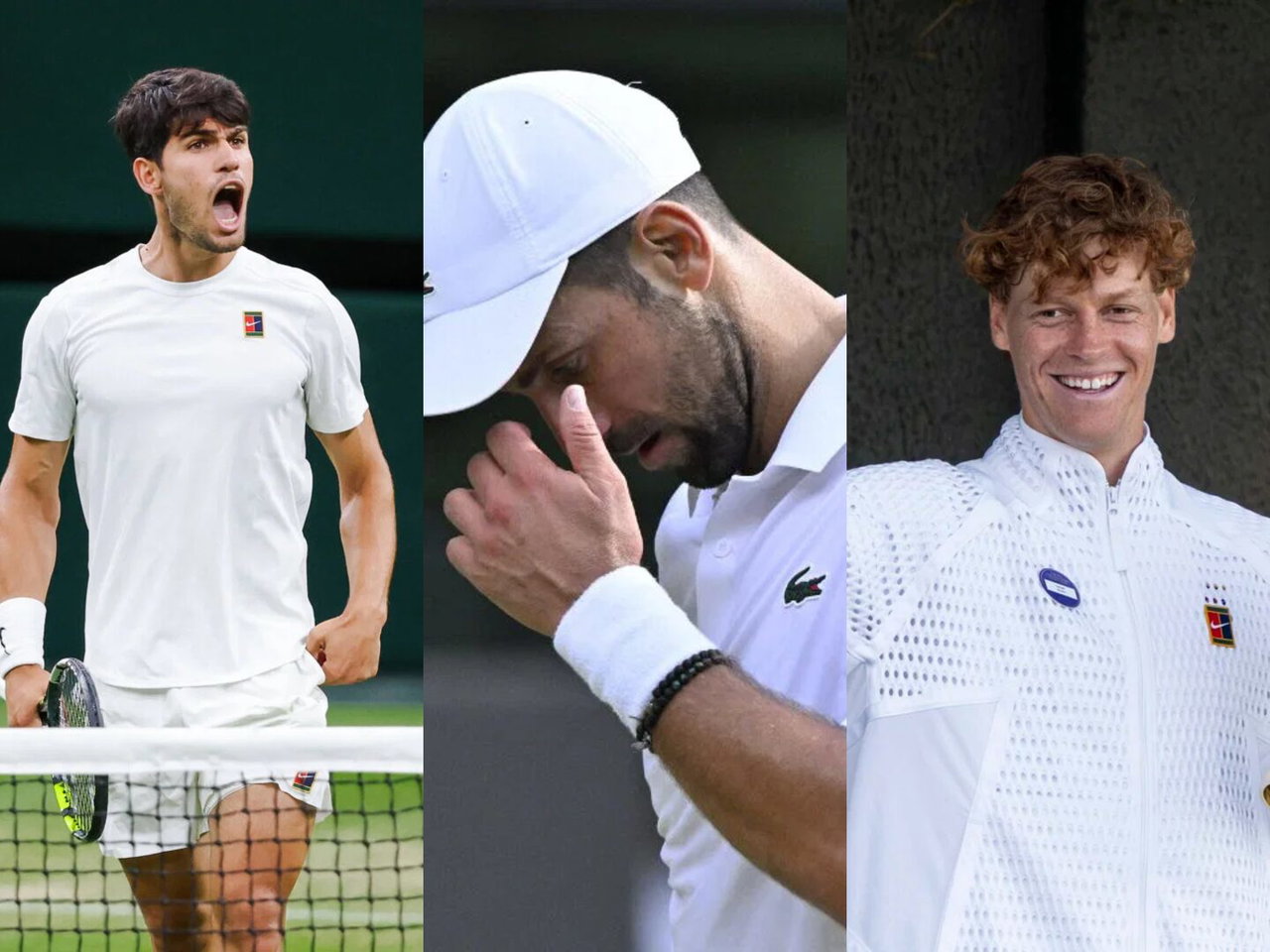
Novak Djokovic has made one of his most honest statements about the true nature of sharing a court with two of the most dominant forces in men’s tennis currently. Appearing on LeBron James and Maverick Carter’s show The Shop, the 39-year-old was asked directly how it feels competing against Jannik Sinner and Carlos Alcaraz. Djokovic tackled the question with a candid response.
Watch What’s Trending Now!
“I want to kick their a**,” he said. “But to be honest, when I see them play, there’s a contrast in styles with Federer and Nadal, you know, really contrasting styles. I showed up as well, different. We were, three of us, we were all different. And now with Alcaraz and Sinner being the dominant force in tennis, these two guys remind me of myself so much.”
“I’m playing myself from 10 years ago and 15 years ago. It kind of hurts me to feel that on the court, like, geez. I mean, I know how to crack the code, but, you know, can I?”
Later in the same conversation, he brought up the comparison with Federer and Nadal. The 24-time Grand Slam champion explained how central these two were in his own growth over the past 20 years. “It was always the case of, how do I measure myself against the top guys? Federer and Nadal are the biggest competition I ever had, and we shared the stage for like 20 years,” he said while noting the relatively narrow generational gap between the three of them.

Imago
Sport Bilder des Tages TENNIS : Hommage a Rafael Nadal – Roland Garros 2025 – 25/05/2025 Roger Federer Swiss and Novak Djokovic Serbia attend the tribute to Rafael Nadal Spain during the 2025 French Open at Roland Garros on May 25, 2025 in Paris, France. Photo Dante Badano / PSNewz – ParisFrance PUBLICATIONxNOTxINxFRAxBEL Copyright: xx
“Federer is like six years older, Rafa is a year older, so we’re kind of close in generation. I was always measuring myself against them, trying to figure out how I could beat them on the biggest stage.” Facing Sinner and Alcaraz now, he suggested, stirs the same instinct, just from the opposite side of the age gap.
The results back up exactly why that instinct has become so exhausting to chase. Djokovic’s last Grand Slam title dates back to the 2023 US Open, defeating Daniil Medvedev in straight sets. Since then, Sinner and Alcaraz have won 10 out of the last 11 majors between them. The Serbian did beat Alcaraz for Olympic gold in Paris 2024 to complete his dream and even became the oldest man in the Open era to reach all four Grand Slam semifinals in 2025, but always failed to cross the last hurdle.
Earlier this year, Djokovic defeated the Italian in the Australian Open semifinal in a five-set epic before falling to Alcaraz in four sets in the final. From 2024 onwards, he has played both opponents 11 times, securing only three victories: one over Sinner and two against Alcaraz. There’s a common notion on the tour that the 39-year-old Djokovic cannot defeat Sinner and Alcaraz in a row, which he will have to do in order to win the 25th slam. He has suggested that in their era it would be “very difficult but not impossible,” and he almost proved it in Melbourne.
Djokovic’s run without a major title in eleven consecutive tournaments is a feeling he described, chasing two players who have taken his own game and simply run further with it.
Djokovic opens up about recovery between marathon matches
The conversation turned more physical when Carter brought up Djokovic’s Wimbledon quarter-final, a five-hour, fifteen-minute battle against Felix-Auger Aliassime that had left an impression on everyone watching. Just two days later, after having pushed his body to its limit, the seven-time Wimbledon champion had to face the 24-year-old defending champion.
“Oh man, I wish I could have a few more days to recover. But I didn’t have that. And you know, it’s part of the sport, I guess,” he said. “I came out, and it was a clean sweep from his side. He beat me, but I went out and I gave it all, gave it what I can. As a competitor, I owe it to the sport, I owe it to myself, to my family, to the fans. But recovery is the big one. It takes more time to recover nowadays.”
The same admission prompted Djokovic to extend his critique to the knockout system in tennis, compared with team sports. He explained that in basketball, if a player has a bad night or even a stretch of bad games, they can still make it to the final, but in the case of a Grand Slam, one off-day and the tournament ends right there.
“If I’m having a bad day, I didn’t sleep, whatever it is, and I’m just not feeling myself and I lose first round, I’m gone. The fans don’t have a chance to maybe see me later in the tournament,” he said.
Adding to that, he said he would like to see the sport find a way to guarantee marquee players more than a single shot at each major. This was an unusual occasion when Djokovic was not talking about his own place in his sport, but rather its structure. The Serbian ultimately returned to his central point: the margins against Sinner and Alcaraz are now thinner than they’ve ever been, and the lack of recovery time is now playing as important a role as anything on the court.