
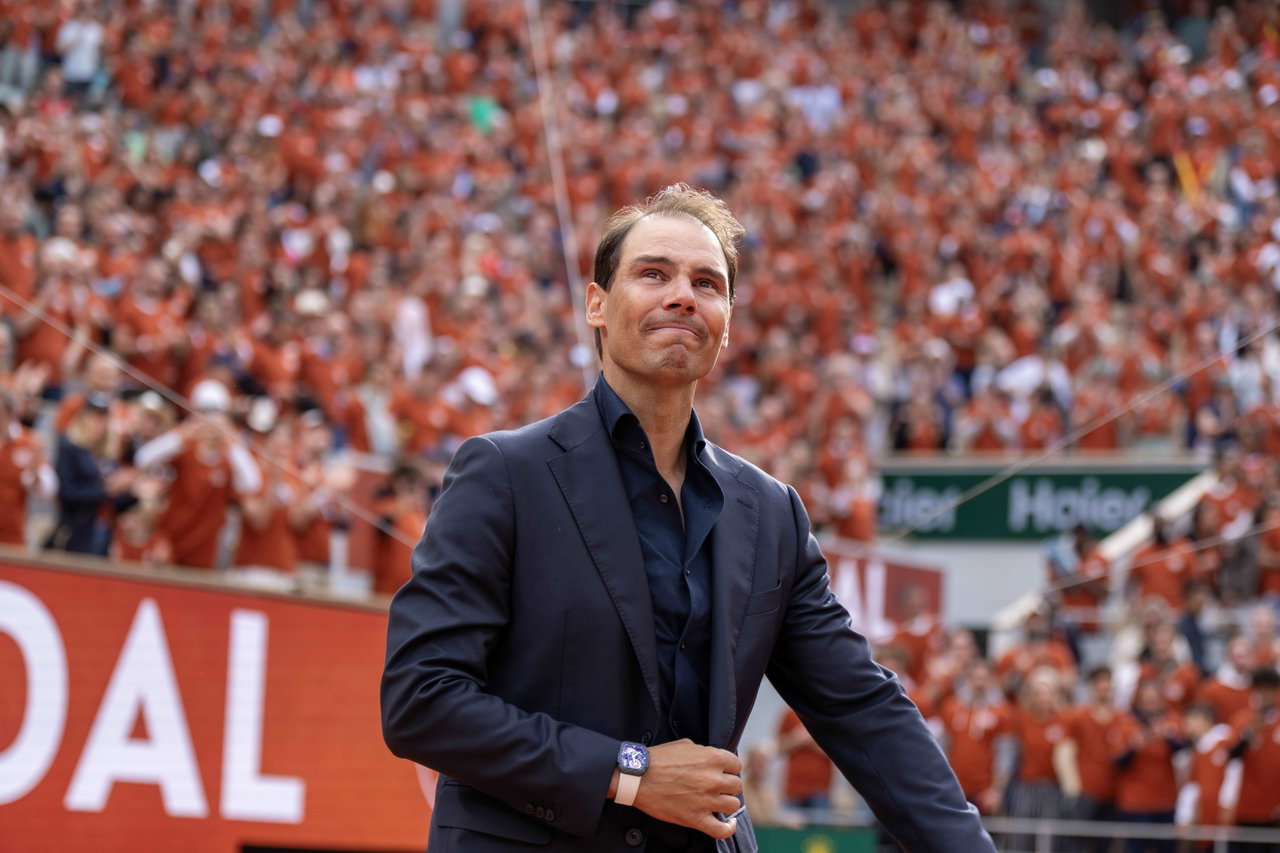
The remarkable career of Rafael Nadal has inspired generations of athletes. Yet, not everyone sees his story of success as the prime example. And 46-year-old former French cyclist Jérôme Pineau is one of them. The Frenchman has now ignited a fresh debate by questioning whether Rafa’s legacy truly sends the right message to young athletes.
Watch What’s Trending Now!
“No, (Rafael) Nadal is not a good role model for young athletes. I will simply say that, given his facts and his words, if he were a cyclist, he would be convicted of doping,” Pineau added while talking in a recent appearance on RMC’s “Les Grandes Gueules du Sport”.
“Obviously, in terms of resilience, talent and hard work, there are no problems; he is an example,” Pineau added later. However, the former cyclist then explained what he believes is the real concern. “When it comes to not listening to one’s body, raging on pain and creating other disorders to treat a problem that has already been present for some time. I am one of those people who says: ‘I play sport at the highest level, but if I have a problem, I take care of myself, I stop and start again when I am healed.'”
The Frenchman’s comments carry extra weight because they touch on a subject that followed the Spanish icon throughout much of his career.

✨ Rafa est-il vraiment un bon exemple pour les jeunes sportifs ? @jerome_pineau5 : "C'est évidemment un exemple de résilience. Son talent est incontestable, mais il ne peut pas l'être dans la mesure où il n'écoute pas son corps en se créant d'autres maux pour soigner un mal"
Even the recent documentary “Rafa” released on Netflix also reminded fans how Nadal’s chronic foot injury forced him to find different ways just to get through matches, let alone win them.
Back in 2005, when Rafa won the French Open on his debut, the same year also marked the beginning of his long injury battle. He broke his left foot during his Madrid Masters final victory, following which the Spanish icon was diagnosed with the rare degenerative condition known as ‘Mueller-Weiss syndrome’.
The issue became even more public 11 years later, in 2016, when a hacker group released Nadal’s medical records. It showed the legal use of ‘betamethasone’ in 2009 and ‘tetracosactide’ in 2012.
Even in 2022, when Rafa won his last French Open, he himself revealed that he played the tournament with his left foot anesthetized through local infiltration to control the pain.
Even so, the Frenchman does not accuse the Spanish icon of breaking anti-doping rules but focuses on the message the former cyclist believes young athletes today could take away from Nadal’s story.
How Rafa tested his body throughout his tennis career
Suffering through sport may seem pointless to many athletes nowadays. But when someone comes out stronger, happier, and more fulfilled, some believe the struggle is worthwhile.
Even when the Spaniard was 22, he admitted, “Tennis for me became a race against time.” Later in life, he also reflected on that journey while battling pain. “You probably don’t need to suffer the stress that I have suffered to become what I have become.”
His foot condition gradually led to more physical problems after years of suffering with this. And ultimately, it affected his knees, hips, and back over the years.
Back in 2012, those physical problems forced him to miss both the Olympics and the US Open because of tendinitis in his left knee. “My knee was destroyed. The tendon basically had a hole in it,” Nadal said at that time.
After winning his last Grand Slam title on Parisian clay, Nadal admitted he had no feeling in his foot. John McEnroe, the 7-time Grand Slam winner, even reacted in disbelief. “He doesn’t feel his foot, and he’s winning this? What are you going to tell me next? He’s going to play blindfolded, and he’s going to win it also?”
While the docuseries may suggest that Rafa’s journey should not necessarily be a blueprint for the next generation of athletes, it also highlights something undeniable: With enough determination and an unbreakable desire to win, one can often achieve things that might seem impossible.