

There is no denying that 2005 was the year that a young Rafael Nadal announced himself to the tennis world. Aged 19 at the time, the Spaniard went on to win 11 singles titles, including his first-ever French Open triumph, and rose to No. 2 on the rankings. While it was definitely one of the most dominant years of Nadal’s extremely successful career, it was also the year in which he discovered an extremely rare disorder that could’ve robbed us of an all-time great.
Watch What’s Trending Now!
It was after his victory over Ivan Ljubičić in the Madrid Open final that Nadal was diagnosed with Müller-Weiss syndrome, an incurable foot condition that affected the navicular bone. This left him out of action for the coming months and kept him from the 2006 Australian Open. Looking back at the time he picked up the syndrome, Nadal described it as one of the “toughest” years of his career.
“That was probably the toughest part in my tennis career because that was just the beginning. 2005 was the year that I won my first Grand Slam. I finished the year at World No. 2. That was in one of the last tournaments of the year. So after that, it was just the beginning of my success,” he said in an interview with CNN.
At that point, Nadal felt that his future as a professional tennis player was very bleak and wasn’t sure if he would be able to continue playing on the tour for many years.
“So, in some way, when you receive all the news that maybe you will not be able to keep on doing the same things as you are used to doing. In some way, you are projecting your future of being a professional tennis player and thinking that you will have 7,8 or 10 years of being on the professional tour, and that’s why you have been practicing all your life. And in 1 second, it looks like now you may not be able to keep doing what you’re doing,” he added.
A person generally develops the condition when the navicular bone in the midfoot progressively breaks down. It is a rare condition that causes chronic pain in the midfoot and hindfoot. The pain can even lead to difficulty in walking and can cause swelling in the affected foot.
However, the Spaniard refused to give up and continued playing with the pain. Nadal used specifically designed insoles (orthotics) and modified tennis shoes. These were built to redistribute pressure away from the deteriorating navicular bone and provide essential arch support.
Despite discovering his condition, Nadal went on to win five singles titles in 2006, including a second consecutive French Open victory. He would continue to win titles as the years went on, and by 2015, he had already become a legend of the sport, winning a total of 14 Grand Slams and an outrageous 53 ATP titles. However, it was during this year that his deteriorating mental health started to take a toll on him.
After spending years on the tour, there came a time when Nadal’s mind wasn’t able to handle the pressure of constantly playing matches and battling injuries. This led to him suffering from severe anxiety issues, and he couldn’t go outside the house without a water bottle.
While fans thought of this as a superstition, Nadal had revealed that it was a kind of mechanism that he used to find mental order. At this point, Nadal knew that he needed help to improve his mental health.
“Probably because I went through a lot of injuries, a lot of pressure, and arrived in a moment where, in some way, you are not able to handle all of this – even if in my mind I was able to handle all of this. It arrived at a point where your mind fails, and that’s what happened.
“I always thought that I needed to fix things for myself, in terms of mental strength. But when I cannot go out on the street without a bottle of water in my hand, that’s a big thing. So, I needed to find help, and that’s what I did,” he stated.
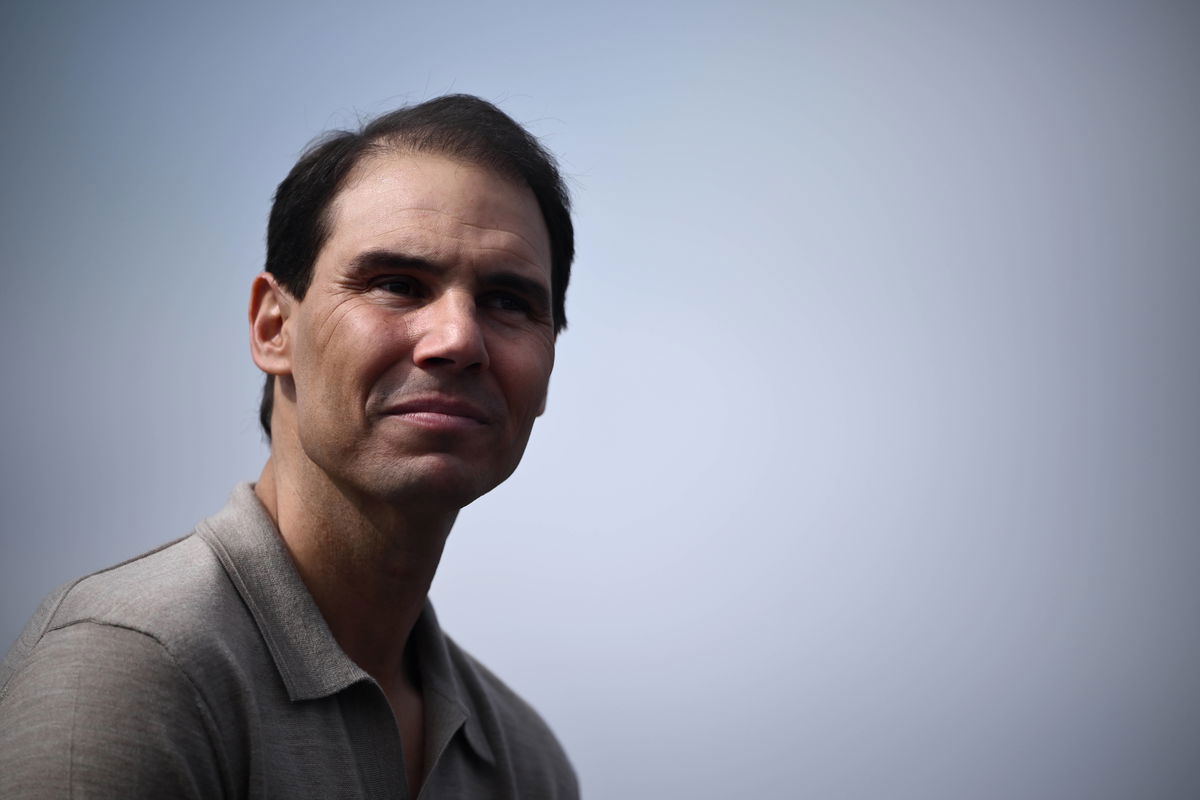
Imago
TENNIS AUSTRALIAN OPEN, Spanish former tennis player Rafael Nadal speaks during a branding partnership event during Day 14 of the 2026 Australian Open tennis tournament at Melbourne Park in Melbourne, Saturday, January 31, 2026. NO ARCHIVING MELBOURNE VICTORIA AUSTRALIA PUBLICATIONxNOTxINxAUSxNZLxPNGxFIJxVANxSOLxTGA Copyright: xJOELxCARRETTx 20260131166489562820
The Spaniard then sought help from a psychologist before turning to a psychiatrist, and would finally start seeing some improvement in his condition after a few months.
“I first went to a psychologist. I tried it, but it didn’t work because I already knew all the things that I had heard, as I was very rational. Then I went to the psychiatrist, and then I started with some medication for a while, and I was able to start feeling improvements after a couple of months. That went on for around a year, and then I recovered,” he concluded.
After a major improvement in his mental health, Nadal continued breaking records on the tennis court. He went on to play for the next nine years before eventually announcing his retirement in November of 2024 after becoming the World No. 1 multiple times, winning 22 Grand Slams and 69 other ATP singles titles.
Though the 39-year-old has long stopped playing tennis, he continues to suffer from body pain even today. He had recently revealed the drastic measures that he had taken to keep his career going and also gave a worrisome update regarding his health.
Rafael Nadal provides concerning health update amid constant injury problems
When asked about the time he defied the doctors and continued playing matches, Nadal revealed that he had started to take heavy medication by himself during the later stages of his career. This led to him suffering from a serious health condition.
“And there came a day when I said, well, when you say that there is a limit between what is right or wrong, now I am the one who decides when to take anti-inflammatories, when not to take them, how many I take, or how many I do not take. And they (doctors) practically didn’t even know. For the simple fact that, of course, it was uncomfortable for me to have to ask all day when I knew that the other person did not agree with that,” he had told Marca in an interview.
Nadal further revealed that he has two perforations in his intestines due to the massive number of anti-inflammatories that he took to play tennis despite his injury problems.
“But from my point of view, it was either that or I didn’t play tennis. So, when I say that there is a boundary between what is right and wrong, it is because, in the end, I know that it is harmful to my body. In fact, as I said, I have two perforations in my intestines from taking so many anti-inflammatories. But if it hadn’t been like that, my career would have been completely different,” he added.
The intestinal perforations still cause Nadal a lot of problems today, and he also suffers from chronic pain in multiple body parts. It won’t be wrong to say that his 23-year-long career did indeed take a massive toll on his body.