
Imago
Image Credits: Imago
Imago
Image Credits: Imago
For years now, tennis players like Iga Swiatek and Carlos Alcaraz have been raising the same exhausted cry: the schedule is too hectic. And for the likes of Swiatek and Alcaraz, who go deep in most tournaments, it’s all too true.


Once a tournament concludes, another almost instantly begins with no real pause to recover and reset. With four Grand Slams and many mandatory tournaments, the season stretches across nearly ten and a half months (longer than most major sports) over multiple continents. This year was no different for the men’s and women’s tours, perhaps proving even more congested, if the many voices of dissent are anything to go by.
Watch What’s Trending Now!
The 2025 season began on December 27 with the United Cup in Australia and ran all the way through to the Davis Cup Finals from 18 to 23 November. After that, it was time for the break: a mere five weeks and four days until the new season begins on 1 January. But is that really enough time to recharge?
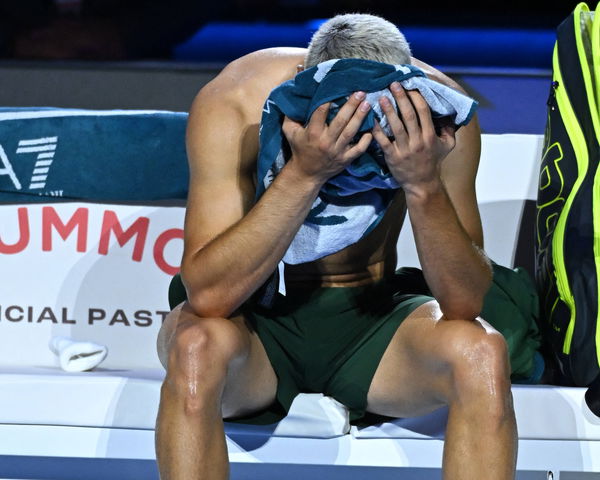
For most players, five weeks is simply not enough. It is barely enough time to let the body heal, let the mind breathe, or even spend proper, unhurried time with family. And that is exactly why so many are now asking for a longer off-season. Not for luxury, but for sustainability after a long, draining season.
Burnout is no longer rare; it is normal for Carlos Alcaraz and others
In the last few seasons alone, we have seen:
Premature ends to players’ seasons
Rising injury withdrawals
Players skipping entire swings for recovery
Mental health breaks
When Swiatek spoke about fatigue at the end of long Asian swings, she pointed out a pattern, not an individual struggle. As she said, the season is “too long and too intense.” The world No. 2 even suggested she might skip some mandatory tournaments in the future, regardless of the penalties. “I don’t know yet how my career is going to look like in a couple of years,” she admitted. “The only thing I can do now, when I decided I’m going to play all these mandatory tournaments.”
Carlos Alcaraz echoed similar concerns, calling the schedule “really tight” and urging tennis authorities to make changes. He highlighted how back-to-back mandatory tournaments leave players drained, both mentally and physically. “I will consider skipping some mandatory tournaments … to the benefit of myself mentally,” he said.
Imago
Nitto ATP, Tennis Herren Finals – Torino Carlos Alcaraz ESP during his second match at the 2025 Nitto ATP Finals in Torino, ITALY, on November 11, 2025. Photo by Corinne Dubreuil/ABACAPRESS.COM Turin Italy PUBLICATIONxNOTxINxFRAxUK Copyright: xDubreuilxCorinne/ABACAx
Alexander Zverev has also been blunt about the lack of downtime in tennis, saying, “I don’t think we have an off-season… I don’t think we have time to mentally rest (and) physically rest.”
Taylor Fritz echoed the sentiment, pointing out that top players actually get even less of a break. “There’s no offseason, and if you’re a top player, you actually get even less of an offseason,” he said. “People don’t understand you have to be training during that time. The offseason is your time to train, so if I have three weeks, I take one week [to relax or go on vacation] and that’s it. I get one week off the whole year. It’s absurd.”
Coco Gauff, the world No. 3, put it even more plainly. She said it feels “impossible” to keep up with the mandatory tournaments. “I definitely would like to see in my lifetime on tour a solution be made to make the season shorter,” she said. And as players ask for solutions, the data backs their concerns.
The number of retirements, withdrawals, and injuries this year has been shocking:
At the Shanghai Masters alone, there were seven retirements or walkovers in just one week.
Across all ATP Masters 1000 events this year, the total has reached 41 retirements and walkovers.
Numbers like these are not normal.
At the China Open in Beijing, a combined WTA 1000 and ATP 500 event, five of the 12 matches in one day ended in retirements. And this doesn’t even take into consideration the injuries, physical discomfort, and psychological stress that many athletes continue to endure in silence. The argument that player welfare is actually being safeguarded is getting harder every month.
The real problem is not just one tournament
On the surface, the issue looks simple. Too many tournaments. Too many mandatory events. Long travel. Short turnarounds. But the deeper problem is what this does to the rhythm of a player’s year.
Top players are now expected to:
Play a near year-round calendar
Defend ranking points almost every week.
No recovery buffer and traveling through time zones.
- Some events are mandatory, especially elite ATP Masters 1000s, Grand Slams, and some WTA tournaments. And by chance, if a player missed it, they might lose the points and the handsome bonus.
By the time the season nears its end, most players are drained. But still, commitments keep coming in thick. Indoor events. Tour finals. the Davis Cup. Exhibitions. Media tours. Sponsorship commitments.
So, what is the solution?
The tennis calendar has never been this full. Players are always on the move with 12 WTA and 13 ATP tournaments as well as team events such as the Billie Jean King Cup, Davis Cup, and Laver Cup. And now, the ATP plans to add yet another Masters 1000-level tournament in Saudi Arabia as early as 2028. Instead of addressing player concerns, the calendar is still growing.
There are changes, but are they enough?
A few minor changes have been made:
In order to give WTA players a little longer off-season, the Billie Jean King Cup finals were rescheduled for September.
Organizers of the Grand Slams refused more radical changes, including reducing the number of tournaments to approximately 75 to 118 and developing a so-called Premier Tour, due to governance fears.
But the ATP has suggested a system of a waterfall to protect players:
- The most elite players give importance to the year-end finals, Masters 1000s, and Grand Slams.
- Newer or lower ranked players have the opportunity to play in smaller tournaments to gain ranking points and to practice matches.
- The point is to balance workload and protect the health of players; however, it is difficult to implement this concept when the organizers of Grand Slams have such a significant influence on the sport.
The idea is logical. Nevertheless, the execution is the main problem, but how?
A breaking point for tennis’s power structure
Tensions have reached a high point: In 2025, the Novak Djokovic-led PTPA alongside several players filed a lawsuit against the ATP, WTA, and ITF demanding improved scheduling, fairer payments, and improved welfare.
Djokovic, the founder of the PTPA and longtime critic of the calendar, says real change depends on players getting involved:
“Players are not united enough… They make comments, they complain, and then they go away … But you have to invest the time, you have to invest energy yourself … to understand how the system works and what can be done to improve things for the players,” he said.
The Serb added a warning about empty gestures: “Because going out in the media and talking about this and that, OK, it might stir up some energy or some attention. But at the end of the day, nothing is going to change, you know? I know it from my personal experience, trust me.”
The bottom line is that the majority of top players are in agreement that they are being pushed to the very limit of what their bodies can endure. But if the status quo continues, it’s only a matter of time before meaningful change becomes a necessity, not just an idea.