Imago
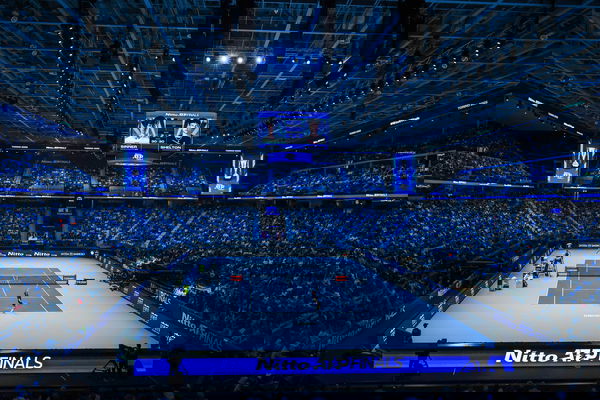
View inside the Arena during Men s Singles Group Stage match against Ben Shelton of United States on day six of the Nitto ATP, Tennis Herren Finals 2025 at Inalpi Arena in Turin PUBLICATIONxNOTxINxITA Copyright: xFabrizioxCarabelli/IPAxSportx/xipa-agency.netx/xx IPA_67956563 IPA_Agency_IPA67956563
Imago
View inside the Arena during Men s Singles Group Stage match against Ben Shelton of United States on day six of the Nitto ATP, Tennis Herren Finals 2025 at Inalpi Arena in Turin PUBLICATIONxNOTxINxITA Copyright: xFabrizioxCarabelli/IPAxSportx/xipa-agency.netx/xx IPA_67956563 IPA_Agency_IPA67956563
Over the past year, tennis has wrestled with intense debate over its overcrowded calendar. The conversation reignited before the 2025 season when Carlos Alcaraz warned, “they are gonna kill us in some way.” Now, amid that ongoing unrest, a bold new question has emerged: what if tennis added a fifth Grand Slam?
Watch What’s Trending Now!
The idea has resurfaced after Angelo Binaghi has once again pushed tennis into a heated global debate. The long-serving president of the Italian Tennis Federation believes the sport should consider a fifth Grand Slam. He shared his views while speaking to the Italian newspaper Corriere. Binaghi has held his role since 2001, making him the longest-serving federation president in tennis.
According to Binaghi, Italy is ready to host such an event. He believes Rome, the home of the Italian Open, is the natural choice. However, he made it clear that government backing would be essential. “A Grand Slam in Italy will be possible when the government invests in tennis’s potential,” he said.
Binaghi also pointed to Italy’s rising global profile in tennis with players like Jannik Sinner firmly putting Italy on the tennis map. He cited a conversation with a senior government official. “Economy Minister Giorgetti told me that at global financial meetings, before even greeting him, they congratulate him on Sinner and tennis,” Binaghi explained.
Imago
European Open ATP, Tennis Herren Tennis Tournament ATP TOUR logo inscription displayed on the net of the central court during a quarter semi final tennis match of the singles competition at the ATP 250 European Open Tennis tournament in Lotto Arena, Antwerp, Belgium on October 18, 2024. Antwerp Belgium PUBLICATIONxNOTxINxFRA Copyright: xNicolasxEconomoux originalFilename:economou-notitle241018_np70m.jpg
His comments come at a time of major structural change in the sport. Over the last few years, tennis has expanded aggressively into new markets. One of the biggest players in that expansion has been Saudi Arabia’s Public Investment Fund.


The PIF has formed partnerships with both the ATP and WTA Tours. It previously hosted the ATP Next Gen Finals. Riyadh is now the permanent host of the WTA Finals, one of the most prestigious events on the women’s calendar.
The ATP has also confirmed further plans in Saudi Arabia. It is set to host a historic 10th Masters 1000 tournament. The one-week tournament could begin as early as 2028 and it would join the elite group of top-tier events outside the Grand Slams.
Those tournaments currently include Indian Wells, Miami, Monte-Carlo, Madrid, Rome, Toronto or Montreal, Cincinnati, Shanghai, and Paris. These events sit just below the four Grand Slams in importance.
Binaghi, however, believes Italy offers more than the Middle East. He pointed directly to fan engagement, especially at the Next Gen ATP Finals last season. “In Rome, all my life. Look at Next Gen: in Milan the arena was always full; in Jeddah there wasn’t a single person in the stands,” he said.
Attendance, he argues, reflects tradition and passion. Rome, in his view, already feels like a Slam venue. He also highlighted the economic benefits Italy already sees from tennis.
“Just look at the economic impact of the International Tennis Championships on the region: last year it was €895 million, this year it should reach €1 billion,” Binaghi stated. He believes those figures prove the tournament’s value.
He then compared a Masters event to a Grand Slam. “The ratio between a Masters 1000 and a Grand Slam is one to four,” he said. “We’re talking about a potential economic impact of around €4 billion, with additional tax revenues of around €600 million.”
Binaghi also emphasized that Rome achieves this success without public funding. “The Internationals currently generate €148 million, without public funding,” he added. In his view, that strengthens Italy’s case.
Imago
WTA, Tennis Damen Finals 2025 – press conference, PK, Pressekonferenz RIYADH, SAUDI ARABIA OCTOBER 31: A WTA Finals Riyadh branded microphone is seen during a press conference on Media Day ahead of the WTA Finals Riyadh, at King Saud University Indoor Arena in Riyadh, Saudi Arabia, on October 31, 2025. Riyadh Saudi Arabia PUBLICATIONxNOTxINxFRA Copyright: xArturxWidakx originalFilename:widak-wtafinal251031_npW14.jpg
Italy’s recent tennis boom plays a major role in his argument. Over the last decade, the country has produced a wave of elite players. Matteo Berrettini reached a Wimbledon final. Lorenzo Musetti became a consistent top-level threat.
On the women’s side, Jasmine Paolini has enjoyed a breakthrough rise. Most importantly, Italy now boasts a world No.1. Jannik Sinner’s success has transformed the nation’s tennis identity.
Sinner’s rise has drawn unprecedented attention to Italian tennis. Stadiums are full. Television ratings are strong. Sponsors are eager. As iconic Italian singer Gianni Morandi told Sinner after his ATP Finals victory, “In Italy there’s Ferrari, Armani and you.“
And Binaghi believes this momentum should be rewarded. This is not the first time he has raised the issue. During last year’s Italian Open, he openly challenged tennis tradition. “In what other part of society is there a monopoly that lasts for more than 100 years?” he asked.
He followed with a sharper point. “Why are there always four [Grand Slams] and always the same four? … It’s absolutely unfair and doesn’t help tennis grow.” His stance has remained consistent.
Italy’s ambitions go beyond hosting a Slam. In February last year, reports claimed Italian tennis bosses made a bold bid for the Madrid Open, currently owned by IMG.
According to La Stampa, IMG received an offer worth around $585 million. The federation reportedly wants to expand the Rome Masters into a two-week event.
Only Grand Slams currently run for two weeks. Expanding Rome would push it closer to Slam status. Some believe this could create an unofficial “fifth Slam.” The speculation increased after Endeavour confirmed it was considering selling parts of its IMG portfolio. That list included the Madrid Open and Miami Open.
Despite these ambitions, serious concerns remain. The biggest obstacle is history. Wimbledon is the oldest tennis tournament in the world. Its traditions are unmatched. The US Open is not far behind in age and prestige. The Australian Open has grown into a global spectacle. Only the French Open is under 100 years old in its current form.
A fifth Slam would disrupt this historic structure. Tennis is deeply rooted in tradition. Many believe four Slams define the sport’s identity. Records present another major problem. Grand Slam counts are central to tennis history. They define greatness. Adding a fifth Slam would change everything.
Imagine a player winning 30 Grand Slam titles in a five-Slam era. How would that compare to Serena Williams’ 23? Would there be an asterisk? The GOAT debate is already complicated. Comparing pre-Open Era titles is difficult. Many players were banned from majors in the 1960s. Adding another Slam would worsen the issue.
There is also the calendar-year Grand Slam. Only five players have achieved it. Steffi Graf last completed the feat in 1988. In the Open Era, only a few players have won five or more consecutive Slams. Margaret Court did it from 1969 to 1971. Martina Navratilova did it in 1983 and 1984.
Steffi Graf also achieved five straight majors from 1988 to 1989. Among men, only Don Budge won more than four in a row, claiming six between 1937 and 1938. Completing a Grand Slam is already one of the toughest challenges in sport. Adding a fifth would make it nearly impossible. Legacies would also be questioned. Do Roger Federer, Rafael Nadal, and Novak Djokovic still own career Grand Slams? What about Andre Agassi?
Rod Laver’s historic doubles in 1962 and 1969 would also become harder to contextualize. Tennis history would feel fractured.
Scheduling presents perhaps the biggest practical problem. The tennis calendar is already overcrowded. Players compete nearly year-round. A Grand Slam lasts two weeks. There is no clear two-week gap in the calendar. Adding one would force major changes.
Even upgrading an existing event would cause disruption. Other tournaments would likely be cut. Players would face even heavier workloads.
This matters because players have been vocal for years. The debate intensified before the 2025 season. Concerns came from both the ATP and WTA. Injuries have increased. Recovery time has shrunk. Mandatory events limit flexibility.
Aryna Sabalenka recently addressed the issue after winning in Brisbane. She was asked about following a lighter schedule. Her response was clear. “The season is definitely insane, and that’s not good for all of us,” she said. “The rules are quite tricky with mandatory events.”
She also explained why skipping events is difficult. “I’m still skipping a couple of events to protect my body, because I struggled a lot last season.” Two-week Masters events have also drawn criticism. Stefanos Tsitsipas once shared his frustration. “The two-week Masters 1000s have turned into a drag,” he said.
He added that the quality has dropped. Players lack recovery time. Training windows are gone. Matches come too fast. Alexander Zverev echoed similar concerns on the Nothing Major Podcast. He spoke about how the Masters events used to feel.
“I mean, I won it, which was even more awesome for me, but you get there, you play your five matches, and you get out of there,” he said. He explained why players liked the old format. “You do not have to stick around or practice in between matches.”
Zverev then addressed the growing calendar pressure. “Now the ATP has made four mandatory 500 events for you to play,” he said. He concluded with a warning. “So you don’t get under 20 events except if you are pulling out of the big events.”
With these concerns unresolved, the idea of a fifth Grand Slam feels overwhelming to many. Tradition, records, scheduling, and player health all stand in the way. Yet supporters argue the sport must evolve. Growth brings opportunity. New markets bring new fans.
For now, the debate remains open. Tennis stands at a crossroads. The question persists. Does the sport need a fifth Grand Slam?
Related Newsletters