

Novak Djokovic wrapped up his 2026 campaign in Paris with a surprising second-round loss to Rinky Hijikata. The shocking result mathematically eliminated him from the 2026 Nitto ATP Finals in Turin. It’s the first time since 2017 that the 24-time Grand Slam champion has missed the Nitto ATP Finals, finishing the year ranked world No. 12 and outside the top 10 for the first time in nine years.
Watch What’s Trending Now!
While many will see this late-season dip as the definitive sign that the 39-year-old is now in his final phase of a truly historic career, the records still held by his most direct rival in terms of career achievements at the year-end do provide a very good reason to keep going. Djokovic still holds the record for the most year-end championships.
Chasing Federer’s Year-End Records
Djokovic already has the outright record for the most ATP Finals titles, seven, which he secured when he won in Turin in 2023, beating Federer’s six. Federer still has a number of major records that are just within Djokovic’s grasp if he’s prepared to play in all the finals in 2027. The official ATP Tour stats show that Federer qualified for the ATP Finals a record 18 times between 2002 and 2020. Djokovic matched that qualification total in 2025, having of course pulled out of both the 2024 and 2025 editions without playing a single match.
By qualifying for the 2027 ATP Finals, Djokovic would have taken the all-time record to 19 career qualifications. Federer has the record for the most physical appearances at the Nitto ATP Finals with 17; Djokovic is just one short of that with 16. A return to the court in Turin next November would see him reach Federer’s total of 17 appearances at the age of 40.
The statistical hunt goes way beyond the year-end championships and into the wider Open Era statistics. His 7th China Open brought his career singles title total to 102. That put Djokovic one title short of Federer’s 103 and seven of Jimmy Connors’ all-time Open Era record of 109. In late October 2026, he looked back at joining that 100-title club with his long-time rival.
“Pancho Gonzalez, maybe Pancho Segura… very few have played into their late thirties and maybe even forties. That’s a very special class to be a part of,” Connors had stated.
Federer also holds the ATP Finals record for total match wins, 59-17, and Djokovic is second, 50-18. Getting to 59 wins would obviously require a number of deep runs, but breaking the qualification tie and matching the appearance record are both very tangible, achievable goals for a player who has spent 20 years systematically eroding every single benchmark in men’s tennis.
Respect and Trust From His Greatest Rival
The Federer-Djokovic dynamic has changed completely since the Swiss legend retired in 2022. It’s gone from a hostile on-court rivalry to deep mutual respect. They’ve met 50 times in ATP, and Djokovic has just edged it 27-23. Federer’s comments on Djokovic’s continued competitiveness have always been about the very same mental attributes that could see Djokovic back on the scene in 2027.
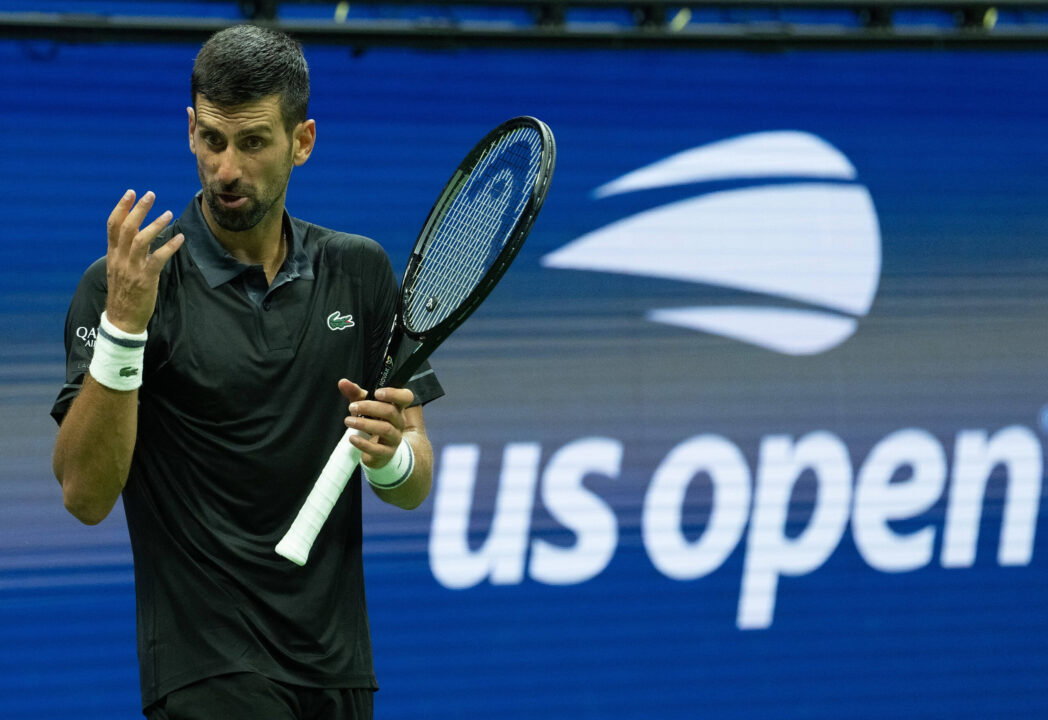
Imago
2026 US Open – Day 1 NEW YORK, NEW YORK – AUGUST 30: Novak Djokovic of Serbia reacts during his match against Mariano Navone of Argentina during the 2026 US Open – Day 1 at USTA Billie Jean King National Tennis Center on August 30, 2026 in New York, New York. New York USTA Billie Jean King National Tennis Center New York United States Copyright: xSusanxMullane/ISIxPhotosx 9746
At a press conference at the 2026 US Open in August, prior to an exhibition at Arthur Ashe Stadium, Federer was very open about Djokovic’s relentless drive and his ability to still be in the race. “I feel that every time Novak comes into a tournament, a major, he’ll be in it with a shot,” said Federer at Flushing Meadows. “So I always think that as long as he’s in the draw there is a chance. And I think that’s one of the reasons he’s still playing actually, because he genuinely has to believe he can still do it. That’s my view as well.”
Federer also pointed to the physical and tactical progression that has enabled Djokovic to outlast his contemporaries right into his late 30s. “I mean, I feel like whenever Novak enters any tournament, for that matter, or major, he’ll be in it with a shot,” said the 20-time major champion. Federer said during the US Open media session. “So, I always think that, as long as he’s in the draw, there is a chance. And I think that’s also one of the reasons he’s still playing because he actually truly must believe that he can still do it. And that’s my opinion too.”
Those words carry a specific resonance coming from a player who competed at the top level right into his late 30s, reaching the Wimbledon quarterfinals at 39 in 2021 and qualifying for his final ATP Finals at the same age in 2020 before knee surgeries curtailed his career. Having personally navigated the physical toll of battling players half his age across grueling tour seasons, Federer’s public endorsement underscores that Djokovic still possesses the fundamentals to challenge the very best.
Overcoming the 2026 Stumble Before 2027
To turn Federer’s records into reality, Djokovic would have to deal with the consistency issues that effectively killed off the second half of his 2026 season. He did reach the Australian Open final and made it to the Wimbledon semis, but his Masters 1000 form collapsed. In 2026, he won just 3 matches at the Masters 1000 level and failed to reach a single quarterfinal at that level for the first time in 21 years.
His late-season push for Turin collapsed in quick succession. After a second-round defeat to Hubert Hurkacz in Shanghai, Djokovic took a late wildcard into the Swiss Indoors in Basel, where he was again knocked out in the second round by Jan-Lennard Struff. Heading into the Rolex Paris Masters needing a semi-final run to stay in the PIF ATP Live Race to Turin, Djokovic was defeated in a three-set match by world no. 83 Rinky Hijikata, ending his run with 2,940 points.
“It’s time to rest,” he told the media after his Paris Masters exit.
Ironically, by missing the 2026 ATP Finals, Djokovic gets a massive off-season to recover in advance of the 2027 Australian Open. Rather than having to go through the gruelling indoor schedule in November, he can now take nearly 10 weeks to get himself back in shape before heading to Melbourne Park, where he has won a record 10 titles.
Missing out on Turin in 2026 gave Djokovic a very real sense of vulnerability and at the same time crystallized his remaining aims on the ATP Tour. He’ll be 40 in May 2027, so the biological clock is definitely ticking, but history has shown time and again that Djokovic performs at his very best when he’s chasing a specific, tangible objective. Federer’s career stats are very much in his path – 103 titles and 17 ATP Finals appearances. Federer’s own enduring legacy may well be the very thing that sets Djokovic back in the direction of Turin one final time.