Roland Garros Lauded for Making ‘Great Decision’ That Other Tour Events Should Follow

Add us on Google
Roland Garros Lauded for Making ‘Great Decision’ That Other Tour Events Should Follow
Add us on Google
Imago
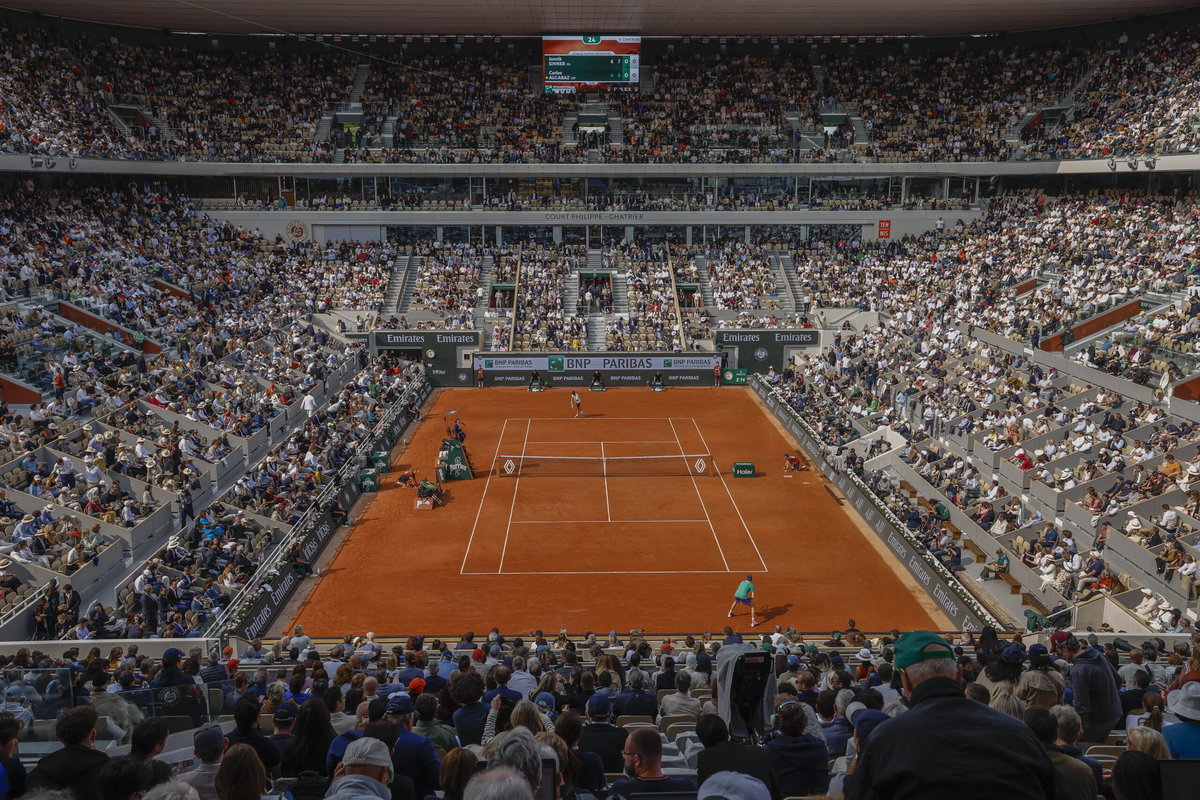
June 8, 2025, Paris, Paris, France: General view during the tennis Grand Slam of Roland Garros 2025 menÃââ s final match between Jannik Sinner ITA and Carlos Alcaraz ESP at Philippe Chatrier central court in Roland Garros Stadium – on June 08 2025.Paris – France Paris France – ZUMAb253 20250608_zsp_b253_093 Copyright: xLoicxBaratouxx
Imago
June 8, 2025, Paris, Paris, France: General view during the tennis Grand Slam of Roland Garros 2025 menÃââ s final match between Jannik Sinner ITA and Carlos Alcaraz ESP at Philippe Chatrier central court in Roland Garros Stadium – on June 08 2025.Paris – France Paris France – ZUMAb253 20250608_zsp_b253_093 Copyright: xLoicxBaratouxx
The era of Electronic Line Calling quickly took over the Grand Slams. As the line judges were made redundant by other slams, the French Open decided to go against the new normal. Their recent decision regarding the line judges earned high praise from a former player. The French Tennis Federation can just set another precedent for the other slams again.
Watch What’s Trending Now!
The FFT decided to retain the services of the line judges. In clay courts, the mark of the ball when it hits the ground is clearly visible to the human eye compared to hard or grass courts, where there are no obvious marks. Therefore, using human judges instead of the electronic line-calling system will be a prudent choice, as the mark can be easily spotted, unlike the artificial system, which has an in-built error rate that can often render results inaccurate. That is the point forcefully made by former World No. 1 Doubles player Paul McNamee, who supported the French Open’s decision.
Taking to Twitter, McNamee also opined that other Tour-level clay court competitions should also follow suit after the premier clay-court event on the calendar, saying “Great decision by @rolandgarros to retain linespeople … a ball mark on clay is visible to the naked eye, & is more accurate than the technology which is known to be imperfect with a coefficient of error… Tour events on clay ought to follow the best clay court event in the game”.
Great decision by @rolandgarros to retain linespeople … a ball mark on clay is visible to the naked eye, & is more accurate than the technology which is known to be imperfect with a coefficient of error… Tour events on clay ought follow the best clay court event in the game
— Paul McNamee (@PaulFMcNamee) May 19, 2026
While the Australian Open (2020), the US Open (2021), and Wimbledon (2025) all adopted ELC, Roland Garros held firm. Even Wimbledon, a tournament steeped in tradition, made a bold move last year by removing line judges and adopting the ELC system.
However, the French Open strays away from electronic reviews as well. The slam only started hosting night games in 2021 after installing floodlights and a retractable roof.
The electronic line-calling system was adopted to reduce human error at critical points in high-pressure matches, but it has experienced notable glitches that have often courted controversy.
The Electronic Line Calling System Is Far From Foolproof, and That Has Led to Controversies
Last year, when Wimbledon switched to ELC, it attracted a lot of attention, and people were keen to see how the new technology would perform. During one of the fourth-round matches between Anastasia Pavlyuchenkova and Sonay Kartal, the system was at the center of controversy.
During a very crucial stage in the first set, a ball hit by Kartal looked decidedly long to the naked eye, but there was no call from the electronic system. The ball was clearly long, so the chair umpire took control and asked the point be replayed, which went in favor of the local favorite. Pavlyuchenkova was irritated and even accused of local bias, as Kartal was a British player. Later, investigations revealed that the electronic system was switched off in some parts of the court, resulting in missed calls.
Even the match between Taylor Fritz and Karen Khachanov had a similar glitch, in which a ball that was clearly in was called out by the ELS’s automated voice. Other external factors affect the functioning of the ELS as well, as seen in the match between Luciano Darderi and Rafael Jodar at the recently concluded Italian Open.
During the match, the stadium was filled with smoke from celebrations at a nearby football game, which shut down the ELS. The tracking cameras could not operate in the smoke, prompting the chair umpire to halt the match. Elena Rybakina received a contentious call during her Madrid Open match against Zheng Qinwen, prompting even the calm Kazakh to complain to the chair umpire.
The ELS’s built-in error coefficient is prone to periodic incorrect calls on clay courts, as the topsoil often shifts on the court, creating a disparity between where the ball actually landed and where the tracking system thought it landed. On the other hand, manual ball-mark checks need the umpire to see the right mark. That was a cause of controversy at the 2024 French Open final, where the chair umpire made a call with the naked eye, giving Carlos Alcaraz the advantage over Alexander Zverev. The French Open did not have ELS, but Hawkeye replays showed that the ball was out, and Zverev was robbed of a 2-2 parity in the final set.
Players have not been fully trusting of the ELS, but in modern times, the introduction of technology into sport might be a foregone conclusion, and it will be interesting to see how long the French Open can hold out against the tide.
