
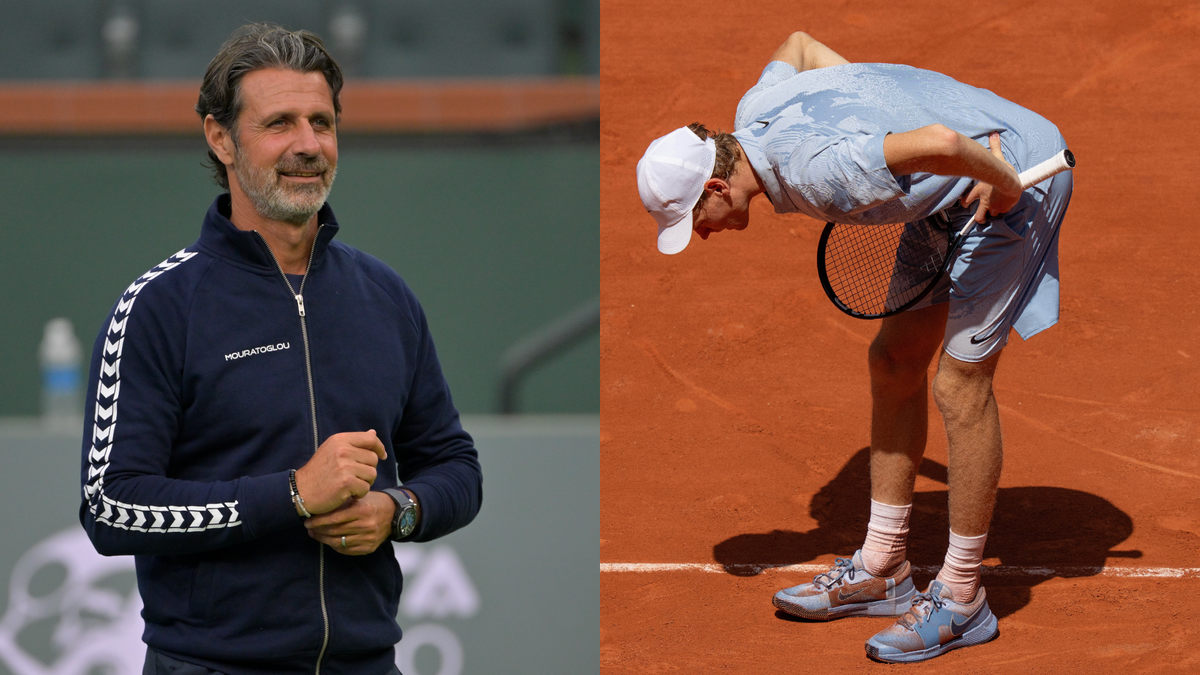
Jannik Sinner was four points away from sealing a spot in the third round as he led 6-3, 6-2, 5-1 against Juan Manuel Cerúndolo before his body gave up. The world No. 1 dropped 11 of the last 12 games and left the court looking like a different person as Cerúndolo pulled off one of the biggest upsets in recent French Open history. The question that dogged him into his press conference was the same question everyone in Paris was asking, and an iconic tennis coach believed the explanation wasn’t as straightforward as it seemed.
Watch What’s Trending Now!
“It really wasn’t because of the heat. The conditions were perfectly acceptable for playing. It was just me today. I didn’t sleep well, and I didn’t feel well when I woke up,” he said after losing 6-3, 6-2, 5-7, 1-6,1-6.
“And there’s a big difference,” Jannik Sinner added. “Shanghai was very tough. Humidity is very high. Australia was very, very warm. It’s different when you play on a hard court because the heat also comes from underneath. Here it was warm, but it was okay. It was not like I was dying because of the heat. I think today was a completely different scenario. I don’t remember the last time I felt so weak,” he further revealed as the Parisian temperature peaked between 32-33 degrees C on the match day.
French coach Patrick Mouratoglou, who helped Serena Williams win 10 of her 23 Grand Slam titles, knows the difference better. He’s studied the best players in the world for thirty years and had a very different take on the same press conference.
“Everybody got extremely surprised, understatement, by Jannik’s loss at Roland Garros,” Mouratoglou said on Instagram. “For me, it’s 100% a mental issue. The real message I get from his press conference is the fact that he doesn’t want his opponents to know that he has a weakness there. He actually has one big weakness, which is his resistance to extreme heat and humidity. When you have both, it’s even worse.”
View this post on Instagram
Mouratoglou’s argument is not purely speculation. He pointed to a pattern that has been developing for two years. “That’s not the first time it happened. It happened in Shanghai. He had to retire during the match because he was cramping all over his body. He almost lost at the Australian Open.”
His cramps worsened until officials shut the roof and activated air conditioning due to the temperature as he won. The roof that saved Jannik Sinner in Melbourne, and the dry Paris heat that just missed the WBGT threshold for a cooling break, were the difference between Sinner surviving and Sinner collapsing.
Sinner himself admitted how the roof saved him at the Australian Open. “I got lucky with the heat rule. If he keeps playing the way he was playing, maybe I was dropping a little bit, maybe my tournament was over today,” as he beat Eliot Spizzirri in a 4-6, 6-3, 6-4, 6-4 in the third round. He eventually went on to lose a marathon semifinal to Novak Djokovic.
“I understand why he doesn’t want to admit it,” Mouratoglou said. “He probably doesn’t want his opponents to think that, when it’s really hot, if they play against Jannik, they have a chance. That’s a real concern for Jannik.”
The Road Ahead for Jannik Sinner Makes the Issue Harder to Ignore
Mouratoglou’s warning lands harder now: clay season ended, harder conditions ahead.
“Now he has to focus on Wimbledon, but right after that it’s the American Swing,” Mouratoglou warned. “Extreme conditions. The heat and humidity are terrible. And that’s often the case at the US Open too.”
Sinner has already announced he will skip Halle and head straight to Wimbledon, giving himself maximum recovery time after Paris. Wimbledon starts June 29th, and the American hard court swing follows regardless of rest, and New York in late August is precisely the kind of atmosphere Mouratoglou is talking about. If the vulnerability to conditions is real, the slate in the second half of the year will test it over and over again.
Besides, Sinner’s genetics might play a role in his perception of extreme heat as well. The MC1R gene is responsible for the unique red hair Sinner has. The gene produces pheomelanin, which amplifies heat perception instead of eumelanin, which protects skin from heat. Sinner’s skin is not only burning faster. His nervous system may be registering the heat more acutely, sending distress signals sooner and louder, leading him to feel extreme tiredness quicker than his opponent.
Sinner’s winning streak of 30 matches won is over, for now. His attempt to complete the career Grand Slam at Roland Garros has been put back at least a year. Whether his exit was a result of illness, heat, fatigue, or a combination of all three may never be fully resolved. But Mouratoglou’s point holds, regardless of the reason: Sinner decided not to tell the full story in that press conference, and his opponents will have taken note.