
Imago
Helicopter Aerials during the Miami Open tennis tournament, Saturday, Mar. 23, 2024, in Miami Gardens, Fla. (Hiro Ueno/South Florida Stadium)
Imago
Helicopter Aerials during the Miami Open tennis tournament, Saturday, Mar. 23, 2024, in Miami Gardens, Fla. (Hiro Ueno/South Florida Stadium)
Remember Dylan Colaci? He first grabbed headlines in 2014 when Roger Federer casually flicked a ball his way, and the 14-year-old responded with a stunning one-handed catch. This year, at the Australian Open, now 24-year-old Dylan reunited with Federer to relive that magical moment. But in a remarkable twist, the spotlight at the ongoing Miami Open shifted to a 69-year-old ballkid, Maureen Olson, rewriting expectations entirely.


“I outrun some of the kids,” said Olson while speaking to Telegraph Sport about the demanding shuttle runs during trials at the Miami Open. She described the selection process as intense and physically challenging. Her words immediately set the tone for her remarkable story.
Watch What’s Trending Now!
“Even when I’m walking around, I get double looks with the uniform,” Olson added with a laugh. “I think it’s hysterical. Because I know what they’re thinking.” Her presence continues to surprise many at the tournament.
Olson is now in her third year as a volunteer ball person in Miami. Her passion for tennis and the role is clear. Like others in her category, she returns year after year, driven by pure love for the sport.
Imago
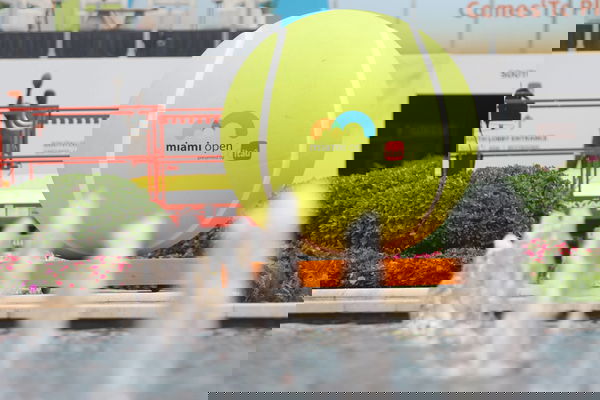
March 15, 2026, Miami Gardens, Florida, USA: Detail view of a tennis ball display outside the grounds on Opening Day of the Miami Open at Hard Rock Stadium. Miami Gardens USA – ZUMA 20260315_mda_v151_203 Copyright: xLorenzoxVasquezx
Outside the tournament, Olson works as a Starbucks barista. During the event, she swaps that role for long days on court. She spends up to 10 hours in the South Florida heat, dressed in the bright Lacoste orange-and-white uniform.
“I don’t think people realise how detailed and demanding it really is,” she explained. “They just see people out there throwing the ball; it’s so much more than that.” Her statement highlights the precision and discipline required.
The structure of ball person selection varies across tournaments. At Wimbledon Championships, ball boys and girls are chosen from local schools after strict trials. In contrast, the Miami Open has no upper age limit for its ball persons.
There are also differences in compensation. At the US Open, ball persons are paid for their work. However, the Miami Open relies entirely on volunteers, making the commitment even more notable.
This year, 815 applicants competed for 421 available spots. The youngest selected was 13, while the oldest was 71. Those aged 55 and above are called the “silver streak,” and several of them, including a husband and wife, even appeared together in court, proving age is no barrier.
And to be clear, she isn’t the only one making headlines at the Miami Open, as several other “silver streak” members have also stood out, quietly supporting players and proving age is no barrier on court.
65-year-old Ray Waterhouse reveals how he discovered the Miami Open volunteer opportunity
It was Ray Waterhouse’s wife who first told him about volunteer roles at the Miami Open four years ago. She was eager to become an airport greeter for Rafael Nadal. That initial interest sparked their involvement with the event.
However, things did not go as planned for her. “The funny thing is, she never got to be an airport greeter,” Waterhouse says, explaining that too many people applied and cuts had to be made. His wife was among those who missed out.
For Waterhouse, the attraction was different. He wanted to be closer to the action on court rather than off it. That goal pushed him to pursue the demanding role of a ball person.
Still, earning that opportunity was not easy. “There’s so many hard things that it takes to be able to get on the court. Just driving here every day is a pain in the neck. And 250 kids in a room? Not easy.” His words reflect the competitive and logistical challenges.
Despite the obstacles, the reward made it worthwhile. “The training is hard for someone my age, but then once you get on the court, it’s electric. It’s just awesome. It’s one of the rare things that someone of my age can do at one of these events.” The experience clearly holds special meaning.
Other participants share similar perspectives. Alyssa Griffin, 55, and her 60-year-old husband, AJ Russo, are in their second year working matches together. Their involvement highlights the inclusivity of the event.
Russo pointed out the mental demands of the role. “The mental aspect is really, really tough about it, and if you don’t stay focused on the court, you’re gonna make a mistake,” he said. His comment underscores the concentration required.
Marc Adler, the director of ball persons, enforces strict selection standards. He ensures that every participant meets the same expectations regardless of age. “As long as you can come out, go on the court, run, show us that you’re able to, you know, hold up like everybody else, no matter the age you are, perform the way we expect of you, be fast, be focused, be mature, then we will give you that same opportunity,” said Adler.
Experience also plays a role in handling the physical strain. Sixty-year-old Robert Williams, who has worked the US Open, understands the demands well. “When it’s 95 degrees outside, and you’re running for six to eight hours a day, it can be really difficult,” he said.
James Blake, now the Miami Open’s Tournament Director, values their contribution. “They’re volunteers, and it gives them something positive to do something where they do make a difference,” he said.
And now, as the tournament nears its conclusion, with only the women’s doubles final and men’s singles final remaining, these stories highlight the dedication behind the scenes and invite reflection on the true impact of ball kids.
