
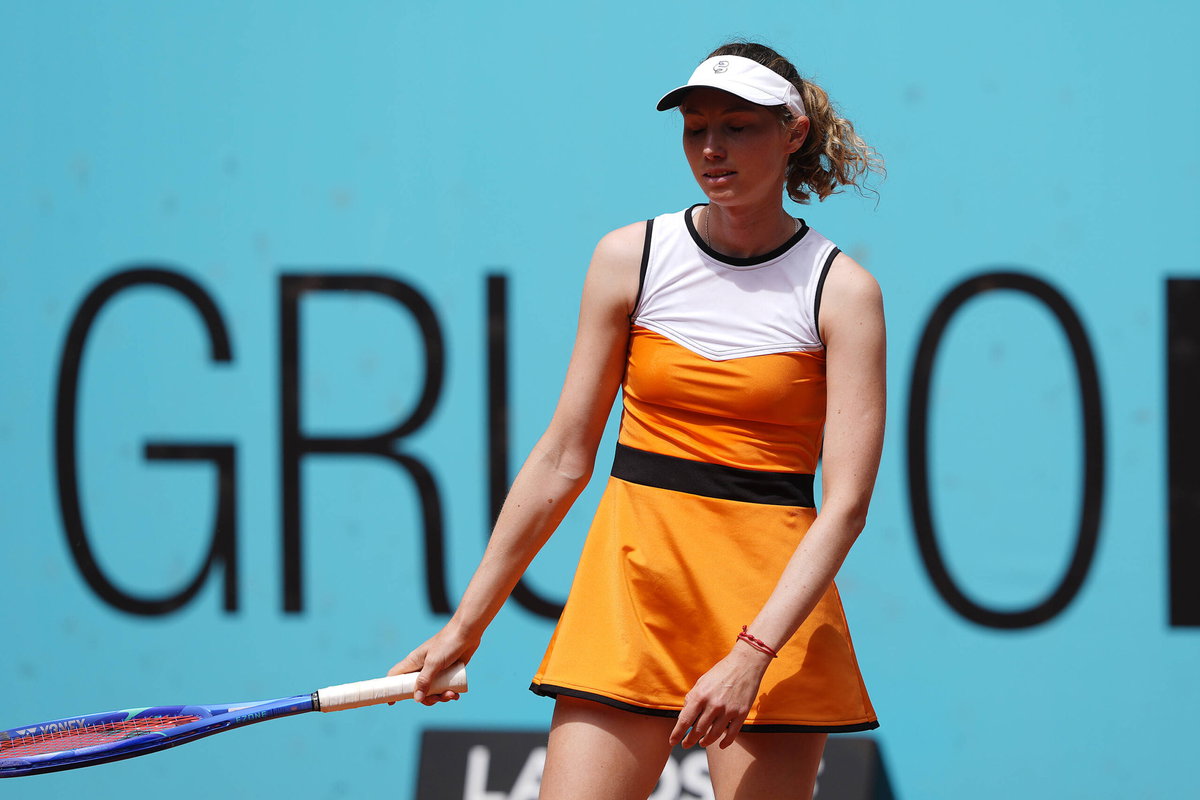
Cristina Bucsa’s tennis journey has been anything but ordinary. Born in Moldova, she moved to Spain with her family when she was just three and grew up training in Cantabria. She quickly made her mark, winning regional and national titles across multiple age groups before eventually breaking into the world’s top 30.
Watch What’s Trending Now!
So when a player of her level is still choosing her equipment based purely on comfort rather than sponsorship, it naturally raises questions. Why isn’t someone with her resume tied to a major gear deal? Now, Bucsa has finally opened up about the challenges she has faced on that front.
After losing in the second round of the Mutua Madrid Open to Zeynep Sonmez 6-1, 6-7(4), 6-2, Bucsa addressed the question that has followed her throughout her career, now with a new urgency attached to it.
Spain’s Higher Sports Council, the CSD, has brokered sponsors and other benefits for other high-profile Spanish athletes. Bucsa bluntly answered the question about whether the CSD had approached her for sponsorship deals. “The Higher Sports Council hasn’t contacted me yet. Some people have contacted me, but I didn’t like their proposals. So I’m still waiting for someone who is willing to invest in my career,” she said.
The revelation is significant when her status is considered. The Spanish star is World No. 30 and the top-ranked Spanish woman in WTA singles. She secured her first WTA singles title earlier this year at the Mérida Open, the first for a Spanish woman in years.
She also holds an Olympic bronze medal in the women’s doubles from Paris 2024 (with partner Sara Sorribes Tormo). But she enters the clay court season, the most significant part of her year, without the formal support that might be expected for her level of success.

🇪🇸Bucsa continúa sin patrocinadores: 😔"Sigo esperando a alguien que se atreva a apostar por mi carrera" puntodebreak.com/2026/04/24/buc…
It’s not a new situation. Until recently, Bucsa was the only player in the world’s top 100 without a clothing or racquet sponsor. She shopped for her own clothes and decided on racquets by trial and error. She finally signed a deal with Country Club by Dasha, a Singapore-based clothing brand owned by former tennis player Dasha Berezhnaya, in 2025. This was a milepost, but the bigger picture is that Spain’s top female tennis player is funding her career without the support that those ranked well below her enjoy.
Bucsa’s support team is no different, with the same do-it-yourself spirit. Her father, Ion Bucsa, a Moldovan biathlete who competed in the Nagano 1998 and Salt Lake City 2002 Winter Olympics, is her coach, her osteopath, her physiotherapist, her masseur, her nutrition and fitness trainer. The team of experts, four or five people, that other top-30 players employ is personified in one person for Bucsa.
“Besides being my coach, he’s also an osteopath, physiotherapist, masseur and he knows a lot about fitness and nutrition,” Bucsa has said.
It is a set-up born of necessity that has, somehow, created a top-30 player and an Olympic medalist.
Bucsa has no Instagram. No TikTok. No X account. Just a Facebook page that she rarely touches, mainly to schedule training time with other players.
This is the exact reason why she stated that she is waiting for someone “brave” enough to bet on her career. Brands will not be interested in an athlete who has no social media presence, as that will result in much less reach to the crowds. It is a big gamble for brands to back a player with no social media presence, and that’s where the CSD comes into the picture.
It makes sense for her, a psychology major and philosophy reader who has never craved the limelight. But it poses a conundrum: a player who does not want to be found, and wonders why she is not being found.
But the Madrid conference reveals that the realities are beginning to set in. Proposals have come, but she has not liked them. The Spaniard is still waiting; however, the circumstances shouldn’t require it.
Golf shoes at Wimbledon and a father who does it all: The story of Spain’s No. 1
The tale of Ion Bucsa’s involvement in his daughter’s career is one of the more fascinating in the history of women’s tennis. An Olympic biathlete turned, step-by-step, into everything that a high-class tennis operation needs.
After his daughter’s Olympic bronze in Paris, the relief and ambition in his voice were visible. “Let’s see if she opens up a bit now and we can find a sponsor,” he said. A line that summed up the disparity between what Cristina had done and what she had in return.
The story that is most emblematic of the charms and challenges of the Bucsa operation took place at Wimbledon in 2019. In the lead-up to her first All England Club appearance, the 28-year-old had bought a pair of grass-court shoes online. When the package arrived, it only contained sunglasses instead of the shoes she ordered. With time to spare, her entourage went to Decathlon and tried golf shoes, as they have grass spikes, but they are not made for tennis and are not allowed in tournaments.
They found a tennis shop near Wimbledon. It was the only pair they had, two sizes too big. There were no alternatives. She bought them, filled them with socks to prevent them from slipping, and won a qualifying match.
What she did in SW19 was a testament to her passion for the sport and the sheer talent Bucsa possesses. It is not surprising that a player who has achieved her success entirely without the support, also became Spain’s top-ranked woman not despite the constraints of her situation, but alongside them.
As she has gotten there, World No. 30, Olympic medal winner, Spanish No. 1: the question of why she has not received the support may be one that Spanish tennis and the CSD find hard to sidestep.