Imago
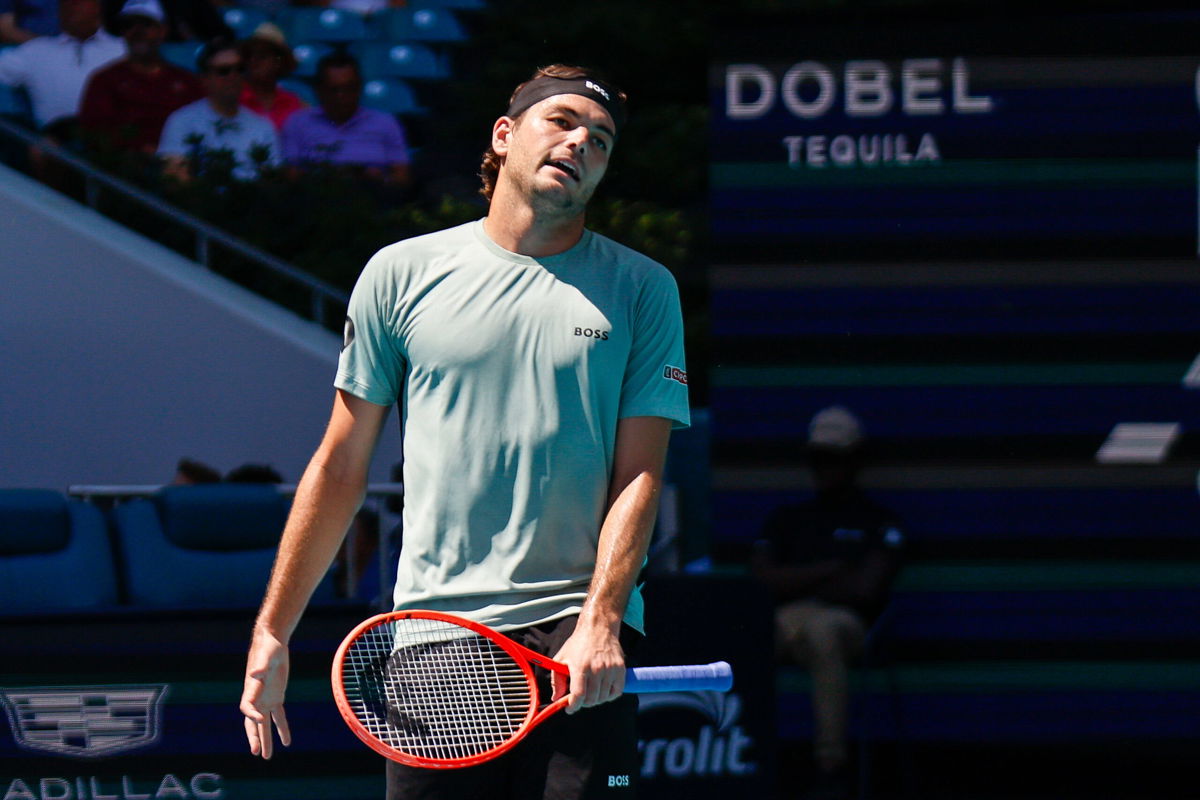
MIAMI GARDENS, FL – MARCH 24: Taylor Fritz USA reacts during a mens fourth round singles match against Jiri Lehecka CZE at the Miami Open on March 24, 2026, at Hard Rock Stadium in Miami Gardens, Florida,Photo by Chris Arjoon/Icon Sportswire TENNIS: MAR 24 Miami Open EDITORIAL USE ONLY Icon2603240010044
Imago
MIAMI GARDENS, FL – MARCH 24: Taylor Fritz USA reacts during a mens fourth round singles match against Jiri Lehecka CZE at the Miami Open on March 24, 2026, at Hard Rock Stadium in Miami Gardens, Florida,Photo by Chris Arjoon/Icon Sportswire TENNIS: MAR 24 Miami Open EDITORIAL USE ONLY Icon2603240010044
Taylor Fritz’s third-round exit at the Miami Open against Jiri Lehecka in three sets was rather telling. He struggled with his serve, winning just 72% of his first-serve points. That’s a relatively low figure for a player who often ranks among the top two in that category. Now, this issue largely stems from an injury that has hampered him for the better part of a year and has now finally forced his hand.


The world No. 7 has withdrawn from the upcoming clay Masters 1000, Monte-Carlo, due to his knee tendinitis. This injury has hindered Taylor Fritz since early 2025. What began as post-match pain that could be managed during cooldown has developed into difficulty bending his knee, severely hampering his serve.
Watch What’s Trending Now!
The timing of the break offers some comfort, given that clay is not his strongest suit. Throughout his career, he has recorded a win percentage of 56.5% on clay, which is his lowest across all surfaces. On the other hand, he has a win-loss percentage of 64.8% on grass, where he has won five of his 10 ATP titles.
Now, despite facing challenges with this issue throughout, he managed to stay in the top 10 of the world rankings. Fritz won titles at Stuttgart and Eastbourne last year and later reached the semifinals of Wimbledon, where he lost to world No. 1 Carlos Alcaraz in a tough four-set match. This propelled him to reach Turin for the ATP Finals, but there, after a long match against the same opponent, he said that his knee was “completely cooked.”
🚨 Taylor Fritz déclare FORFAIT pour le Masters 1000 de Monte-Carlo (5-12 avril). ❌🇲🇨
Deuxième membre du TOP 10 absent du tournoi après Ben Shelton. 🇺🇸
L’Américain, toujours gêné par son genou, pourrait manquer d’autres tournois sur terre battue. 🧱 pic.twitter.com/sRVgJA0WGX
— Univers Tennis 🎾 (@UniversTennis) March 26, 2026
The unpredictability of the injury has been the most frustrating element for the American. Before entering the Miami Open, he had suggested that he could take a break after the conclusion of the Sunshine Double, and that’s exactly what followed.
“I’m still managing my knee. Some days it’s better than others, and I don’t know why exactly. In Dallas, for example, it felt amazing, and it didn’t bother me at all the whole tournament. I felt like I was moving great. And then, in the lead-in to Indian Wells, it wasn’t. It felt like I almost regressed a little bit. The same thing happened in Australia, as well,” Fritz stated.
The results across 2026 have reflected such inconsistency. The 28-year-old reached the fourth round of the Australian Open, losing to world No. 5 Lorenzo Musetti in straight sets. He followed that up with a strong run at the Dallas Open, reaching the final of the event.
But after that, he could only squeeze two wins at Delray Beach and Indian Wells combined. The Lehecka loss at Miami was the last piece of data in the pattern that Fritz and his coach, Michael Russell, had been tracking so carefully at this point, and the answer was obvious.
“We said, after Miami, if we’re not seeing big improvements, it might be time to… just, like, slow down a bit on the playing and get it healed 100 percent,” Fritz said.
The Miami exit settled it. Monte-Carlo is off, and a broader clay-court withdrawal looks increasingly likely as Fritz prioritizes getting the knee right once and for all. But before taking this break, the American was iffy about his decision.
Taylor Fritz was hesitant to take the break
The former world No. 4 has never been a quitter when it comes to the tour. Even now, with the injury acting as the deciding factor, the temptation of the ranking race has not made the decision any easier. During an interview with Bounces, Taylor Fritz explained precisely what makes a break so difficult to swallow.
Imago
Image Credits: Taylor Fritz/Instagram
“There’s a lot of that,” he said when asked whether he worries about missing out on points. “I hate being in a spot where people are picking up points, and I’m not giving myself an opportunity to pick up points. It sucks.”
And that fear is based on a bad experience.
“I hate kind of having to play catch-up, like I did last year: I came back at the end of clay-court season, and I was like 20th in the race. And I was stressed out that we’re halfway through the year, and I was like 20th in the race. So I don’t like putting myself in those positions. I mean, obviously it worked out for me last year, but I obviously don’t want to keep putting myself in those situations where I’m playing catch-up, because I’ve missed time,” Fritz added.
It worked out for him last year, as he finished the season strongly, reaching the quarterfinals of the US Open and the final of the Japan Open. But the knee is posing a challenge that grit and resilience alone cannot solve.
Fritz does the most damage in the grass season, which starts in June at the Stuttgart Open. Being in shape by that window is the actual reward, and skipping Monte-Carlo is the first step towards it.
Written by

Edited by

Deepali Verma