Imago
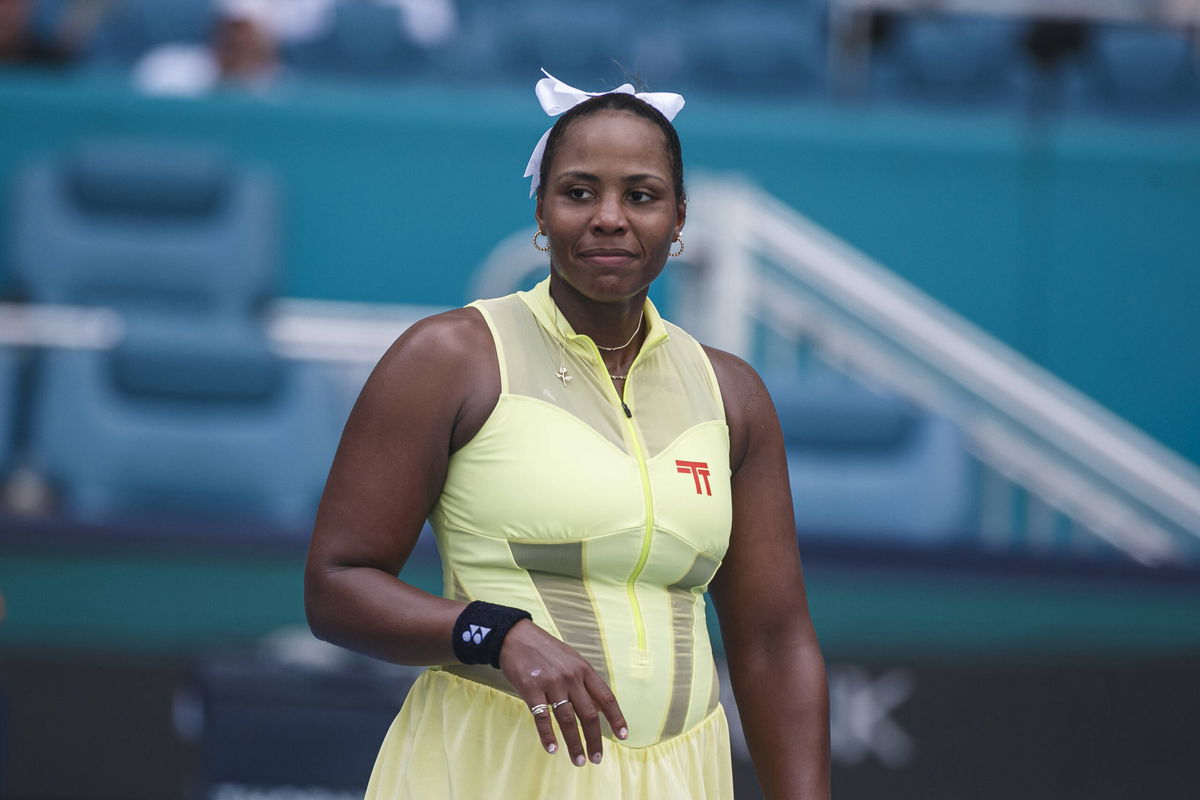
Miami Open Presented by Itau 2026 – March 27 Miami, Florida – March 27: play, react and celebrate during the match between Katerina Siniakova of Czechia / Taylor Townsend of USA against Gabriela Dabrowski of Canada / Luisa Stefani of Brazil on day 11 of the Miami Open at Hard Rock Stadium on March 27, 2026 in Miami, Florida, United States. Copyright: xLatinxSportxImagesx
Imago
Miami Open Presented by Itau 2026 – March 27 Miami, Florida – March 27: play, react and celebrate during the match between Katerina Siniakova of Czechia / Taylor Townsend of USA against Gabriela Dabrowski of Canada / Luisa Stefani of Brazil on day 11 of the Miami Open at Hard Rock Stadium on March 27, 2026 in Miami, Florida, United States. Copyright: xLatinxSportxImagesx
At a knife-edge moment in the Miami Open final, rain cruelly interrupted the battle as Sara Errani and Jasmine Paolini stood on the brink at 5-6, 40-0, serving to force a tiebreak against Katerina Siniakova and Taylor Townsend. The sudden halt froze the tension, leaving a roaring Stadium court in stunned silence. Yet moments after lifting the trophy, Townsend revealed she took a calming nap while her partner remained under pressure.


During the rain delay at the Miami Open, Taylor Townsend stayed relaxed. She said she ate, had long conversations with her partner, and even took a “mom’s 15-minute power nap.”
Watch What’s Trending Now!
In contrast, Katerina Siniakova felt pressure off the court. She was “stressed” because she had to change her flight to Charleston for the start of the clay season. Despite the tension, the duo used the break to regroup. “During the rain delay, we talked about what we wanted to do,’’ Siniakova said.
She explained how they reset mentally before returning. “We did kind of a reset. … We wanted to stay aggressive and stay there on every point.” Siniakova emphasized the clarity in their plan. “We knew what we wanted to do, and it helped us get into the zone and into our game.”
Imago
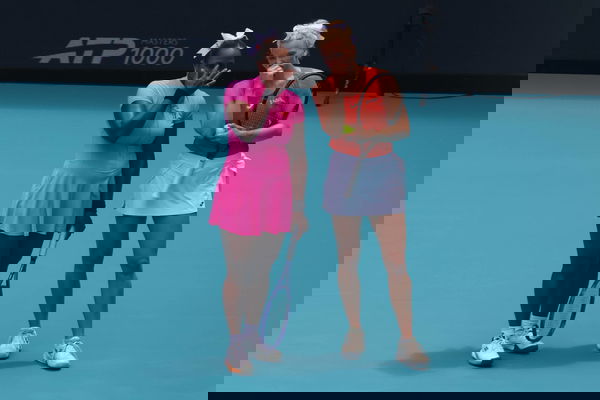
March 29, 2026, Miami Gardens, Florida, USA: TAYLOR TOWNSEND USA and KATERINA SINIAKOVA CZE during their women s doubles finals match against SARA ERRANI ITA and JASMINE PAOLINI ITA at the Miami Open at Hard Rock Stadium in Miami Gardens, Florida. Teennis 2026: Miami Open Women Doubles Finals PUBLICATIONxINxGERxSUIxAUTxONLY – ZUMAv151 20260329_zsp_v151_013 Copyright: xLorenzoxVasquezx
However, the chaos did not end with the weather delay. Once play was ready to resume, a surprising decision changed the flow of the final. The women’s doubles match was moved from the Stadium court to the Grandstand. This switch allowed the men’s final between Jannik Sinner and Jiri Lehecka to begin on the main stage.
Rain delays on finals day are not new in Miami. Typically, with two matches scheduled, both are played on the Stadium court, even if it takes longer.
This year, however, both finals ran at the same time. Fans were forced to choose between matches, which highlighted the ongoing lack of attention given to doubles tennis.
Townsend admitted the situation felt unusual. “I was a little bit surprised because that’s never happened in a final,’’ said Townsend, whose son Adyn turned 5 on the weekend the duo won Indian Wells.
Still, she remained focused on finishing the match. “Honestly, I didn’t really care; I just wanted to finish. I wanted to play. It was nice that the fans came out, and the stands weren’t empty.”
She also described her mindset during the delay. “I was just chilling [during the rain delay]. When [the tournament supervisor] said it was time to go, we went. I didn’t mind; a court is a court. That’s how I grew up. That’s how I was raised from the time I started playing. I played on courts with cracks and weeds up to here. As long as it has lines, you can do whatever you can do.”
After play resumed, Sara Errani held her nerve to serve the set into a tense tiebreak. The momentum briefly tilted, but the contest remained on a knife-edge after a long rain delay.
Within minutes, however, Taylor Townsend and Katerina Siniakova took complete control. They stormed through the breaker 7-0 and sealed a dominant 7-6 (0), 6-1 win, claiming 75% of first-serve points and converting 5-of-10 break chances.
The victory lifted them to No. 3 in the Doubles Race, while Jasmine Paolini and Errani moved from No. 8 to No. 6, both teams marking their second Miami finals runs.
And the Miami Open ultimately turned into a chaotic event, with relentless rain heavily disrupting matches throughout the tournament.
Rain havoc disrupts the majority of Miami Open matches in 2026
Even before the final-day chaos, this year’s Miami Open was already facing serious concerns due to rain. The disruptions were consistent from the very beginning of the tournament.
A similar situation unfolded during the Jannik Sinner vs Jiri Lehecka final. Play was halted for nearly 80 minutes just three points into the second set, but the interruption did little to shake Sinner’s rhythm, as he returned just as sharp and clinical as before.
Much to the frustration of fans, the tournament has been held in Miami since its move from Key Biscayne in 2019. The shift brought a new setting but also new challenges.
Each year, the Miami Dolphins’ Hard Rock Stadium is converted into the main Stadium Court. Organizers take pride in transforming a football venue into a tennis arena. However, the open structure of the stadium played a major role this year. Weather conditions exposed the limitations of the setup.
From the very start, rain disrupted scheduling. On March 17, organizers announced that no matches would be held on March 18 due to “heavy rainfall in the lead-up to the tournament.”
They explained that an extra day was needed to prepare the Stadium Court. The venue, which seats 13,800 spectators, had to be readied “for optimal conditions,” even though players had reportedly practiced there on March 17.
Problems were not limited to the main court. A first-round match between Matteo Arnaldi and Alexander Shevchenko was stopped midway because Court 4 lacked artificial lighting, making it impossible to continue after sunset.
Another unusual incident occurred during the match between Daniil Medvedev and Francisco Cerundolo. A spider cam cable became entangled in the umpire’s chair, causing a strange and potentially dangerous delay.
There was also controversy involving Aryna Sabalenka during the Miami Open. The defending champion was shifted from the main stadium to the Butch Buchholz court to make room for matches featuring Carlos Alcaraz and Joao Fonseca. The decision sparked criticism among fans and observers.
With the tournament now over and players heading into the clay season, focus turns to tournament director James Blake to address these recurring issues.
