
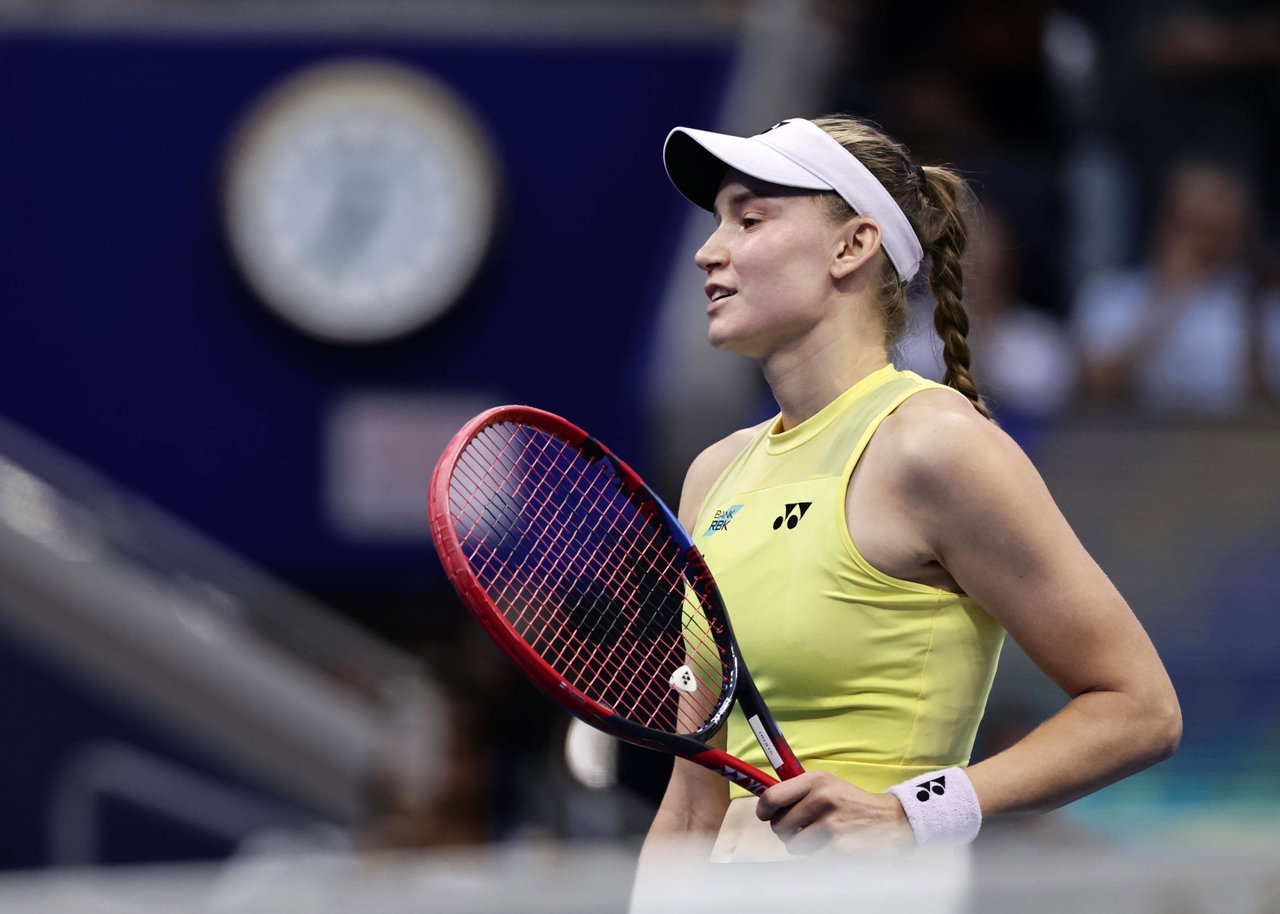
Elena Rybakina stepped onto the court in Cincinnati on Aug. 20 with strapping around her left ankle. Reaching the final would have made her world No. 1. But before that, her North American swing had already run to nine matches, six in Toronto, where she lost the final to Iga Swiatek, and three in Cincinnati. As fate would have it, down 4-1 to Swiatek in the first set, she had to retire after a medical evaluation. Twenty-three days later, she was holding the US Open trophy, having already clinched the world No. 1 ranking three days earlier. It was a remarkable turnaround, but that did not mean her injury troubles were suddenly behind her.
Watch What’s Trending Now!
After taking some time away, Rybakina arrived in Beijing and returned to the practice court on Sept. 28, practicing alongside Coco Gauff on Center Court ahead of the China Open. Gauff had only positive words about Rybakina’s trajectory, saying, “I mean, you reach a certain age, things start to come together. You start doing well, being more consistent. I think that’s where she’s at, in her prime. Yeah, but I think she’s going to win many more.”
However, pictures that circulated from the practice told fans a different story, with many expressing concern over Rybakina’s health and urging her to withdraw from the China Open, where main-draw play begins Wednesday.
“She really should take more rest and passing on Beijing She looks tired,allergies doesn’t look good. Even with Kazakhstan president,she didn’t look in top form When i think,she is thinking doing 2 1000 2 500 and finals..impossible,” one fan wrote.
Rybakina had picked up an Achilles tendon injury at the Cincinnati Open, which forced her out of the tournament during the quarterfinals against Iga Swiatek. “It’s painful to walk,” she said after leaving Cincinnati, adding that the issue had been bothering her for “a long period of time” and that an MRI would follow. Swiatek said afterward that watching an injury like that even made her feel “a bit like scared”.
Despite the injury, Rybakina pushed through the US Open, with the Kazakhstan Tennis Federation later saying she used painkillers during the latter stages of her run. She went on to win her third Grand Slam, becoming the 30th woman in WTA history to reach No. 1 and the first player representing Kazakhstan to do so. During her opening win in New York, she had already described her approach as taking it “a step at a time,” with recovery and the need to “listen to the body” as the priority.
Not long after that, she withdrew from Kazakhstan’s Billie Jean King Cup Finals team in Shenzhen, scheduled for Sept. 22-27, with her coaching staff noting that she needed at least two weeks of treatment and recovery. With barely any time between that announcement and the China Open getting underway, the redness around her eyes and overall look of exhaustion in Monday’s practice photos did little to reassure fans that she had gotten anywhere near the rest she needed.
As for the allergies mentioned by a fan earlier, Rybakina has said publicly that she has “a lot” of them and that a nutritionist and a physical therapist help plan her diet and monitor her body through the season. Before the Italian Open in May, she said she had struggled with them the week before, with some days better and some worse.
While there is no new medical update from her team, against such a backdrop, fans turned understandably concerned. “She still looks in a lot of pain,” one fan wrote. “She is not looking good,” another said.
The worry is compounded further by the state of the draw itself. Seven seeded players are missing from this year’s field entirely. Of the top 10 specifically, two have withdrawn: world No. 3 Jessica Pegula with a back injury and world No. 10 Marta Kostyuk with a wrist problem. The defending champion Amanda Anisimova, just outside the top 10 at world No. 11, has also pulled out because of a left wrist injury.
Fan reactions also went after the bracket. “Elena needs to boycott Beijing with that hellish draw and let some random lucky loser take the fall for her,” one fan wrote. “She looks a lot in pain and BEIJING TRYING TO K*LL HER WITH THE DRAW,” another put it more bluntly.
The WTA released the draw on Sept. 28 with Rybakina seeded first and given a first-round bye. Her quarter includes Chinese wild card Zheng Qinwen, who lost to her in the US Open quarterfinals, and 31st seed Wang Xinyu, also from China, along with sixth seed Elina Svitolina and ninth seed Belinda Bencic. The other quarter of her half holds Coco Gauff, Iga Swiatek and Iva Jovic. Sabalenka sits in the bottom half, so the US Open finalists could only meet again in the final.
Rybakina’s last three Beijing editions went three different ways. She reached the semifinals in 2023, beating Zheng Qinwen, Tatjana Maria, Mirra Andreeva and Sabalenka before losing to Liudmila Samsonova. A back injury forced her out in 2024, along with Wuhan. Last year, seeded eighth, she edged past Caty McNally in three sets in the second round before losing to Eva Lys in three sets in the third.
After Beijing, Rybakina’s calendar still includes the Wuhan Open, WTA Finals, and potentially more 500-level tournaments, leaving limited time to recover before year-end and the next Grand Slam in January 2027.