Imago
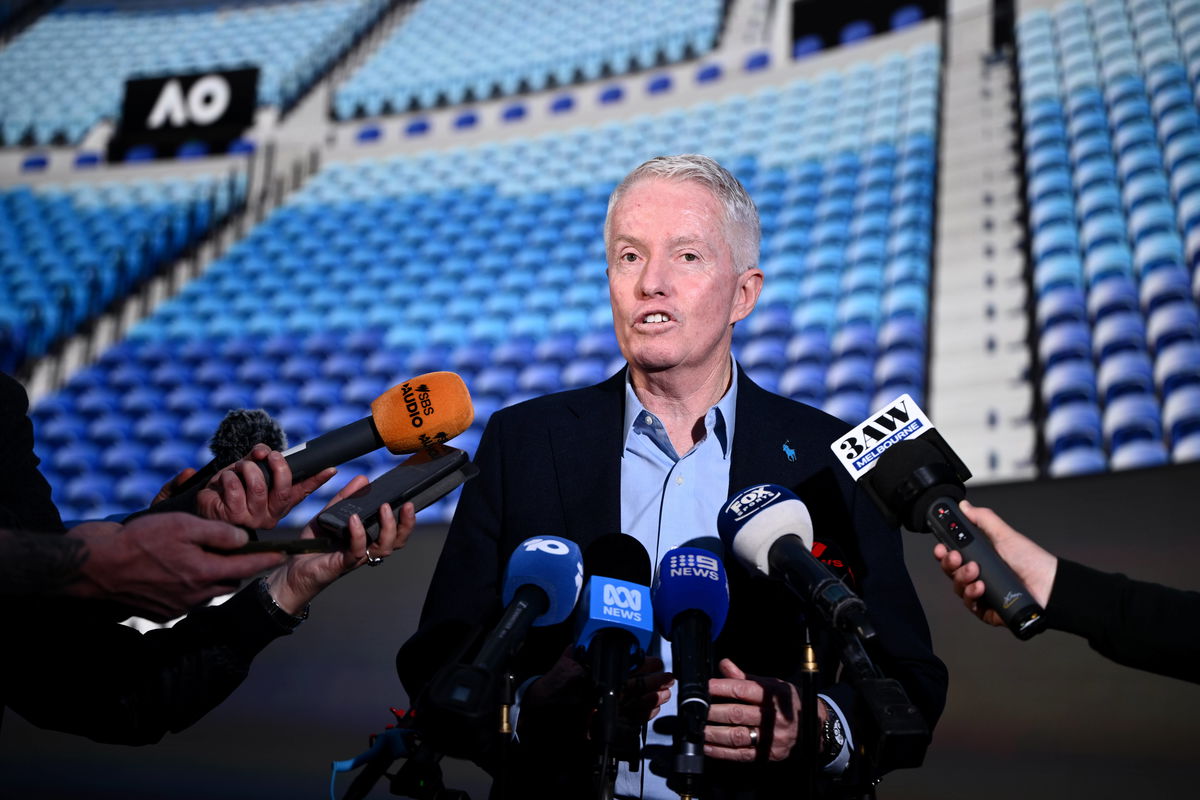
AUSTRALIAN OPEN TENNIS LAUNCH, Australian Open CEO Craig Tiley speaks to media following the launch of the 2026 Australian Open tennis tournament, in Melbourne, Tuesday, October 7, 2025. NO ARCHIVING MELBOURNE VICTORIA AUSTRALIA PUBLICATIONxNOTxINxAUSxNZLxPNGxFIJxVANxSOLxTGA Copyright: xJOELxCARRETTx 20251007181509994653
Imago
AUSTRALIAN OPEN TENNIS LAUNCH, Australian Open CEO Craig Tiley speaks to media following the launch of the 2026 Australian Open tennis tournament, in Melbourne, Tuesday, October 7, 2025. NO ARCHIVING MELBOURNE VICTORIA AUSTRALIA PUBLICATIONxNOTxINxAUSxNZLxPNGxFIJxVANxSOLxTGA Copyright: xJOELxCARRETTx 20251007181509994653
Imago
AUSTRALIAN OPEN TENNIS LAUNCH, Australian Open CEO Craig Tiley speaks to media following the launch of the 2026 Australian Open tennis tournament, in Melbourne, Tuesday, October 7, 2025. NO ARCHIVING MELBOURNE VICTORIA AUSTRALIA PUBLICATIONxNOTxINxAUSxNZLxPNGxFIJxVANxSOLxTGA Copyright: xJOELxCARRETTx 20251007181509994653
Imago
AUSTRALIAN OPEN TENNIS LAUNCH, Australian Open CEO Craig Tiley speaks to media following the launch of the 2026 Australian Open tennis tournament, in Melbourne, Tuesday, October 7, 2025. NO ARCHIVING MELBOURNE VICTORIA AUSTRALIA PUBLICATIONxNOTxINxAUSxNZLxPNGxFIJxVANxSOLxTGA Copyright: xJOELxCARRETTx 20251007181509994653
Before he could begin his new role leading American tennis, departing Australian Open boss Craig Tiley dropped a bombshell: the Australian Open was once on the verge of leaving Melbourne permanently.
Watch What’s Trending Now!
Speaking on SEN’s Whateley, Craig Tiley addressed the serious stakes surrounding the AO. He said, “If there was not an investment by the Victorian Government in the further redevelopment, it would have been gone by 2017.”
He continued, “Contract was up in 2016, and there was a great deal of interest from the city of Sydney, from the city of Shanghai. And you can see today why there was a great deal of interest in the impact that it has on the city.” With genuine interest from rival cities like Sydney and Shanghai, the tournament’s future in Melbourne was suddenly hanging in the balance.
Tiley later described the turning point. “So, the Victorian government made a very good decision back then to make an investment, and there’s a billion-dollar investment that was made in the precinct. Half of it was specifically for tennis players; the other half was a general upgrade to the precinct. So that was close.”

Imago
AUSTRALIAN OPEN TENNIS LAUNCH, Australian Open CEO Craig Tiley speaks during the launch of the 2026 Australian Open tennis tournament, in Melbourne, Tuesday, October 7, 2025. NO ARCHIVING MELBOURNE VICTORIA AUSTRALIA PUBLICATIONxNOTxINxAUSxNZLxPNGxFIJxVANxSOLxTGA Copyright: xJOELxCARRETTx 20251007175353623451
Today, the tournament is firmly based at Melbourne Park. The 2026 edition attracted more than 1.3 million spectators across qualifying and the main draw. The event continues to grow each year.


Over the past decade, it has generated nearly $3.5 billion for the Victorian economy. This makes it one of the state’s most important sporting assets. Its economic impact is significant.
However, stability was not always guaranteed. When the hosting contract expired in 2016, other cities were ready to step in. Sydney and Shanghai were strongly linked to possible bids.
Speculation grew in the late 2000s and early 2010s. Many believed the Grand Slam could relocate. The Victorian Government’s agreement created leverage for competing markets. The major shift came in 2010. A $363 million redevelopment was announced at Melbourne Park. It marked the first stage of a larger transformation.
The project’s expansion into a billion-dollar upgrade proved decisive, as the modernized facilities for players and fans strengthened Melbourne’s global position and secured the long-term confidence needed to fend off competing bids.
Tiley will soon replace Lew Sherr at the USTA. Sherr left to join the New York Mets of Major League Baseball.
The departing CEO later recalled another major challenge that emerged in 2020.
Craig Tiley reflects on how COVID-19 tested the AO management
The relocation scare was not the only time Melbourne risked losing the Australian Open. The COVID-19 pandemic created another serious threat. Strict border controls and quarantine rules placed the event in doubt.
Australia closed its borders and limited international travel. Organizers faced huge uncertainty. Once again, the tournament’s very existence was on the line.
Tennis Australia committed its entire $80 million cash reserve. It also secured a $40 million loan. These steps helped stage the delayed 2021 edition.
Chartered flights were arranged for players and support staff. This ensured safe entry into the country. The event went ahead despite global disruption.
Craig Tiley called that period a defining test. He said, “And then during Covid, we were reminded (that) when not running an event changes the event.” His message was clear.
He stressed the importance of continuity. “It was really important to get that going because that could have been a moment when, again, if the Australian Open didn’t happen, the players could point to the difficulty of the distance,” he explained.
He added, “And not having it for one or two of the COVID years would have negatively impacted (the tournament). So, we were very focused and very fortunate that we had a government that very clearly understood that if it didn’t happen, it’s going to be a problem.”
Today, the AO is contracted to stay in Melbourne until 2046. While the event is now on solid ground, past uncertainty still shapes its story.
Tiley now prepares to lead the USTA and oversee the US Open starting August 30, 2026. Many in tennis are watching closely to see how he manages his new role.
Related Newsletters