
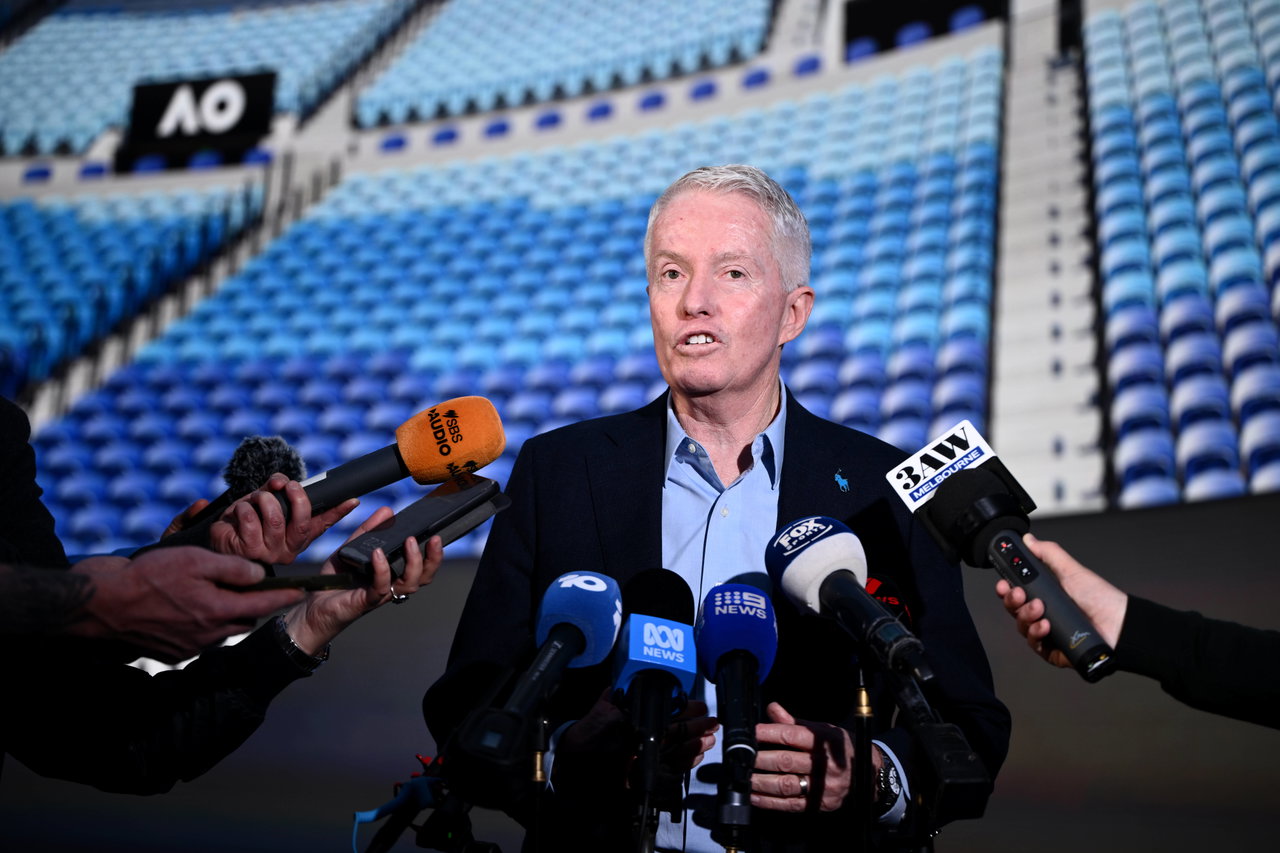
Grand Slam scheduling has been the topic of discussion in tennis for quite some time, and it looks like similar discussions are going to dominate the headlines once again at the upcoming US Open, under the leadership of new USTA chief Craig Tiley. Tiley’s move from the Australian Open to New York was highly publicized, given his successful tenure at Melbourne, but it looks like he has brought the scheduling controversies from Australia with him, prompting a tennis insider to take a swipe at him.
Watch What’s Trending Now!
“Women playing second on the first two US Open night sessions. Likely starting late and in half-empty stadium,” wrote Jose Morgado on X. “You can see Tiley’s influence already.”
Day 1 of the US Open will see the two-time champion Venus Williams take on Sofia Kenin at Arthur Ashe Stadium as the second match in the night session. Another two-time champion, Naomi Osaka, will play her match against Anastasia Zakharova in the same time slot on Day 2.
However, Morgado’s words hold merit, as both Williams and Osaka will be taking the court after Novak Djokovic and Ben Shelton have played their opening-round matches, which start at 7 pm. Should the men’s matches become a five-set slog, the women might find themselves on court near midnight. Now, the likes of Williams and Osaka do have the star power to draw a late-night crowd, but if the timing is pushed too far, casual fans, and especially families with children, will have to leave the building to find transportation home.
Scheduling controversies under Tiley’s regime are nothing new, as there have been marquee clashes at the Australian Open with record-breaking late finishes. Back in 2024, Daniil Medvedev finished a match as late as 3:40 a.m., while the 2023 clash between Andy Murray and Thanasi Kokkinakis finished beyond 4 a.m.
Tiley has not been shy of putting even the top-ranked female players during the second shift of the night session, as he put the defending champion, Aryna Sabalenka, second on the Rod Laver Arena back in 2024. The Belarusian got on court after Djokovic had played a four-hour marathon match in his first round, meaning that the women’s World No.1 had to play a Grand Slam match at midnight in front of a half-empty stadium.
During his tenure at the Australian Open, Tiley was not in favor of moving matches to other courts if an earlier match ran over, nor was he in favor of starting matches earlier, citing the tournament’s commercial interests. At the US Open, shifting the women’s matches to other courts would be a difficult decision to make, as that would mean not utilizing the seating capacity of the largest tennis stadium, Arthur Ashe Stadium.
Putting women during the primetime evening slots has long been a debatable issue in tennis, with the French Open seldom putting a women’s match in the night, even if it featured a top-ranked player, a norm that was broken this year with the match between Sabalenka and Osaka, which got the primetime slot on Phillipe Chatrier. Wimbledon has faced its own issues with its strict curfew, with matches often being stopped at crucial moments, and players having to continue playing the next day.
For Tiley, scheduling is not the first obstacle faced at the US Open. The former Australian Open boss was also against the players’ demands in the ongoing pay dispute, but he seems to have addressed them with a record-breaking prize money pool and player support programs.