
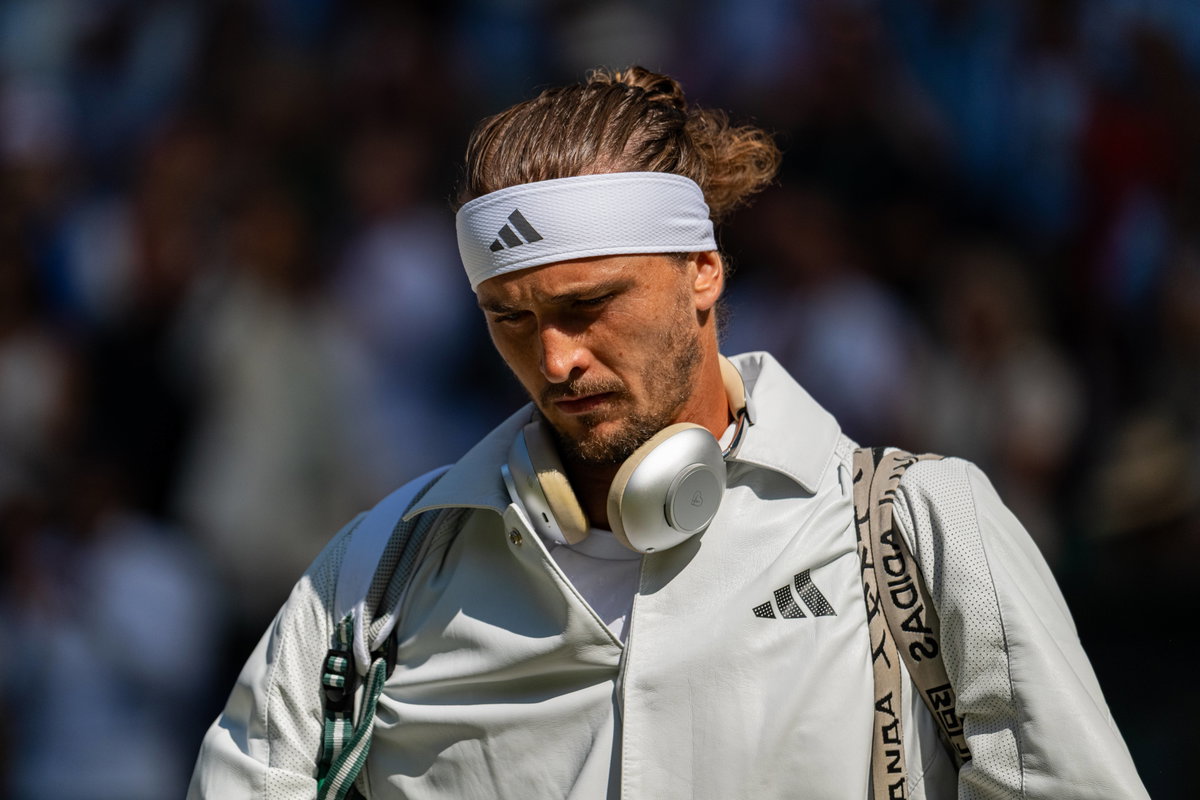
On the last night of the Laver Cup, Andre Agassi gave the most accurate psychological assessment of Alexander Zverev’s career. He turned directly to the German and began to mimic his voice, stating, “I mean, each and every one of you, congratulations, Sasha, on the crazy year. Seeing you win for the first time, I know how important that was to you. It was important to me too, because, you know, I could start listening to your press conferences again.”
Watch What’s Trending Now!
Agassi’s remark went straight to the heart of the current state of tennis. “Why do I always lose? Why do I always… Why am I the third-best in the world? I suck,” Agassi remarked. The O2 Arena laughed, but Agassi continued on Zverev’s mentality. “But then you win, and then it’s like, ‘I’m only a one-Slam champion. I’ve got to do it again!’”
For almost ten years, Zverev was known as a player with several ATP Masters 1000 titles, Olympic gold, and Tour Finals wins. Yet he never won the sport’s four greatest honors. Having now achieved a Grand Slam victory, the long-awaited outlet has not opened up. Rather than enjoying the recognition, Zverev finds himself stuck in an unrelenting loop of expectations.
The Agassi Moment: A Mirror Held Up by an Icon
Agassi’s parody was not a casual jab but a perceptive comment coming from someone perfectly placed to make it. While he was playing, Agassi had also struggled with perfectionism, self-contempt, and the sense of emptiness that comes after great successes.
By imitating Zverev’s post-match complaints and self-criticism to immediately move the goalpost, Agassi revealed the German’s true psychology.
He understood that Zverev does not view tennis in terms of satisfaction. For players of Zverev’s type, a defeat confirms terrible self-doubt, whereas a win simply resets the clock on failure.
The First Grand Slam Illusion
When a player finally wins their first Grand Slam title, as Zverev did in June this year by winning the French Open, they cross that hurdle on becoming the version they always wanted to be. Their confidence flows freely, self-doubts reduce and the sport becomes more enjoyable for them. In fact, winning a first Major often brings about a more intense and suffocating kind of scrutiny.
Before securing the Major trophy, a player’s struggle is all about their potential and the right moment. Commentators wonder if he is finally going to make a breakthrough. As soon as the trophy is placed on the mantelpiece, the question changes overnight to one concerning legitimacy. People immediately ask whether it was just a temporary breakthrough or the beginning of a long-term dominance.
A Brutal Self-Assessment
If you look at Zverev’s evaluation of himself from season to season, it has changed drastically. In his mid-twenties, after suffering devastating five-set final and semifinal losses, his press conferences often took the form of emotional post-mortems. He openly doubted his nerve, criticised his tactics and pointed out his habit of missing crucial moments in the game.
Now there is a change in the vocabulary, but the emotions are still the same. Rather than asking why he always loses, his usual line has become one of insisting that one grand title is by no means sufficient. He continues to raise the bar for himself and hasn’t let the internal pressure die down.
The Second and Third Problems
In almost every other individual global sport, being the second or third best player in the world would be a matter of undisputed superiority. In men’s tennis, however, it often seems like a golden cage.
For two decades, the sport was shaped by the standard set by Roger Federer, Rafael Nadal, and Novak Djokovic. It means you are either winning the title on the final Sunday or your performance in a tournament is considered a failure. Even after a great tournament, if they lost in the semifinals to the top seed, it was not considered a successful event.
Zverev’s deep frustration at being ‘only’ elite is a direct reflection of this distorted system.
The Alcaraz-Sinner Factor
When Zverev was at the peak of his career, he was mainly dealing with the final years of the Big Three. At the same time, he was also going through a career-threatening ankle injury risk. Whereas now Carlos Alcaraz and Jannik Sinner have come along and sped up the pace of the game.
The two young champions each won several Slams before reaching twenty-three and controlled their matches with a fierce game and bold actions. Because Zverev is competing alongside two generational phenoms, as a late-blooming player, he can not be just satisfied with his game. He can’t just point to his collection of trophies and compare his abilities to the sport’s younger leading players. The German veteran still has a lot to catch up on to be considered on the same podium as Alcaraz and Sinner.
How Does Tennis Measure Greatness?
Tennis is probably a sport obsessed with metrics. Zverev has already won an Olympic gold medal in the singles event, and half a dozen major ATP trophies. He has also maintained his ranking consistency better than others. Earlier, this kind of achievement was sufficient in itself to guarantee a place in the annals of legend. However, nowadays there is more emphasis on World No. 1 and the total number of Grand Slam singles titles. Zverev knows tennis history remembers multiple Grand Slam champions more than one-time champions.
While Zverev usually faces a lot of backlash, these criticisms fall short of the severity of his own inner thoughts. Zverev has always believed in personal accountability, no matter the match results. Whenever he fails to perform well, his frustration is visible on the court itself. Zverev’s real struggle isn’t the press room or anything else. It is his internal expectation that sees anything less than complete dominance as a failure.
Is Chronic Dissatisfaction a Burden or the Spark That Fuels Progress?
This question now arises: Does Zverev’s inability to feel satisfied force him to remain at the top? Or is it a psychological trap which will eventually break him down?
On the one hand, a constant state of dissatisfaction is necessary if anyone is to achieve greatness. Michael Jordan, Novak Djokovic, and Serena Williams established their legendary careers by deliberately subjecting themselves to injustices and never feeling they had reached the end of their journey. It was because of this intense dissatisfaction that Zverev was able to fight his way back from his disastrous torn ligament to attain the top of the sport.
On the contrary, a constant state of discontent takes away a player’s sense of perspective and his emotional resilience. If each victory seems inadequate and each defeat seems disastrous, then burnout will necessarily occur. A champion who is unable to enjoy the moment when he reaches the top will eventually find the climb to be an unbearable task rather than something he is passionate about.
It is still uncertain whether Alexander Zverev’s relentless drive will see him achieve multi-Slam immortality or instead leave him in continuous frustration. This is the central story of his career. Although he has now won the prizes and his legacy is beginning to take form, the turmoil within the player has not subsided. In top-level tennis, winning does not bring about peace of mind, only high stakes.