
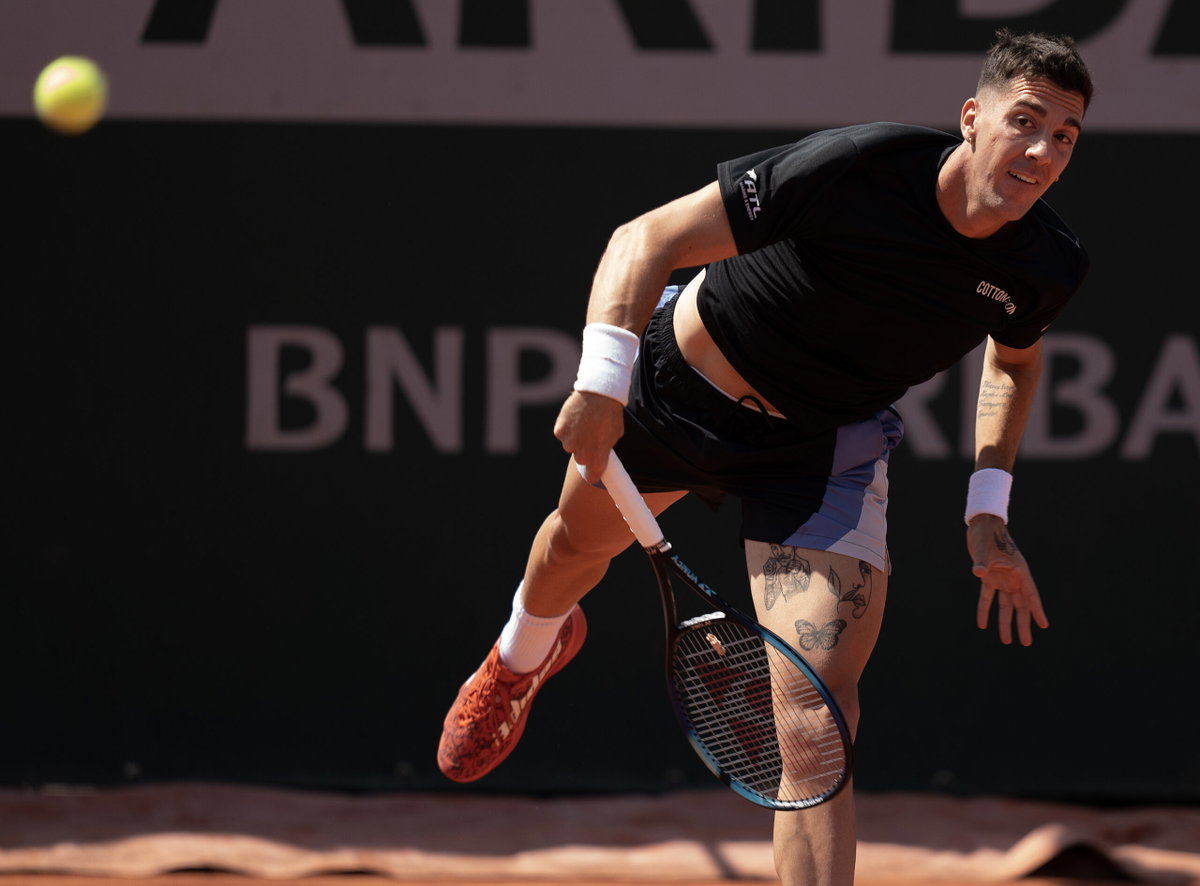
Thanasi Kokkinakis lay flat on his back on the boiling clay of Court 6 on Monday, arms out wide, staring up at the Paris sky. He had just clawed back from 2-5 down in the fifth set to beat the home favourite, Terence Atmane, in four hours and 18 minutes, landing 24 aces and winning just his fifth tour-level match in 17 months.
Watch What’s Trending Now!
When news arrived that something extraordinary was happening, hundreds of fans had left Philippe-Chatrier to fill the balconies overlooking Court 6 mid-match. The atmosphere was everything Kokkinakis had been fighting for fifteen months to get back to. But when the cameras and the crowd had gone, the 30-year-old Australian quietly drew a line in the sand.
“I’ve done everything I can, and if it’s not enough, it’s not enough,” he said at the post-match press conference. “I said to my team, I’m going to play until the Aussie Open next year. If stuff is not going well and my arm doesn’t feel great, then that will probably be it for me.” The Australian Open 2027 is not just a tournament on the calendar. It is a verdict.
The deadline only makes sense because of what the arm has endured. For four to five years before the 2025 Australian Open, Kokkinakis had been playing on a pectoral muscle that wasn’t properly attached to his shoulder, something he first felt as far back as 2019, hitting a forehand in qualifying against Peter Polansky.

Thanasi Kokkinakis: "I’ve done everything I can and if it’s not enough, it’s not enough. I said to my team I’m going to play until the Aussie Open next year. If stuff is not going well and my arm doesn’t feel great, then that will probably be it for me." thesecondserve.com/thanasi-kokkin…
He kept going. In 2022, he won a doubles Grand Slam title with his fellow countryman and friend Nick Kyrgios at the Australian Open and climbed to a career-high ranking of No. 65 in 2023. The pectoral was held, but it wasn’t until a five-set defeat to Jack Draper in the second round of the 2025 Australian Open that he finally broke it open. He retired injured midway through a doubles match alongside Kyrgios the following day.
In February 2025, Melbourne surgeon Dr. Greg Hoy took the Achilles tendon from a cadaver and reattached the pectoral muscle to Kokkinakis’ shoulder. That’s after dozens of doctors had been consulted, including doctors from Rafael Nadal’s team. There was no one who could give them any answer. According to the National Institutes of Health, cadaver-tendon reconstructions are relatively rare in competitive, high-demand, and young athletes, who account for only about 10% to 15% of such graft choices.
No tennis player had ever had the surgery. There were several surgeons who were reluctant to do it. Studies also showed that young athletes gifted with cadaver grafts have significantly higher failure and re-tear rates. But the decision was straightforward as Kokkinakis explained: “I was fine with retiring rather than keeping on doing what I was doing.”
Recovery consumed every corner of his life. He said that he woke up and checked his arm first. In some months, it was not feasible to lift it sideways.
“I had to get my mate to floss my armpit after I had a shower to dry that off for a long period of time,” he told The Second Serve. “I’ve got a big scar there. It looks like a shark bite. That’s my new normal.”
By the time he was cleared to return to the court, a year ago, he had started taking commentating jobs and was pondering life post-tennis. The sport had not finished with him yet, but it had made him consider what finishing would look like.
In January 2026, he made an emotional doubles return with Kyrgios in Brisbane, and in the first round of his singles event in Adelaide, he defeated Sebastian Korda, but his shoulder flared up again, and he withdrew. He withdrew from the Australian Open singles draw and played no tour match for four months before returning to Zagreb this month at a Challenger match, where he won two qualifying rounds then dropped out before the main draw. In all truth, Roland Garros was the first real challenge as to whether the surgery had been successful enough to allow an athlete to continue his career.
Kokkinakis barely practised in the three days before his first-round match.
“Even a few days ago, there were talks that I wasn’t sure if I’d play,” he said. “I had some people flying in, and I told them to stay home, because I didn’t want to play a few games and have something go bad.”
By his own admission, he was terrified to step out on court, not because of his fear of the other player, but because he feared his arm wouldn’t make it to the end of the match. “I was very scared, very nervous to go out there, but yeah, when I got going, I just played on energy.”
It lasted for four hours and eighteen minutes. The arm that had been rebuilt with a dead person’s Achilles tendon outlasted a world No. 52 on one of tennis’ biggest stages, in 30-degree heat, with a rowdy French crowd behind the home player. At the end, Kokkinakis lay on the clay and accepted the moment. His Instagram caption read two words: “Worth the wait.” The comeback that the medical community had doubts about has survived its sternest test.
What comes next: Round two and a career on the Line
The victory gives Kokkinakis time and faith, but he is not letting one victory change the picture. He carefully kept his feet on the ground. “I think to come back after such little tennis on a Grand Slam stage and in these conditions, against a good player from France as well, it’s probably my best mental effort considering where I was,” he said. The physical reality has not disappeared — it has just been managed for one afternoon.
The second round match against Pablo Carreno Busta on Wednesday was hardly on his radar. The 34-year-old Spaniard is a two-time Grand Slam semi-finalist and one of the most seasoned clay-court players on the circuit, having earned a career-high ranking of No.10 in the world. It’s a hard draw, to say the least, and a really hard one for a player who’s played less than 10 games in the last 17 months. But Kokkinakis wasn’t planning to look so far ahead. “I’m looking at tomorrow morning and seeing how I’ll wake up,” he said.
A run of some of Roland Garros’ greatest clashes: a five-set win over Bernard Tomic in 2015, a five-set defeat to Stan Wawrinka in 2023, and a five-set defeat to Taylor Fritz in 2024 is now coming to an end with this one-tournament run. He set the finish line at the Australian Open in January 2027 for himself. Monday has shown him that he has all the reasons to think that he can reach it. “Days like today give me a lot of hope that that’s probably not going to be it, and I can keep pushing.”
Currently, his second-round match is underway. After putting his heart and soul into the match against the Spaniard, Kokkinakis had to retire. Carreno Busta won the first set 7-5, but the Australian bounced back in the second, winning it 6-4. Just after the first game in the third set, his body gave up on him, and he had to leave the court in disappointment.