
Imago
View inside the Arena during Men s Singles Group Stage match against Ben Shelton of United States on day six of the Nitto ATP, Tennis Herren Finals 2025 at Inalpi Arena in Turin PUBLICATIONxNOTxINxITA Copyright: xFabrizioxCarabelli/IPAxSportx/xipa-agency.netx/xx IPA_67956563 IPA_Agency_IPA67956563
Imago
View inside the Arena during Men s Singles Group Stage match against Ben Shelton of United States on day six of the Nitto ATP, Tennis Herren Finals 2025 at Inalpi Arena in Turin PUBLICATIONxNOTxINxITA Copyright: xFabrizioxCarabelli/IPAxSportx/xipa-agency.netx/xx IPA_67956563 IPA_Agency_IPA67956563
The contaminated meat controversy that once shook tennis has returned to the spotlight, reviving memories of the doping chaos it caused years ago. Even the ATP Acapulco organizers removed meat from player meals before the tournament began this year. In a reassuring turn, three South American players have now been cleared after investigations linked their positive tests to contaminated meat.
Watch What’s Trending Now!
On February 18, the International Tennis Integrity Agency (ITIA) confirmed that Conner Huertas del Pino of Peru, Mateo Barreiros Reyes of Brazil, and Andrés Urrea of Colombia are cleared to return to competition. The decision came after a detailed anti-doping investigation.
Each player showed that the prohibited substance, boldenone, entered their system through contaminated meat. Their evidence satisfied the ITIA after a thorough review.
The investigation included interviews and detailed document checks. Officials examined meal logs, purchase receipts, and food sources during the period in question.
Imago
TENNIS – Internazionali di Tennis – Nitto ATP, Tennis Herren Finals 2025 Atp Logo during Nitto ATP Finals 2025, International Tennis match in Turin, Italy, November 11 2025 Turin Italy PUBLICATIONxNOTxINxFRAxUK Copyright: xIPAxSport/ABACAx
Independent scientists from WADA-accredited laboratories also reviewed the case. Investigators noted that three low-level positive tests for the same substance came from the same competition.
The samples were collected on May 14, 2025. All three players were competing at an ATP Challenger event in Bogota, Colombia, at the time.
Each sample was divided into A and B tests. Both samples from every player confirmed the presence of boldenone.
The substance is banned under the Tennis Anti-Doping Programme. It falls under Anabolic Agents in section S1 [1.1] of the 2025 World Anti-Doping Agency Prohibited List.
Boldenone is classified as a non-specified substance. None of the players held a valid ‘Therapeutic Use Exemption’ for it.
On July 7, 2025, the ITIA issued pre-charge notices for Anti-Doping Rule Violations. The notices cited Article 2.1 and Article 2.2 of the TADP.
Because the case involved a non-specified substance, provisional suspensions were mandatory. The suspensions began immediately on July 7.
Players had the option to request a lifting of the provisional suspension. However, none of them applied for such a review.
During the suspension period, the players gathered additional proof. Their submissions included detailed receipts and information about the source of the meat they consumed.
The ITIA conducted a parallel investigation to verify their claims. Independent experts confirmed that the explanation was scientifically plausible.
Following similar recent cases in tennis and other sports, the ITIA issued decisions of no fault or negligence. The players were officially cleared.
This case is part of a wider concern linked to contaminated meat, especially in parts of Latin America. Similar incidents have appeared in recent years.
In response to these risks, ATP Acapulco has introduced a major dietary change. Red meat will not be served during the tournament.
The decision is connected to contamination concerns. Organizers want to reduce the risk of accidental doping violations.
Instead of red meat, players will receive alternative protein sources. The menu will include eggs, fish, and other non-meat options.
ATP officials described the policy as “purely preventive.” They said the goal is to protect player eligibility and maintain tournament integrity.
The focus remains on reducing avoidable risks. Player safety and fairness are key priorities for the tour.
With contaminated meat cases appearing repeatedly, tennis authorities are becoming more cautious. The situation has raised fresh questions about food safety for players on the global circuit.
Past contaminated meat cases: The suspensions of Tara Moore and Nicolas Zanellato
One of the most notable cases involved former British doubles No. 1 Tara Moore. Her situation drew significant attention across the sport when Moore tested positive for anabolic steroids boldenone and nandrolone in April 2022. She said the substances entered her system through contaminated meat.
Imago
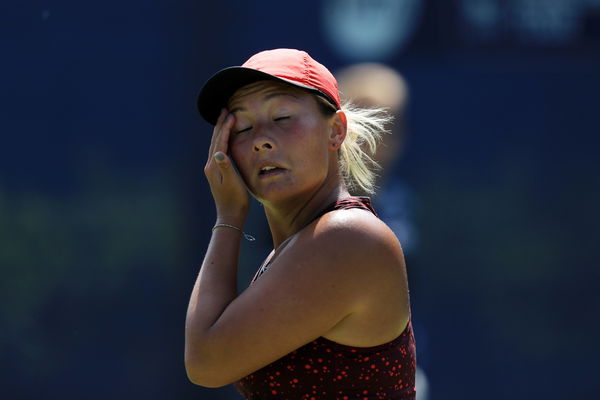
10th June 2018, Nottingham Tennis Centre, Nottingham, England; The Nature Valley Open Tennis Tournament; A dejected Tara Moore of Great Britain misses a forehand against Elena-Gabriela Ruse of Romania PUBLICATIONxINxGERxSUIxAUTxHUNxSWExNORxDENxFINxONLY ActionPlus12035321 ShaunxBrooks
An independent tribunal initially cleared her in December 2023. The tribunal accepted that the positive test was caused by meat consumed while competing in Colombia.
However, the case did not end there. The ITIA later appealed the decision.
After the appeal, Moore received a four-year suspension for anti-doping rule violations. The ruling highlighted the strict nature of the anti-doping system.
“For the ITIA, every case is considered according to the individual facts and circumstances,” chief executive Karen Moorhouse said in a statement.
Another case involved Brazilian player Nicolas Zanellato. He reached a career-high singles ranking of world No. 458 in April 2024.
Zanellato provided an in-competition sample during an ATP Challenger event in Ibagué, Colombia, on June 25, 2024. The sample was split into A and B tests.
The Brazilian argued that he had accidentally consumed contaminated meat. His case added to growing concerns about food safety in certain regions.
The ITIA has been warning players about this risk for several years. In October 2022, it advised caution when consuming red meat in parts of Central and South America.
Officials have also issued similar guidance for events in Asia: “Players are urged to understand the risks of eating meat in these countries (China, Mexico, and Guatemala) during tournaments and seek other sources of protein (such as plant-based or fish) where possible.”
With several unusual cases emerging, awareness around contaminated food risks has increased. Tennis authorities are now taking stronger steps to protect players and prevent accidental violations.
Written by

Edited by

Deepali Verma