
Imago
Image credit: imago
Imago
Image credit: imago
Tennis stands on the brink of 2026, but the echoes of 2025 still linger. It was a season steeped in controversy, from Jannik Sinner’s doping ban to Coco Gauff’s French Open triumph overshadowed by unwanted remarks. Jelena Ostapenko and Taylor Townsend also made headlines beyond the court. And with the new calendar days away, this is the ideal moment to revisit the year’s most defining storms.
Watch What’s Trending Now!
Jannik Sinner’s doping suspension
On March 10, 2024, during the BNP Paribas Open in Indian Wells, Jannik Sinner tested positive for clostebol. He was tested again out of competition on March 18 and returned another positive result. Both urine samples showed “low levels” of the substance, measured at less than one billionth of a gram. The March 10 sample contained 86 picograms per liter, while the March 18 sample showed 76 picograms per liter.
Clostebol is a synthetic anabolic-androgenic steroid. In the US, it is classified as a Schedule III controlled substance. It is commonly used in ophthalmological and dermatological treatments. The same drug previously led to an 80-game suspension for MLB player Fernando Tatis Jr. after he tested positive while playing for the San Diego Padres.
Sinner said the substance entered his body unintentionally. He explained that it came from a massage given by his physiotherapist, Giacomo Naldi. Naldi had been using an over-the-counter spray called Trofodermin on his own skin to treat a small wound. The spray contains clostebol and is legally available without a prescription in Italy.
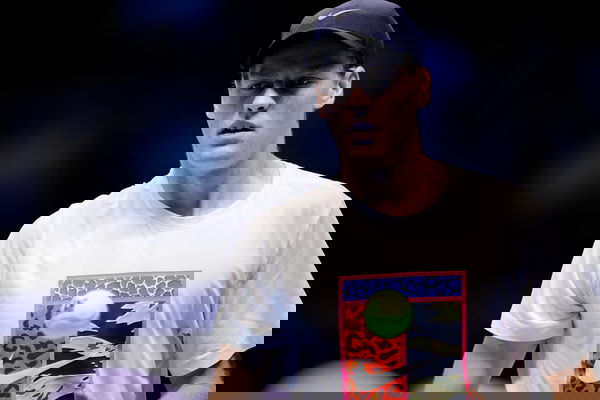
Imago
Jannik Sinner Italy during practice on the central court of the Inalpi Arena Turin, Italy, where the ATP, Tennis Herren Finals will begin on Sunday, Nov. 9 – – Friday, November 7, 2024. PUBLICATIONxNOTxINxITAxFRAxCHN Copyright: xMarcoxAlpozzi/LaPressex
According to Sinner, the spray was purchased by his fitness coach, Umberto Ferrara. He said Naldi used the medication for nine days and treated him without wearing gloves. Sinner claimed this led to accidental contamination during physiotherapy sessions, rather than deliberate use.
On April 4, Sinner was provisionally suspended for violating Article 2.1 and Article 2.2 of the Tennis Anti-Doping Program. He appealed the decision to the International Tennis Integrity Agency, the sport’s global anti-doping body. While the appeal was under review, he was allowed to continue competing. However, he lost the $325,000 in prize money and 400 ranking points earned at Indian Wells.
On August 15, an independent tribunal commissioned by the ITIA cleared Sinner of all doping charges. The hearing was arbitrated by Sport Resolutions. Three scientific experts accepted Sinner’s explanation and found it credible that contamination occurred through physiotherapy treatment. The ITIA cited Article 10.5, stating Sinner bore “no fault or negligence” for the positive tests.
Despite the ruling, the decision was appealed by the World Anti-Doping Agency on September 26. WADA released a statement saying, “It is WADA’s view that the finding of ‘no fault or negligence’ was not correct under the applicable rules.” The appeal reopened uncertainty around the case.
On February 15 this year, Sinner accepted a three-month ban as part of a settlement with WADA. The timing was difficult, as he had just won a second straight Australian Open title. The suspension forced him to miss the Sunshine Double and much of the clay season. He returned to competition in Rome, with the episode renewing debate over the sport’s strict anti-doping rules.
Coco Gauff and Aryna Sabalenka’s French Open controversy
Coco Gauff returned to a French Open final three years after her first appearance. This time, she emerged victorious, claiming her second Grand Slam title by defeating World No. 1 Aryna Sabalenka. It was a thrilling match that went to three sets, with scores of 6-7(5), 6-2, 6-4. Gauff’s triumph marked another milestone in her career, but the post-match reactions added unexpected drama.
Aryna Sabalenka reached her second Grand Slam final of the year at the French Open. She started strong, winning the first set against Gauff. However, she was ultimately outplayed in the next two sets. Despite her effort, the Belarusian struggled to maintain momentum and was overtaken by Gauff’s resilience and precision.
After the match, Sabalenka’s comments sparked discussion. She suggested that Gauff’s win was not entirely deserved. “At 4-1 in the first set, the wind started to get stronger. Also, I think I was too emotional. I didn’t handle myself very well mentally today, so that’s basically it. I was making unforced errors; I have to check the stats. I think she won the match not because she played incredibly, but because I made all those easy ball errors,” Sabalenka explained.
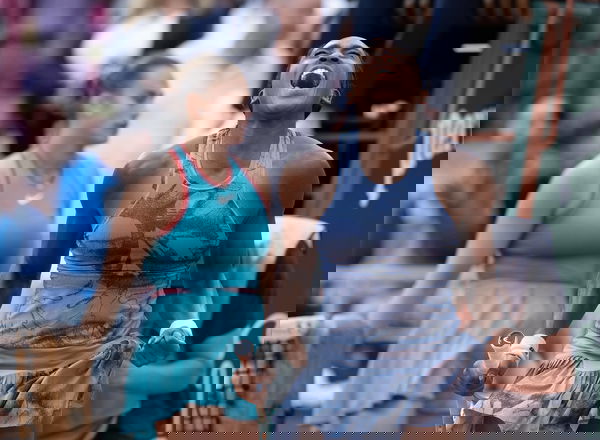
Imago
Tennis: French Open Jun 7, 2025 Paris, FR Coco Gauff of the United States celebrates winning the womenÕs singles final against Aryna Sabalenka on day 14 at Roland Garros Stadium. Paris Roland Garros Stadium ENTER STATE FR, EDITORIAL USE ONLY PUBLICATIONxINxGERxSUIxAUTxONLY Copyright: xSusanxMullanex 20250607_szo_au2_0289
She also reflected on her overall frustration. “That hurts. Especially when you’ve been playing really good tennis all week. If Iga had beaten me the other day, I think she would have gone out today and gotten the win. It just hurts. I’ve been playing really well, and then in the last match, to go out there and do what I did, it hurts.”
Despite the tension, Gauff responded with grace. She aimed to diffuse negativity surrounding the situation. “I’m not the person that will fuel hate in the world,” she said before Wimbledon. “I think people were taking it too far. … It was just really targeting and saying a lot of things that I felt were not nice. I didn’t want to fuel that more.”
The two players quickly mended fences after the French Open. They appeared together on Wimbledon’s Centre Court in a TikTok video, showing a lighter side of their relationship. The public display helped shift focus from the controversy to their sportsmanship.
Sabalenka later issued a formal apology to Gauff, acknowledging her post-match comments were inappropriate. She said, “I was just completely upset with myself, and emotions got over me. I just completely lost it.” Her apology aimed to clarify that the frustration came from personal disappointment, not a lack of respect for Gauff.
The entire episode captured the attention of the tennis world. Fans and commentators debated the incident, but the swift reconciliation emphasized professionalism and respect between top players.
Elena Rybakina’s coaching saga
Elena Rybakina’s coaching situation became one of the most talked-about stories in tennis this season. It began in early January when the WTA provisionally suspended her longtime coach, Stefano Vukov.
The governing body launched an independent investigation into complaints of abusive and controlling behavior. During the Australian Open, Vukov was barred from player areas and practice courts.
Following the suspension, Rybakina distanced herself from Vukov. She hired 2001 Wimbledon champion Goran Ivanisevic as her head coach, signaling a fresh start for her team. The move was seen as an effort to stabilize her coaching setup and focus on her game.

Reuters
Tennis – Wimbledon – All England Lawn Tennis and Croquet Club, London, Britain – July 11, 2024 Kazakhstan’s Elena Rybakina in action during her semi final match against Czech Republic’s Barbora Krejcikova REUTERS/Matthew Childs
The controversy reignited in late August when Rybakina unexpectedly announced Vukov’s return to her team. This came just days before the season’s final Grand Slam. The decision surprised many and created tension within her support staff.
Ivanisevic, reportedly blindsided by the reinstatement, ended his partnership with Rybakina after only two tournaments. Fitness coach Azuz Simcich also departed soon after. Reports suggested Vukov’s influence had created an unhealthy dynamic and emotional dependency. Rybakina rejected these claims, insisting she had never been mistreated.
Despite the coaching turmoil, Rybakina finished the season strongly. She won a title in Riyadh and expressed confidence for the future. Her focus remains on a stronger and more successful comeback next season.
Taylor Townsend and Jelena Ostapenko’s verbal spat
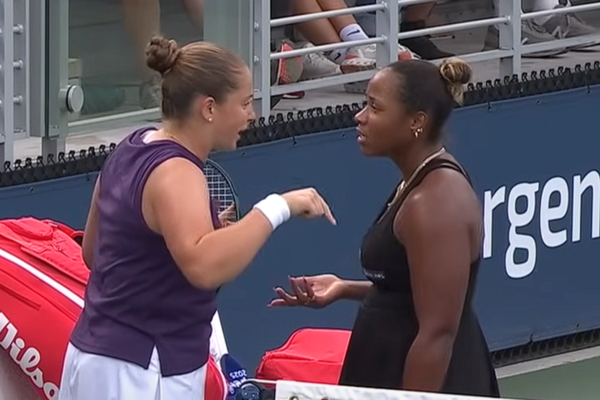
Taylor Townsend defeated Jelena Ostapenko in straight sets during their second-round match at the US Open. The result itself was clear and convincing. However, the match was quickly overshadowed by a tense exchange at the net. What happened after the final point drew more attention than the tennis played on court.
Ostapenko was upset with Townsend for not apologizing after winning a point with a netcord. She felt the moment demanded an apology and believed tennis etiquette had not been respected. The Latvian also accused Townsend of being disrespectful during the pre-match warm-up.
After the match, Ostapenko voiced her frustration publicly. “Today after the match I told my opponent that she was very disrespectful as she had a net ball in a very deciding [moment] and didn’t say [sorry], but her answer was that she doesn’t have to say sorry at all,” she said. Her comments immediately sparked debate.
Imago
Image credit: imago
Ostapenko detailed that issue as well. “In the beginning of the match all players are supposed to start warm up on the baseline. The opponent came out and straight away started the warm up at then which is very disrespectful and against the rules of a tennis match,” she concluded. The remarks intensified the controversy.
Townsend soon responded and shared her side of the story. She revealed that Ostapenko had made personal remarks toward her. “I mean, it’s competition. People get upset when they lose. She told me I have no class, no education, and to see what happens when we get outside the US. I’m looking forward to it. I beat her in Canada outside the US. So let’s see what else she has to say,” Townsend said.
The situation escalated further after Townsend reflected on the meaning behind the comments. She said she was unsure whether Ostapenko’s words were intended to be racist. Still, she felt they echoed harmful stereotypes about Black people being uneducated.
Later, Ostapenko issued an emotional apology on Instagram, explaining that English is not her first language while taking responsibility for her words. The incident quickly became a major talking point among fans and players alike.
Daniil Medvedev penalized for code of conduct violation
Daniil Medvedev was fined a total of $76,000 for multiple code of conduct violations at the Australian Open. The penalties were linked to angry outbursts involving his racket and courtside equipment. Tournament organizers released the fines, two days after his shock second-round exit from the tournament.
The 2021 US Open champion was first fined $10,000 after his opening-round match. During a five-set win over world No. 418 Kasidit Samrej, Medvedev repeatedly smashed a small camera attached to the net with his racket. The match proved far tougher than expected and tested his patience from start to finish.
His frustration carried into the second round against 19-year-old American qualifier Learner Tien. Medvedev was fined a further $66,000 for additional violations. He was also penalized a point during the match.
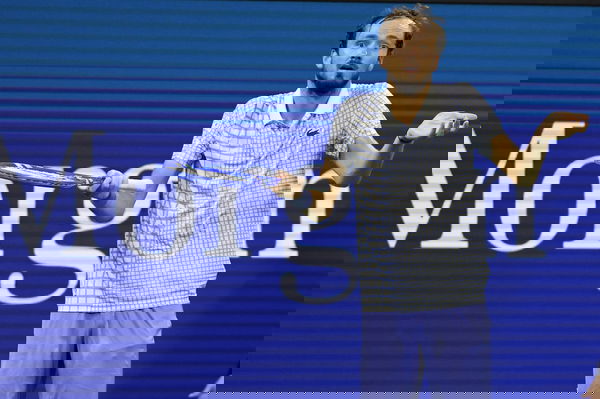
Imago
Tennis: US Open Aug 24, 2025 Flushing, NY, USA Daniil Medvedev gestures after losing a point against Benjamin Bonzi FRAR on day one of the 2025 US Open at USTA Billie Jean King National Tennis Center. Flushing Louis Armstrong Stadium NY USA, EDITORIAL USE ONLY PUBLICATIONxINxGERxSUIxAUTxONLY Copyright: xGeoffxBurkex 20250824_gkb_sb4_159
After being broken to trail 4-3 in the second set, he threw his racket toward the sideline, sending it sliding into an advertising board.
The Russian showed anger at several other moments. He struck a ball against the back wall, knocked over a camera behind the baseline, and punched his racket bag. He also complained after being called for two consecutive foot faults during a second-set tiebreak, which resulted in a double fault and added to his frustration.
This was not the first controversy involving Medvedev this season. At the US Open, he was eliminated by France’s Benjamin Bonzi in a tense late-night match. The contest erupted into chaos during the third set as Bonzi served for the match while leading 5-4 after winning the first two sets.
After Bonzi faulted on his first serve, chair umpire Greg Allensworth stopped play when a photographer walked onto the court. Allensworth shouted, “Not now, get off the court, please,” and awarded Bonzi a first serve again due to “delay caused by outside interference.” The decision triggered a furious response from Medvedev.
Medvedev ran to confront the umpire and shouted, “Are you a man? Are you a man?” He then told the crowd, “He wants to go home, guys. He doesn’t like to be here; he gets paid by the match, not by the hour.” With jeers raining down, the play was delayed for over six minutes. Both incidents drew major attention.
These major controversies aside, which incident caught your attention the most this year?
Written by

Edited by

Janainah Fazlin Anam