
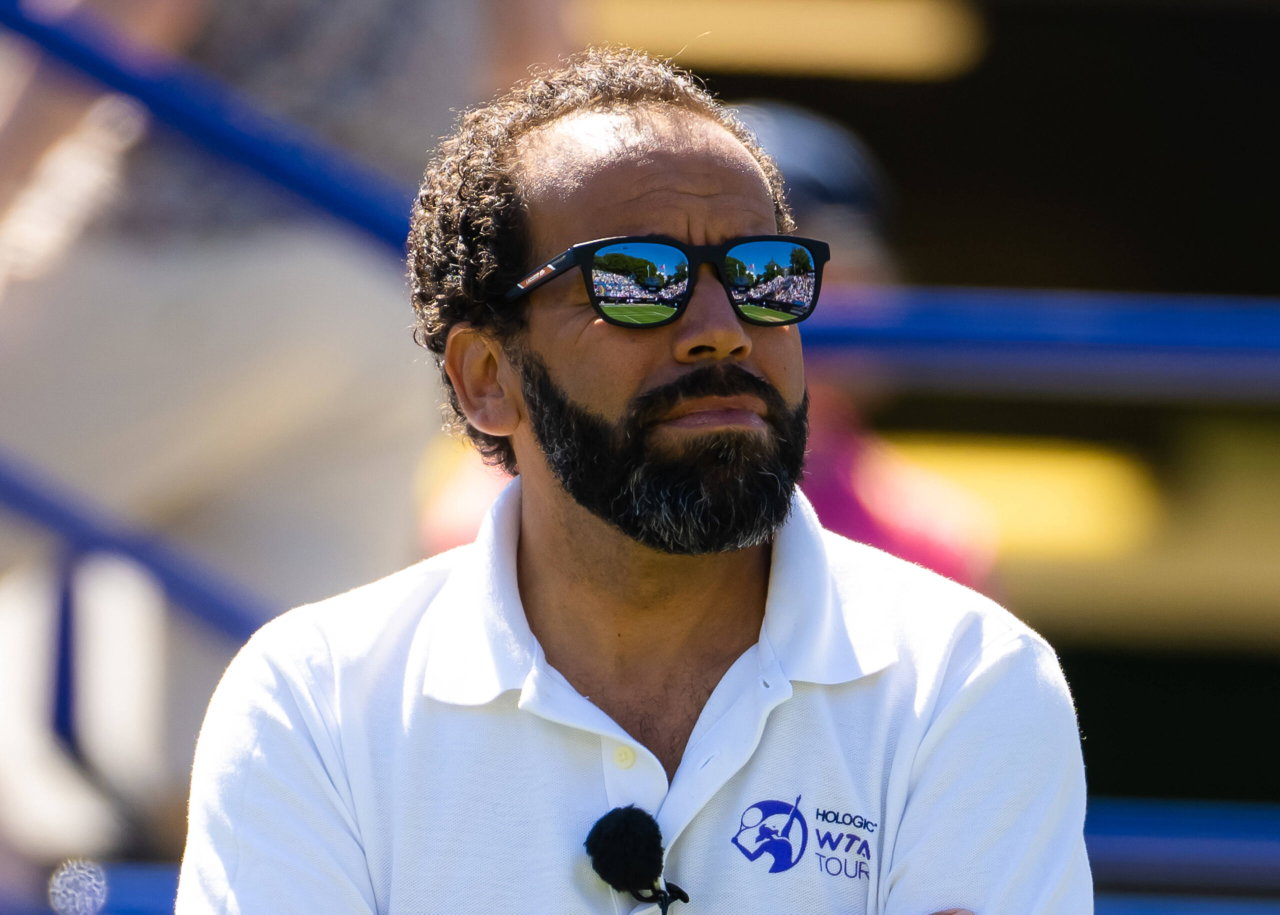
Since the main draw began, chair umpires at the US Open have had plenty to deal with, from warning influencers in the stands to addressing players’ complaints about hecklers. But this time, it was Kader Nouni, the chair umpire known for his distinctive voice, who became the talking point among spectators after an unusual moment during Naomi Osaka’s third-round clash with Elise Mertens turned into evening’s running joke.
Watch What’s Trending Now!
It all started with a routine mid-match call from Nouni. His famously deep voice echoed across the stadium as he calmly called out a simple “Deuce,” only for fans to fire it straight back at him with an exaggerated, drawn-out “Deuuuuce.” Laughter followed. Phones came out. And before long, Nouni’s voice had become an unexpected part of the entertainment.
It was playful rather than hostile. However, the French umpire remained focused, repeatedly trying to keep the crowd from turning the moment into a distraction. And perhaps nobody was better prepared for such a situation than the man affectionately known as the “Barry White of tennis.”
Nouni’s voice has been part of his identity on the tennis circuit for years. His deep, resonant delivery is so distinctive that fans can often recognize him before they even look toward the chair. And that reputation followed him into New York once again.
Nouni has previously explained why communication is such an important part of his work. A call isn’t simply about being correct; an umpire has to deliver it with authority. Back in 2022, after completing three decades of officiating, Nouni confessed, “There were some umpires who were afraid of me because of my voice. A referee is normally discreet. You don’t hear him, you don’t see him.”
“Unfortunately, between my Jackson Five hairstyle and my deep voice, I didn’t manage that! It was a bit out of place, so it can be an advantage when you use it well,” he added.
However, from dealing with frustrated players to keeping the crowd under control, life in the umpire’s chair isn’t always entertaining. Just last week, during Naomi Osaka’s first-round match at the US Open, Nouni was spotted addressing a group of spectators after they caused a disturbance during the match.
Footage showed a woman using a light to photograph a spectator in the hospitality section, while a few were spotted walking around. Seeing this disturbance, the chair umpire said, “Guys, please, in the suite behind me, thank you guys, please take your seat.”
So, from showcasing his authority to entertaining the crowd, Kader Nouni is everywhere!
From being self-conscious to embracing the ‘Barry White’ tag
Nouni wasn’t always comfortable with the attention his voice attracted. He once worried that spectators would remember his sound more than his work. After all, tennis officials are usually at their best when nobody is talking about them.
But Nouni’s voice was never going to be easy to ignore. The story goes back to his teenage years. When he was 17, Nouni called a friend at home, only for her father to answer. After speaking to him, the father apparently doubted that Nouni and his daughter were the same age. The reason? His voice.
Decades later, fans compared him to Barry White, the legendary singer whose bass-baritone voice dominated the 1970s. Following this, the nickname ‘Barry White of tennis’ stuck and Nouni eventually learned to embrace it.
He earned his ITF Gold Badge in 2007, the highest certification level for tennis officials, and became a familiar presence at major tournaments. He has chaired numerous Grand Slam matches, including the 2018 Wimbledon women’s singles final and several French Open women’s finals. However, the voice may have attracted attention, but his resume made sure it wasn’t the only thing people remembered.
A career that began because tennis was expensive. Nouni’s journey into officiating is almost as interesting as the voice that made him famous.
Growing up in Perpignan, Nouni wanted to play tennis. But his mother raised him and his brother alone after his father died when Nouni was two, making lessons and court time unaffordable. So the brothers worked at a tennis club.
Nouni started helping out when he was just nine, doing jobs such as stringing rackets. By age 12, he was already umpiring adult matches at local tournaments.
“It was kind of funny,” he recalled, remembering what it was like to be a teenager telling grown men what they could and couldn’t do on court.
His opportunity grew quickly. At 16, he was invited to officiate at the French national championships in Paris. That experience eventually led to him becoming a line judge at Roland Garros in 1992.
Three decades later, he remains one of tennis’ most recognizable officials. Nouni has seen it all from the chair.
Umpiring at the highest level means occasionally becoming the target of a player’s frustration. At the 2012 Australian Open, Nouni was involved in a heated exchange with David Nalbandian after overruling a line judge’s call on a John Isner serve.
Nouni simply tried to bring the match back under control. “Let’s play,” he said.
That ability to remain composed is part of what has carried him through thousands of matches.
And now, years after worrying that his voice might overshadow his work, Nouni seems comfortable with the attention.
Perhaps the US Open crowd’s playful imitation was just another reminder of how recognizable he has become. For Osaka, meanwhile, the evening ultimately had the ending she wanted. She battled through Mertens and secured her place in the Round of 16.