
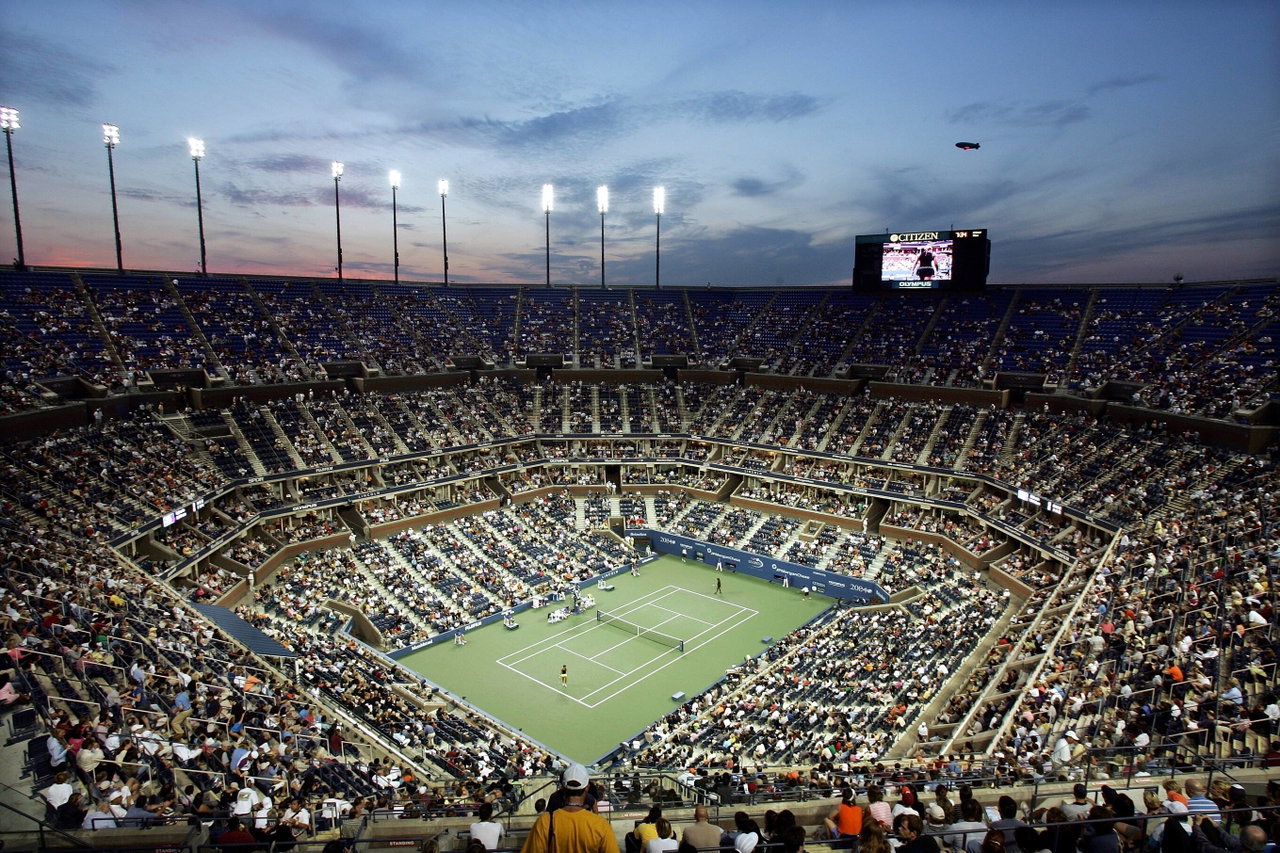
A ring light flashed on at Arthur Ashe Stadium mid-point, and suddenly a Grand Slam match felt like a photoshoot. That one moment now drives the entire discussion about access this year at the US Open.
Watch What’s Trending Now!
Following this incident, ESPN reporter Linda Cohn talked about the situation and provided one of the strongest opinions about the problem of influencers and content creators at the tournament.
“They are handing out credentials to influencers and content creators like they’re going out of style,” she said on her YouTube. “Around 100 of them this year, credentials handed out to influencers, nearly double the number from just a year ago.”
She then summed up her overall frustration bluntly. “Is this still a tennis tournament that happens to be one of the greatest social events in New York, or has it become one of the greatest social events in New York where they happen to play tennis? Because if it’s the second one, well, maybe the influencers haven’t ruined the US Open. No, maybe the US Open has ruined itself,” Cohn added.
The statement is quite valid since the stats prove her point. The USTA accredited close to 100 content creators this year, almost twice the 54 content creators accredited in 2025 by Front Office Sports, where suites are converted into filming areas instead of watching areas.
The basis of Cohn’s criticism goes all the way back to when the first-round match of Naomi Osaka against Anastasia Zakharova was going on. The influencers were using a ring light while filming during the match itself, which compelled chair umpire Kader Nouni to pause the entire match.
Osaka herself dealt with the disturbance afterwards, and her statements are credible as she is the one who was affected by the noise and lights.
“Obviously, if you come to a sporting event, you have to respect the sport,” Osaka said. Moreover, Osaka made it clear that she, along with her opponent, heard people shouting at the suites during the match.
This frustration is part of an emerging trend over the first few days of the tournament. Justin Morelli, an influencer who operates “The ShotClock,” said to The Post that the pushback has been mounting over time and merely came to a head this year.
This is important because it provides the context in which this conflict takes place. USTA’s statistics show that there is no reason for them to expand access for creators since last year’s group alone created more than 5.5 million social media interactions.
The commercial logic is quite clear when one looks at the attendance statistics: 2025’s US Open saw 1.14 million spectators, a 9 percent increase compared to the first time the event attracted a million spectators in 2024, and the average ticket price on the first day hit $363.
But even tennis isn’t alone in that, and that explains why USTA can afford to keep stepping up every year. In August of last year, ATP announced a partnership with TikTok, focusing on reaching out to younger demographics, while WTA introduced its own creator program this year.
However, not all credentialed influencers are in agreement with the backlash, which brings yet another dimension to the debate. Alyssa La Spisa, a food and lifestyle influencer who is credentialed for the tournament, told The Post that influencers must be “mindful” of the event’s focus while calling the criticism a “blanket statement.”
La Spisa also draws an analogy between influencers and brands, which rarely features in the public debate.
“I would argue too it’s not just credentialed creators. It’s also brands inviting creators to their suites,” she said, and noted that such backlash from influencers is also common during her appearances at Formula 1 events.
The USTA has taken some steps in order to remedy the situation, taking away the credentials of influencers Meg Radice and Audrey Jongens when the two displayed their high-security credentials in the media.
It seems as though the USTA is aware of how far its access has gone in terms of its own control. The only remaining question is whether the US Open will find this balance before the end of the tournament.