
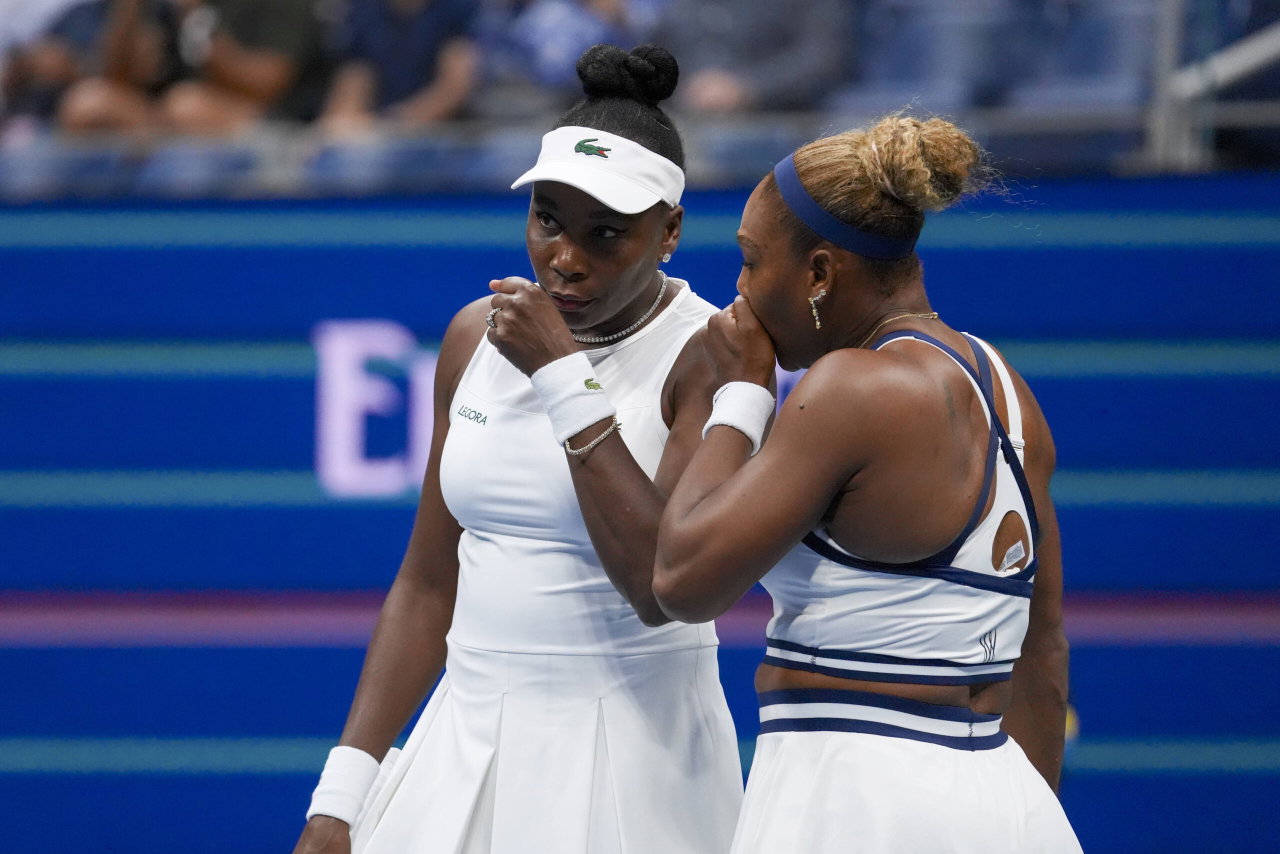
At 5-0 in the deciding tiebreak, the finish seemed almost written. Then the points started slipping away. One became two, two became four, and before Arthur Ashe could settle, the comeback had disappeared. For more than three hours, the 23,000 inside the stadium had watched the match swing from celebration to genuine competition and back to heartbreak.
Watch What’s Trending Now!
Ten of the next 12 points went the other way. The scoreboard had delivered its verdict, but the crowd wasn’t ready to accept it. They didn’t want to see the Williams sisters walk away just yet. And that reaction inside Arthur Ashe has now shown up somewhere else, too.
On Thursday, ESPN PR’s X account shared a few numbers. According to the data, ESPN’s exclusive live coverage of the US Open is the most-watched since 2022 through the completion of the third round on Sept. 5. And one particular Friday night may explain why.
Through the completion of the third round, ESPN’s exclusive US Open coverage is averaging 846,000 viewers, up 5% from 2025 and its highest mark at this stage since 2022. The third round alone averaged 1.1 million viewers across ESPN and ESPN2, a 27% jump from last year.
The gains were not limited to one session, either. Friday’s Day 6 coverage averaged 1.1 million viewers across ESPN and ESPN2, up 17% from 2025. Saturday’s Day 7 coverage on ESPN2 also averaged 1.1 million, a 37% increase. ESPN2’s daytime window on Saturday was up 31%, while its prime-time window climbed 43%.
But Friday night is where the Williams effect becomes difficult to miss. Serena and Venus’ doubles match drew an average audience of 1.2 million, with the audience peaking at 2.2 million between 10 and 10:15 p.m. ET. The sisters eventually lost to No. 14 seeds Hao-Ching Chan and Maya Joint in a three-set thriller, but the match had already become one of the tournament’s biggest television draws.
That is also why the 2022 comparison carries more weight than a routine year-over-year ratings bump. The sisters were playing together at a Grand Slam for the first time since the 2022 US Open, while Serena’s final match before her 2026 return came at that same tournament. Four years later, their presence has helped pull ESPN’s numbers back to that level.
And the match itself offered something more than nostalgia. Serena and Venus were down 1-4 in the deciding set before fighting back to force the match tiebreak. They then raced to a 5-0 lead before Chan and Joint recovered. Maya Joint later admitted, “I’m at a loss for words to think that happened,” after facing the sisters she had grown up idolizing.
The USTA put the attendance at roughly 24,000, while Reuters reported 23,000 fans. Either way, the scale was unusual for a first-round doubles match. The tournament itself acknowledged as much: doubles typically does not occupy Arthur Ashe during the opening week, but the Williams sisters’ return made an exception.
The US Open is chasing the next audience, too
The Williams sisters represent something the US Open already has: a built-in cultural pull that can turn a doubles match into prime-time television. The tournament is also trying to create that pull elsewhere, particularly through social media creators.
The USTA nearly doubled the number of content creators it credentialed for this year’s tournament, going from 54 in 2025 to roughly 100 in 2026. The idea was to reach fans “where and how they consume content,” with creators producing material around the tennis, food, fashion and wider US Open experience.
That strategy has not come without friction. Naomi Osaka’s first-round match against Anastasia Zakharova became an early flashpoint when a group in a hospitality suite made enough noise while recording that chair umpire Kader Nouni intervened and stopped play. Osaka later said, “There was a moment where there was people shouting and stuff. You could hear it quite clearly.”
There is an important distinction, however: the people involved in that particular disruption were not USTA-credentialed creators. The organization made that clear after the incident. Two other creators, Meg Radice and Audrey Jongens, also lost access after posting images of their passes; the USTA said they had been improperly submitted for credentials through a staff list provided by a food vendor.
Still, the controversy has forced the tournament to spell out rules that longtime tennis fans already know instinctively. The USTA’s own guidance now specifically asks spectators to avoid flash photography and ring lights during play, remain seated when a player is serving within their line of sight and keep their voices down during points.
That leaves the US Open with a balancing act of its own. The tournament wants creators to make tennis more visible to people who may not traditionally watch it, but the content cannot become more important than the match happening in front of the camera. For now, the Williams sisters’ return has shown just how much attention the sport can still command without changing the game at all.