Getty
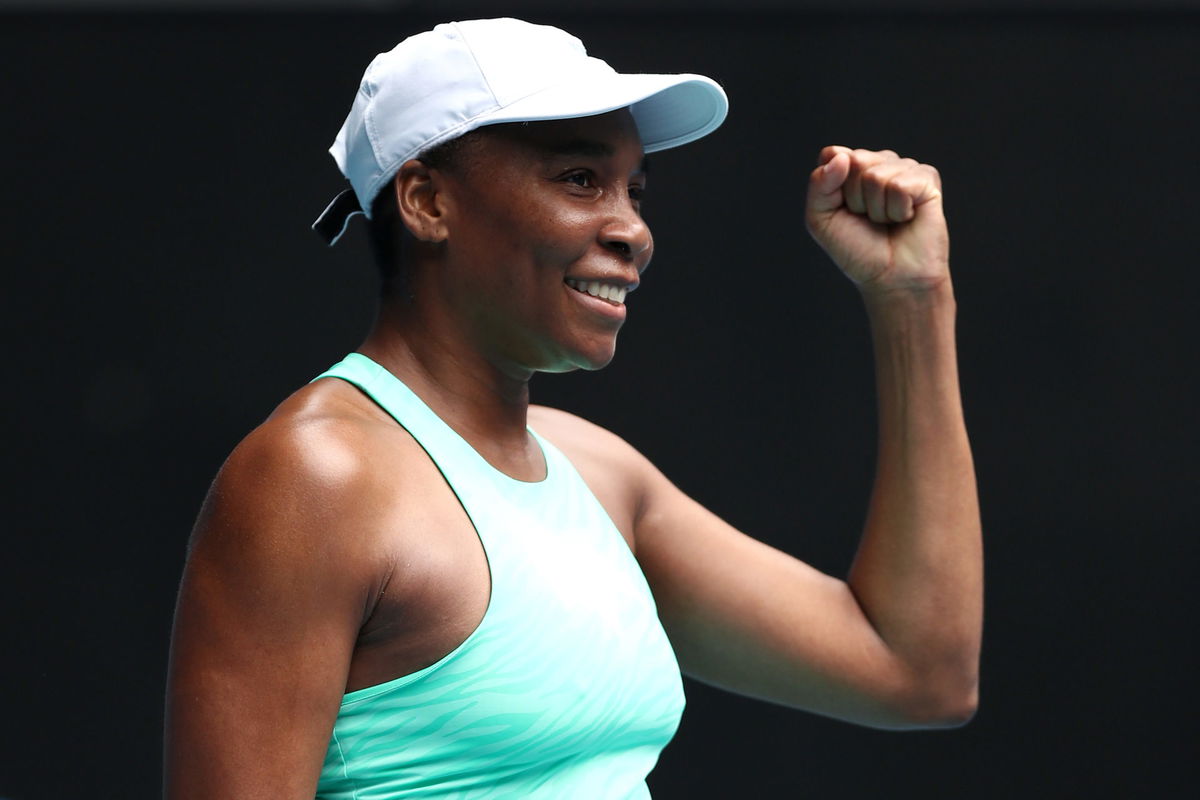
MELBOURNE, AUSTRALIA – FEBRUARY 08: Venus Williams of The United States of America celebrates after winning match point in her Women’s Singles first round match against Kirsten Flipkens of Belgium during day one of the 2021 Australian Open at Melbourne Park on February 08, 2021 in Melbourne, Australia. (Photo by Mark Metcalfe/Getty Images)
Getty
MELBOURNE, AUSTRALIA – FEBRUARY 08: Venus Williams of The United States of America celebrates after winning match point in her Women’s Singles first round match against Kirsten Flipkens of Belgium during day one of the 2021 Australian Open at Melbourne Park on February 08, 2021 in Melbourne, Australia. (Photo by Mark Metcalfe/Getty Images)
Over two decades ago, before the Rod Laver Arena was named, Centre Court at Melbourne Park felt the raw power of a WTA superstar. At just 17, Venus Williams stormed into the competition, and the American powerhouse kicked off a run that stamped her mark on those hard courts forever. She didn’t just make history, she owned it. And now, at 45, she’s charging back for another shot!
Watch What’s Trending Now!
For the first time since 2021, Williams accepted a wildcard for the 2026 Australian Open. She’ll come in smashing records as the oldest woman at 45, to play there since Japan’s Kimiko Date played as a 44-year-old in 2015. She already roared back at last year’s US Open after a 16-month layoff, now it’s time for the land Down Under.
“I’m excited to be back in Australia and looking forward to competing during the Australian summer,” said Venus Williams. “I’ve had so many incredible memories there and I’m grateful for the opportunity to return to a place that has meant so much to my career.”
Even the two-time Grand Slam champ Coco Gauff, who has idolized the WTA pro, calls it “incredible” to watch Venus still grind. “She’s a legend of the sport, so it will be cool to see her back in action,” she said. And it’s true. Venus is a legend, here’s why:
When Venus Williams first lit up Rod Laver Arena
Williams made her first Australian Open main-draw appearance in 1998, storming to the quarterfinals as a 17-year-old. By January 2001, Melbourne Park was about to witness something unforgettable. Venus arrived as the reigning Wimbledon and US Open champion, full of confidence and power, ready to stamp her authority on the hard courts. With her trademark first-strike tennis and unstoppable serve, she transformed Rod Laver Arena into her spotlight.
The 2001 tournament marked her first deep run in Melbourne as a true global superstar. Venus Williams tore through Denisa Chladkova 6-4, 6-1 in the third round, then beat Amélie Mauresmo 6-2, 3-6, 6-3 in the fourth. In the quarterfinals, she overpowered Amanda Coetzer 2-6, 6-1, 8-6, showing the same fearless aggression that had carried her to Grand Slam glory just months earlier.

Imago
Venus Williams playing a shot at the Australian Open Quarter Finals
Her momentum looked unstoppable until Martina Hingis stood in her way in the semifinals. Venus came out swinging with a 6-1 first set but couldn’t sustain the surge, dropping the next two 1-6, 1-6. Despite the loss, her Melbourne campaign proved she wasn’t just a rising talent anymore; she was here to dominate the sport’s biggest stages across all surfaces.
Since her debut quarterfinal run in 1998, Venus has contested 21 Australian Open main draws, building a 54-21 record. In singles, she came so close to winning it twice, in 2003 and 2017, but lost both times to her sister Serena. But her doubles legacy with her sister was different.
Venus Williams and her AO legacy alongside Serena
The Williams sisters’ Australian Open doubles story burst to life in 2001, when Venus and Serena captured their first Melbourne crown. It wasn’t an easy climb but they powered past Martina Hingis and Monica Seles in the semifinals, two legends who brought both flair and fight. Then came a hard-fought final over Lindsay Davenport and Corina Morariu, where the sisters sealed the win and signaled to the world that a new doubles powerhouse had arrived.
They returned in 2003 hungrier and sharper, ripping through a draw packed with heavyweights. Early on, they dismissed Martina Navratilova and a young Svetlana Kuznetsova, the perfect mix of experience and rising strength.
Next came Kim Clijsters and Ai Sugiyama in the quarters, followed by a commanding semifinal over Davenport and doubles ace Lisa Raymond. When they beat the Grand Slam-winning pair of Virginia Ruano Pascual and Paola Suárez in the final, their second Australian Open title felt inevitable.
After a quiet few years, Venus and Serena Williams regrouped in 2008, flashing glimpses of their old brilliance before losing in the quarterfinals to future champions Zi Yan and Jie Zheng. That near miss only fueled their next act.
In 2009, they roared through Melbourne again, knocking out Samantha Stosur and Rennae Stubbs, easing past Hsieh Su-wei and Peng Shuai in the quarters, then rolling over Casey Dellacqua and Francesca Schiavone in the semis before defeating Daniela Hantuchová and Ai Sugiyama in the final. It was a statement made with signature power and precision.

Reuters
Tennis – Australian Open – Melbourne Park, Melbourne, Australia, February 10, 2021 Venus Williams of the U.S. in action during her second round match against Italy’s Sara Errani REUTERS/Asanka Brendon Ratnayake
Momentum carried straight into 2010, where they backed up their dominance with another title run. They took down Bethanie Mattek-Sands and Zi Yan in the quarters, topped Lisa Raymond and Rennae Stubbs in a sharp semifinal, and outclassed the top-seeded Cara Black and Liezel Huber in the final.
They would make one last deep run in 2013, reaching the quarterfinals before Sara Errani and Roberta Vinci, future doubles dominators, stopped them. Across every era and matchup, Venus and Serena didn’t just win titles; they were rewriting what dominance looked like in women’s tennis. Just as Venus did on the singles front.
A look at Venus Williams’ Australian Open glory run
The journey kicked into high gear in 2003 with a finals run that kept fans captivated. After beating Svetlana Kuznetsova, Ansley Cargill, Anca Barna, Nicole Pratt, Daniela Hantuchova, and Justine Henin, she reached the finals to face her sister. Unfortunately, she lost to Serena 6-7(4), 6-3, 4-6 in their first Australian Open final clash.
In 2006 and 2007, she was out early. In 2010, she reached the quarterfinals but lost to Na Li, who beat her 6-2, 6-7, 5-7.
Later in 2014, she fell in the first round to Ekaterina Makarova. Even in 2017, after falling to Serena again in the final, her performance kept her legacy shining bright.
She has reached two finals in Melbourne, in 2003 and 2017, both against Serena. Her tournament record stands at 54 wins and 21 losses, including one semifinal and six quarterfinals.
Now, at 45, Venus Williams returns for her 22nd main-draw appearance from January 18 to February 1, 2026. Five years since her last showing, fans can’t help but wonder: will she bring back the heat and deliver another unforgettable start to the 2026 season?