
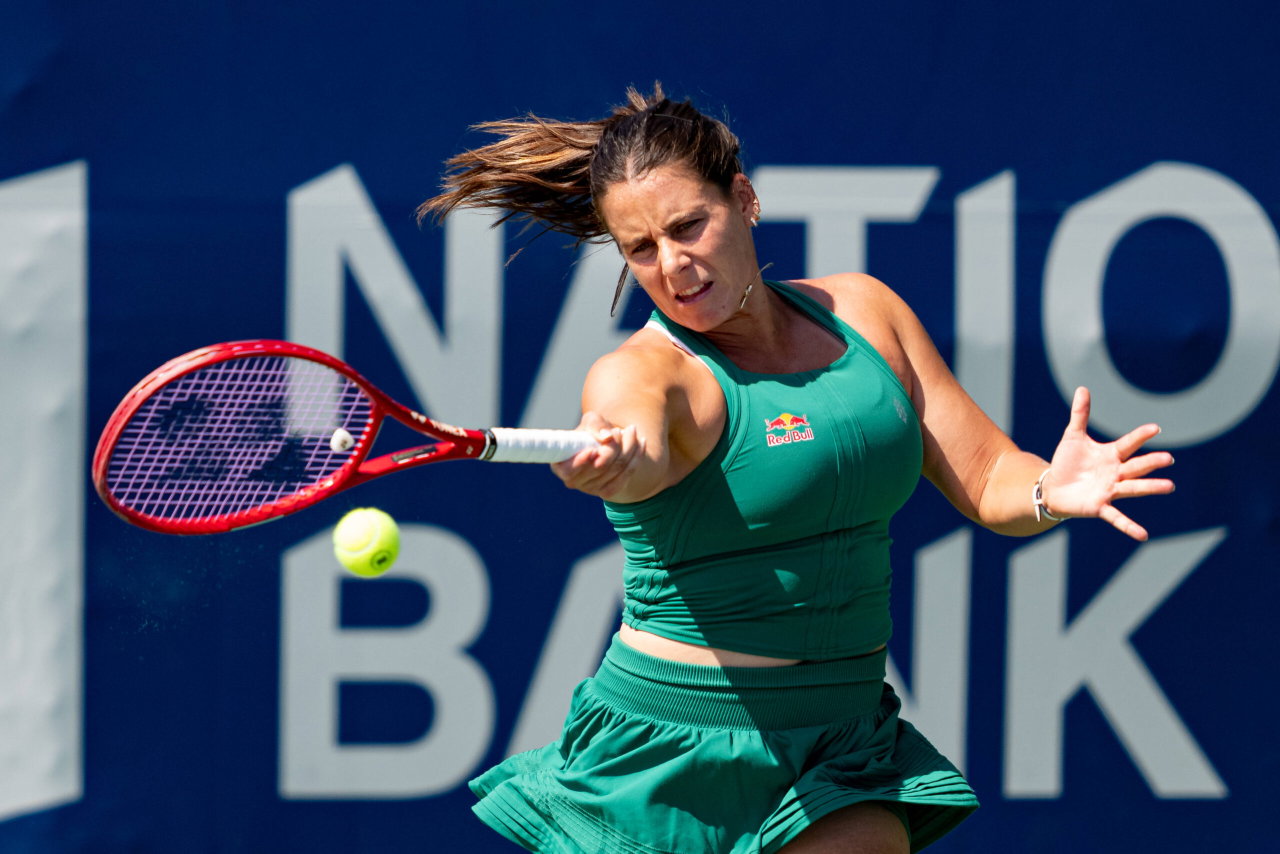
When Emma Navarro won five ITF titles and reached a Challenger final in 2023, the American was considered one of the top talents rising up the ranks. Her rise in the next two seasons was exemplary as she reached a career-best ranking of 8, won titles on the Tour, and even reached the US Open semifinal in 2024. However, while the outsiders could only marvel at her results, they could not realize the physical cost that Navarro was paying for her troubles, something that she opened up about in detail in an emotional message as she ended her 2026 season.
Watch What’s Trending Now!
While Navarro’s hardcore training regimen helped her move to the top of the sport between 2023 and 2024, the American had spotted several symptoms developing. She talked about feeling dizzy, having a wide range of emotions, as well as having brain fog and headaches. However, with success on the court, the American also felt the need to keep her constant workload going, while keeping her conflicted emotions to herself.
“But I remember feeling deep internal anger on the court that week in Hobart, like I wanted to smash every racket in my bag (something I had never done or wanted to do),” said Navarro in her Instagram story. “Everything began to annoy me. My team, other people, anything that didn’t align with my specific preferences or routines, any imperfection on the court, every mistake, every point I lost. But I tried my hardest not to let people see how I felt, to keep it together.”
One could not argue with Navarro’s success on the court, especially during the 2024 season. She won her maiden title in Hobart, reached six semifinals, including the US Open, and the quarterfinals at high-profile events such as Indian Wells and Wimbledon. The American made a name for herself as a quick mover on the court, who could generate equal power on both wings from the baseline. However, even her tactical strengths were coming at a cost.
“From the outside, things looked great. I continued to achieve tennis milestones that far exceeded my expectations, my ranking was rising. My level continued to improve. I continued to get faster and more athletic on the court, and I looked to be the strongest, fittest version of myself I had ever been,” said Navarro in the story. “But something was off,” said Navarro in her Instagram story.
Navarro’s admission reveals that the American was in the worst physical condition at the start of the 2025 season. Even then, the American showed her mettle on the court, reaching the quarterfinal at the Australian Open. She even won a title in Merida, but after that, the season unraveled for her. Navarro had eight second-round exits and six third-round exits in the season, while also having seven quarterfinal appearances, but most of the runs she won through sheer grit and willpower, scrapping through close matches.
It was not until late 2025 that Navarro received adequate medical attention, which revealed the diagnosis of Relative Energy Deficiency in Sports (REDS) and Hashimoto’s Thyroidism. These conditions are notorious for sapping all energy from the body and, in the case of an elite athlete like Navarro, would manifest as headaches, dizziness, and considerable mood swings.
“In the fall of 2025, after struggling for several years to figure out a difficult and confusing array of symptoms, I was diagnosed with a condition known as RED-S (Relative Energy Deficiency in Sport), in which your body does not receive enough energy to support the demands of physical activity and daily life,” said Navarro on Instagram. “This was further complicated by a diagnosis of Hashimoto’s hypothyroidism, which presented a challenging puzzle of energy intake, energy expenditure and medication to be solved.”
Once the diagnosis was in, Navarro was able to take steps toward recovery, which led to a better 2026 season, both on and off the court.
Emma Navarro Made Steps in Recovery in 2026
Navarro did not waste much time once she received the official diagnosis. The American made all the necessary changes to her diet to regulate her calorie intake and compensate for the lack of energy she experienced during her high-intensity training years. By her own admission, she made slow but steady progress.
“The dizziness faded. The headaches became fewer and farther between. Just a couple months ago. I started feeling more comfortable in the gym again with the ability to feel my body moving and my muscles working,” said Navarro on Instagram. “My mind slowly started to quiet down. My emotions calmed. My mental bandwidth expanded. My cognitive function improved.”
However, there was no shortage of criticism of Navarro during this period, with online trolls often taking jabs at the American for her weight gain. Given that Navarro is under a refueling regimen, weight increase was a natural consequence, something that she acknowledged in her message as she closed out her 2026 season.
“So yeah, I gained some weight this year. But I also gained my life back. I have enough energy to seize every day, to train or compete as hard as I want to, and to live a life outside of tennis,” said Navarro in the message. “All that being said. I am taking the rest of this year to work on dialing in my medication and fueling protocols so that I can hopefully feel back to 100% again. I will not be competing in Asia this year, but I plan to be back on the road starting in Australia 2027.”
Navarro showed glimpses of her old form this year, winning a title in Strasbourg and finishing runner-up in Nottingham. However, the American had her best showing at the US Open, where she reached the quarterfinals, losing to compatriot Jessica Pegula in a hard-fought three-set battle.