
Imago
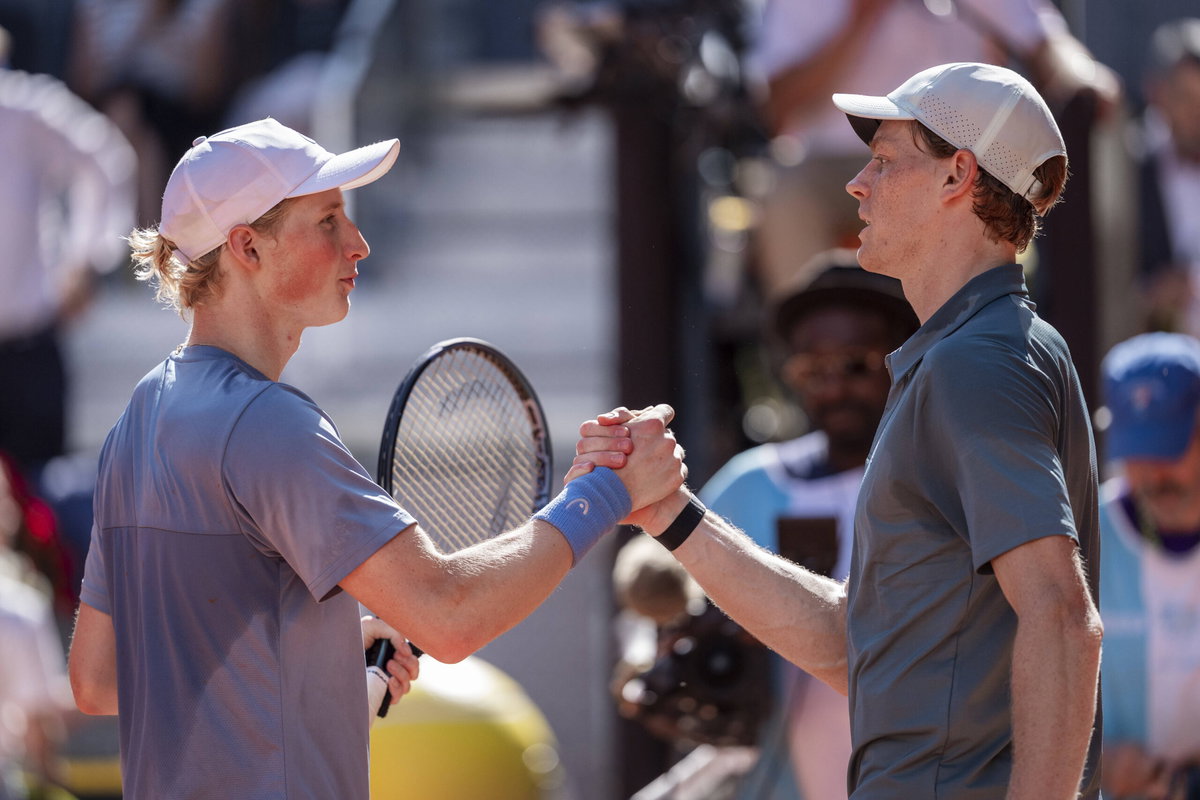
Mutua Madrid Open – Day Seven MADRID, SPAIN – APRIL 26: Jannik Sinner of Italy R greets Elmer Moller of Denmark L at the end of the Men s Singles Round of 32 match during the Mutua Madrid Open 2026 tournament celebrated at La Caja Magica on April 26, 2026 in Madrid, Spain. Madrid La Caja Magica Madrid Spain Copyright: xAlbertoxGardinx AGardin_20260426_Tennis_Madrid_Day7_0835
Imago
Mutua Madrid Open – Day Seven MADRID, SPAIN – APRIL 26: Jannik Sinner of Italy R greets Elmer Moller of Denmark L at the end of the Men s Singles Round of 32 match during the Mutua Madrid Open 2026 tournament celebrated at La Caja Magica on April 26, 2026 in Madrid, Spain. Madrid La Caja Magica Madrid Spain Copyright: xAlbertoxGardinx AGardin_20260426_Tennis_Madrid_Day7_0835
Just a day ago at the Madrid Open, Jelena Ostapenko delivered an unintentionally comic spectacle as her racket slipped mid-serve, cartwheeled toward the net, and narrowly missed her partner Erin Routliffe. It was one of those chaotic moments that had the crowd laughing and wondering what they’d just seen. Then, almost eerily, Jannik Sinner’s Round of 32 opponent, Elmer Moller, repeated the mishit, producing a bizarre shot.
Watch What’s Trending Now!
During the second set, an unusual moment stole the spotlight, when Moller’s racket slipped from his hand in the middle of a rally. Instinctively, he tried to return the ball with his fist. The crowd reacted instantly to the bizarre attempt.
Moreover, under the ITF Rules of Tennis, Rule 19(d) states that a serve is a fault if the ball touches the server, the server’s partner, or anything either player is wearing or carrying.
That same principle helps clarify another unusual situation: a player cannot legally return the ball using their hand or fist. In tennis, only the racket counts as a valid striking surface. More specifically, the ball must be struck with the racket itself, typically the string bed, for the return to be legal.
If the ball touches any part of a player’s body, including the hand if it is not holding the racket, the point is immediately lost. In other words, while tennis allows for plenty of creativity, returning a shot with a punch is not one of them. Hence, while Moller attempted a shot, it didn’t count in his points tally.
Earlier in the set, Moller had taken a medical timeout. At 2-5, he received treatment on his abdominal area from the tournament physio. Despite that concern, he chose to continue competing. Even while dealing with discomfort, he showed resilience. He pushed through the physical strain and stayed engaged in the rallies. His effort kept the match competitive in patches.
Moller’s backhand remained his standout weapon. It was the shot that had helped him climb toward the world’s Top 100. In the second set, he found a better rhythm through that wing.
An unusual end to the set 🤪
Sinner takes the opener 6-2 over Moller!#MMOpen pic.twitter.com/0UKF6ndfcy
— Tennis TV (@TennisTV) April 26, 2026
However, it was not enough to stop Sinner. The Italian maintained control and composure throughout. He closed out the match in straight sets without allowing momentum to shift.
Sinner may have faced an unfamiliar opponent, but his approach remained unchanged. He delivered a clean 6-2, 6-3 victory in the third round of the Madrid Open. The performance was efficient and clinical.
For Moller, the defeat still came with positives. It was at this same event last year that he made his ATP Tour debut, losing to João Fonseca. This time, he returned with greater confidence and results.
He secured two wins in qualifying and added two more in the main draw. That run set up his clash with the World No. 1. Facing a Top-10 player for the first time was a significant step in his journey.
Sinner, however, proved too strong. He wrapped up the match in one hour and 17 minutes inside Manolo Santana Stadium. The victory extended his Masters 1000 winning streak to 24 matches, the fourth longest since 1990.
Now holding a 26-2 record for the season, Sinner is closing in on history. He is just four wins away from becoming the first player to win five consecutive Masters 1000 titles, building on triumphs in Paris, Indian Wells Open, Miami Open, and Monte-Carlo.
Next, the 24-year-old will face Cameron Norrie, who defeated Thiago Agustin Tirante 7-5, 7-6(5), for a place in the quarter-finals. The challenge will be different, but Sinner’s form remains dominant.
As for the racket-slipping moment, it may have been rare, but it added to the spectacle. Such incidents have caught fans’ attention before and continue to do so.
Alexander Shevchenko’s racket shatters mid-serve after slipping from his hand
At the Delray Beach Open 2025, Alexander Shevchenko found himself at the center of a bizarre moment. It came during a crucial match against Michael Mmoh. What followed was something rarely seen on a tennis court.
While serving, Shevchenko lost control of his racket. It slipped out of his hand in the middle of the motion. The situation escalated instantly upon impact. As the racket hit the court, it snapped cleanly in half. The handle separated from the head. The visual was dramatic and unexpected.
The incident quickly became the “image of the day.” It spread across the tennis world as a rare and shocking moment. Fans and analysts were left surprised.
Tennis rackets are usually built for durability. They are designed to last for years under intense use. Breakages typically occur only when players smash them in frustration.
In this case, however, the reason appeared different. Extreme humidity in Delray Beach, Florida, was considered a possible factor. The conditions may have weakened the equipment unexpectedly.
Despite the malfunction, play continued under the rules. Since his first serve had already been called out, Shevchenko was allowed to take his second serve. The point resumed without penalty.
Incidents involving rackets slipping from players’ hands are rare but not unheard of. At times, they have led to chaotic and even controversial outcomes. The unpredictability adds a strange edge to the sport.
One such case dates back to 2017. Tiago Cacao defaulted during an ITF Futures event in Idanha-a-Nova. He was facing João Monteiro in a tense second-round match.
The match stood at 4-4 in the third set after more than two hours of play. Then, Cacao’s racket slipped from his hand. It accidentally struck Monteiro, forcing an abrupt end.
Speaking afterward, Cacao explained the moment. “My racket escaped from my hand and all of sudden it hit Monteiro’s foot,” he said. “I had already understood that I would have been banned, which I accept.”
Now, with Elmer Moller adding another twist by attempting a shot with his hand after a similar slip, these moments continue to stand out. They underline how even rare mishaps can shape matches in unexpected ways.
Written by

Edited by

Purva Jain